
The short answer
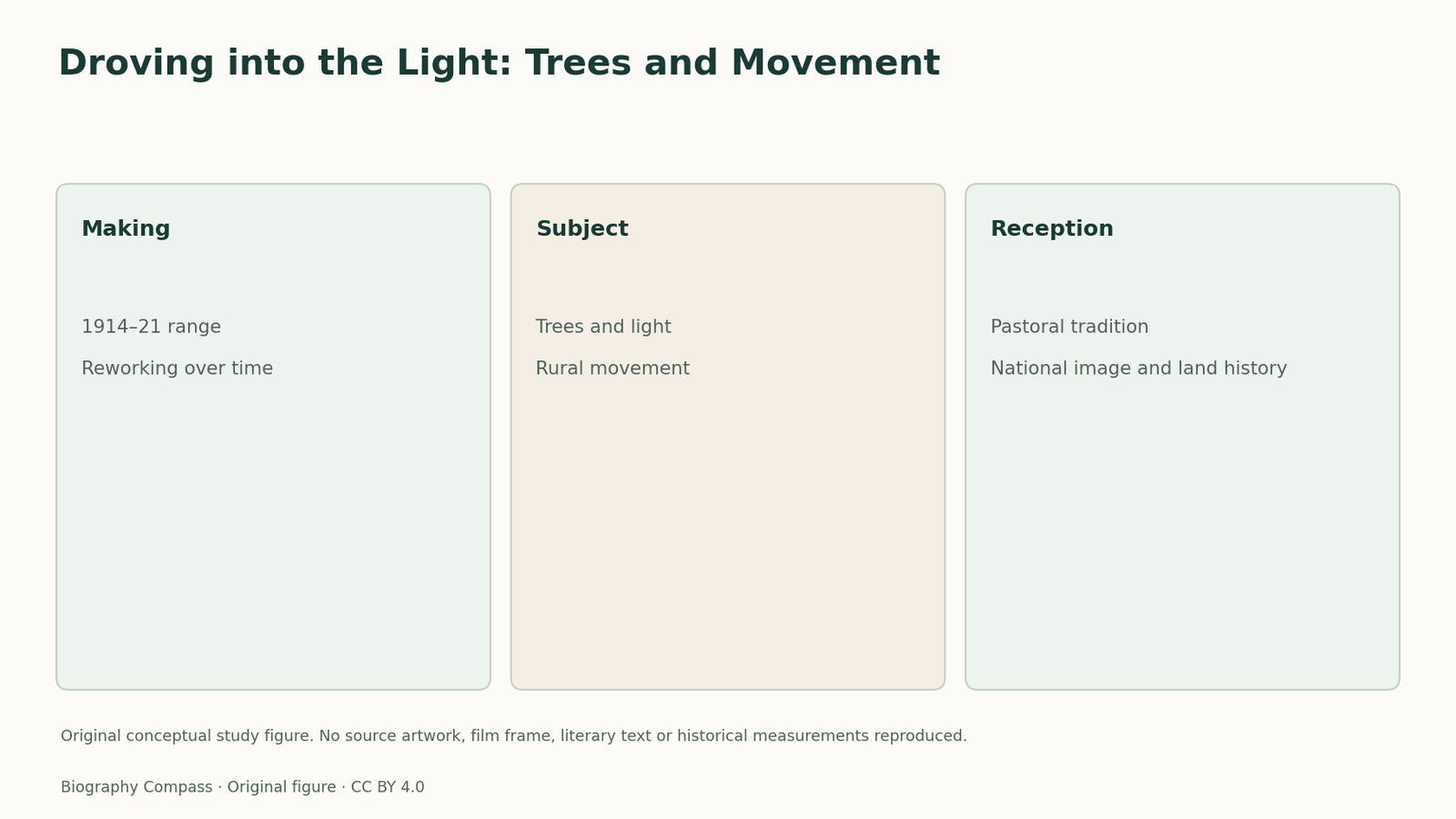
How do trees, cattle and the direction of light organise a landscape that is also a working route?
Read the evidence
Sources, interpretation and production roles
The records answer different questions about this work. The final exercise is an original teaching model.
| Record or question | Supported reading | Boundary or contrast |
|---|---|---|
| Production and ownership | 1914–21 development; 1922 collection gift. | These dates do not identify the same event. |
| Museum emphases | Nature-centred light and pastoral/national histories. | Different emphases need not be collapsed into one intention. |
| Original caption task | Compares formal, artistic and land-use questions. | Historical claims need evidence beyond shapes. |
A catalogue range records a work developed over time
Droving into the Light is catalogued as 1914–21, oil on canvas, in the Art Gallery of Western Australia. A 1922 gift brought it into the collection. These dates identify different events: the production range concerns the painting’s development, while the gift concerns ownership. The NGV label also records an earlier title, Into the Light. The range should not be converted into a claim that the final picture was completed in a single outdoor session.
Light and trees are specific pictorial concerns
Institutional accounts emphasise Heysen’s attention to light falling on trees and his observation of different gum species. In this guide’s reading, a droving subject gives that attention a moving human and animal setting. Rural activity can provide a route into the light rather than merely occupy an empty foreground. The painting consequently invites questions about how scale, shelter and illumination relate. This is a reading of the documented concerns, not an assertion that every tree species or brushstroke in the original has been independently examined here.
A pastoral image has more than one historical frame
The AGWA exhibition places the picture within a European tradition of rural subjects as well as its Australian national reception. It also asks viewers to consider the displacement of Peramangk people around Hahndorf. Those frames concern different histories: artistic convention, public identity and land use. The NGV label’s nature-centred reading offers another emphasis. None requires the claim that all viewers experienced the picture identically. A useful comparison can explain how a familiar pastoral scene carries more questions than its immediate account of light and rural movement. The droving action is therefore worth discussing alongside the trees, since a pastoral view joins movement through land with the light that makes the place visible.
Original exercise: give a landscape three captions
Invent a landscape containing a large tree, an animal path and a small group moving toward an open area. Write three short captions: one about illumination, one about the tradition of rural painting and one asking who used the land before the scene represented. A reference answer recognises that the captions direct attention to different evidence; the last requires historical research rather than an inference from the tree’s shape. Now explain what would be lost if one caption were declared the only possible account. Return to Heysen’s painting by separating its catalogue facts from the two museums’ interpretive emphases. The task neither copies the tree arrangement nor suggests that a diagram can recover an entire place’s history. It makes the coexistence of close pictorial interest and wider historical questions usable for a reader. A picture can reward attention to light while its later display asks how pastoral beauty became a public image of settlement and belonging. Those arguments gain precision when their different supporting records remain visible.
Continue the chronology
Related history guides
Biography context
Explore Australia through connected lives
Connected biographies
People and related creative practices
1877–1968
Hans Heysen
German-born Australian landscape painterHans Heysen developed a highly successful Australian landscape career through close observation, European study and a long working life near Hahndorf.Read biography
1875–1963
Margaret Preston
Australian painter and printmakerMargaret Preston combined European training, Japanese print interests and Australian plant subjects while pursuing a contested vision of national art.Read biography1911–2003
Nora Heysen
Australian portrait and still-life painter and official war artistNora Heysen established a portrait and still-life career distinct from her father’s landscapes, becoming the first woman to win the Archibald Prize.Read biographyQuick answers
Common questions
- Was Droving into the Light made in 1922?
- The painting is catalogued 1914–21; 1922 is the collection gift year.
- Does one interpretation exhaust the work?
- No. The guide compares specific museum readings and identifies the evidence each requires.
Primary and institutional sources
How this history was checked
Sources include production records, institutional collections and the specifically identified passages discussed here. Interpretations and teaching models are distinguished from credits and publication facts. This article was reviewed on 8 November 2026.