
The short answer
A failed parity check says something about a word. Turning that observation into a correction requires an assumption about how the word may have been damaged.
Selected record and original analysis
A checking number is conditional evidence
Read the stated model and observation separately.
| Question | Record or stipulated input | Interpretation |
|---|---|---|
| One change | Flip position 5 | The checking number correctly identifies 5. |
| Two changes | Flip positions 2 and 7 | The same number no longer identifies one damaged bit. |
| Correction rule | Assume at most one change | Keep the assumption attached to the result. |
Chronology
A timeline of the turning points
Selected paper
Published the error-correcting-code account.
What the checking number encodes
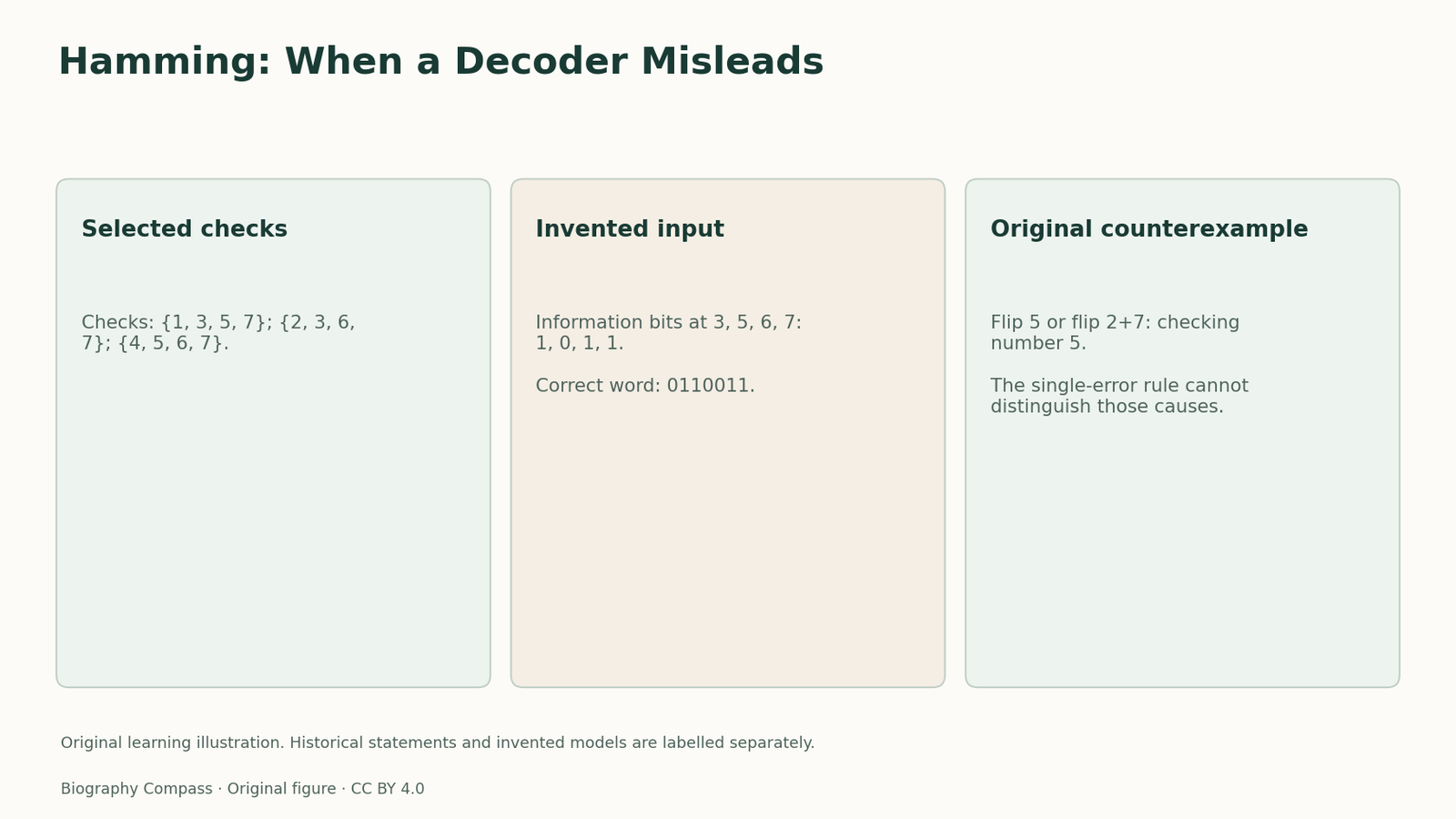
Hamming’s even-parity construction checks positions 1, 3, 5, 7; 2, 3, 6, 7; and 4, 5, 6, 7. Check positions are 1, 2, 4. The failed-check pattern is read as a binary checking number identifying a single erroneous position.
Its structure is not a probability estimate. The inference from a checking number to a correction relies on the allowed number of changes.
Sources for this section: [1]
An original transmitted word
Put invented information bits 1, 0, 1, 1 in positions 3, 5, 6, 7. Choose the check bits so each listed group has even parity. Write positions 1 through 7 from left to right. Then flip position 5 and compute the checking number.
As a separate case, start again with the correct word and flip positions 2 and 7. Apply the same single-error rule. What does it do? Use the lowest-weight check as the rightmost bit of the three-bit checking number.
Sources for this section: [1]
Reference answer: the same signal, two causes
The correct word is 0110011. Its first check requires bit 1=0, the second bit 2=1, and the third bit 4=0. Flipping position 5 gives 0110111. Checks 1 and 4 fail while check 2 passes, so the checking number is 101₂=5. Flipping that position restores the word.
Flipping positions 2 and 7 also gives checking number 2 XOR 7=5. The single-error decoder now flips position 5 even though that position was not damaged. The resulting word has passed checks but is not the transmitted word.
This is a constructive counterexample, not an estimate of real-channel error frequency. An error model permitting two changes cannot use the single-change conclusion without extra information.
Sources for this section: [1]
Capacity is not an unlimited guarantee
The paper requires enough checking combinations to distinguish the no-error case and the individual single-error positions.
For this original seven-position case, three check bits give eight outcomes: one no-error outcome and seven possible positions. That accounting does not reserve separate outcomes for every possible pair of changes. The example explains why adding a plausible decoding instruction cannot create missing information.
Sources for this section: [1]
Continue the chronology
Related history guides
Biography context
Explore United States through connected lives
Connected biographies
The working life behind the record
Quick answers
Common questions
- Are the words copied from a historical experiment?
- No. The information bits and damage cases form an original fixture.
- Does passing the checks prove the original word was recovered?
- No. The double-change example produces a different passing word after a mistaken correction.
Primary and institutional sources
How this history was checked
These selected records support the historical account. Invented inputs and their original reference answers are identified explicitly. This article was reviewed on 31 October 2026.