
The short answer
What separate comparisons establish catalyst activity, functional-group tolerance and practical handling behaviour?
Read the evidence
Different records within the same investigation
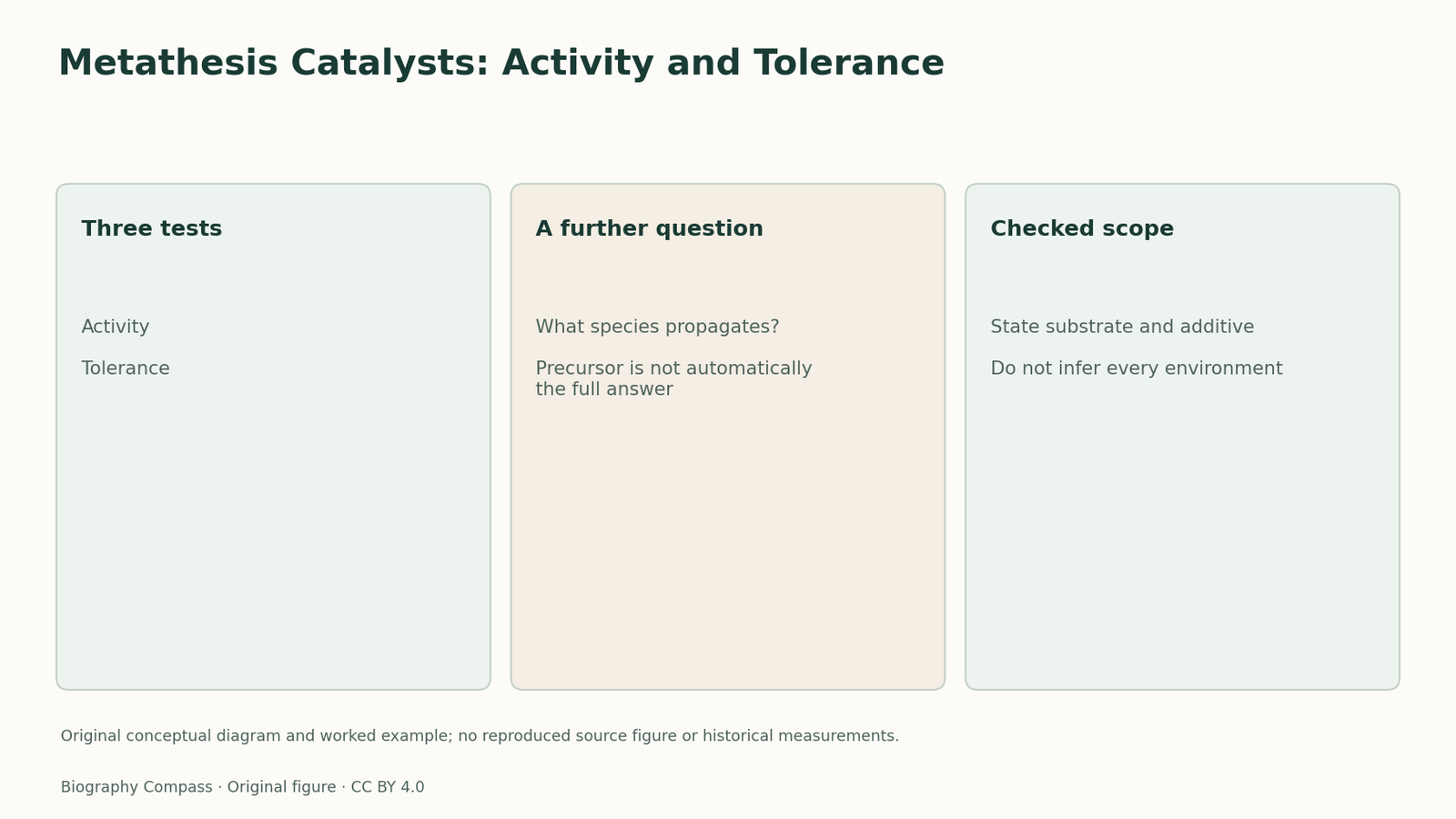
The following comparison distinguishes the specific questions answered by the inspected records.
| Record or test | What it establishes | What remains different |
|---|---|---|
| Activity test | Shows a transformation under specified conditions | Does not establish broad tolerance |
| Observed propagating species | Constrains the operating catalyst account | Does not make every precursor identical |
A useful catalyst has several properties
A catalyst can promote a desired transformation yet fail when a particular solvent or functional group is present. Grubbs’s lecture treats broader tolerance as a problem separate from obtaining metathesis activity. The distinction matters because an impressive result with one substrate does not establish compatibility with every molecular feature. It also explains why practical catalyst development is scientifically informative: changing the system can expose which properties are linked and which require independent tests. This topic asks how the 1992 ruthenium-carbene study connected useful behaviour with a more identifiable catalytic species.
Sources for this section: [2]
What the original abstract supports
Nguyen, Johnson, Grubbs and Ziller reported a carbene species that polymerised norbornene in organic media both without and with protic or aqueous solvent. They described observing a propagating carbene during the reaction. Their abstract contrasts that result with earlier active systems whose intermediates were difficult to characterise. These observations constrain a specific system; they do not show that all functional groups are tolerated or that every ruthenium precursor shares the same active state. The catalyst added initially, a species observed during operation and the products formed should remain separately labelled in the explanation.
Sources for this section: [1]
Exercise: distinguish three questions
Imagine invented catalyst A gives the desired product in a dry comparison but fails after a particular additive is introduced. Catalyst B gives the product in both settings, yet its active species has not been identified. Which result addresses tolerance to that additive? The comparison for B does. Which establishes B’s active structure? Neither product outcome alone. This original exercise contains no historical yields. Its answer separates activity, compatibility and characterisation, allowing a system to be useful in one sense while an important mechanistic question remains open. The categories are complementary rather than rival rankings of scientific value.
One successful additive is not every environment
Now give B a successful test with a second invented additive. That expands the demonstrated scope by one comparison; it does not logically establish universal robustness. If A performs better on another substrate, the relevant choice depends on the task. A precise comparison states the substrate, conditions and measured outcome instead of treating the metal’s name as a complete performance specification. This is why a study of norbornene polymerisation should not silently become evidence for every ring-closing metathesis or every functionalised acyclic substrate. Similar reaction families can still pose different experimental questions.
Sources for this section: [1]
Continue the chronology
Related history guides
Biography context
Explore United States through connected lives
Connected biographies
Researchers and related approaches
1942–2021
Robert H. Grubbs
Chemist and metathesis-catalyst researcherExplore Robert Grubbs’s Kentucky upbringing, academic career and collaborative catalyst research, separating activity, tolerance and active-species evidence.Read biography
1930–
Akira Suzuki
Organic chemistAkira Suzuki helped develop organoboron cross-coupling through a long Hokkaido career, with Norio Miyaura and other collaborators central to the research record.Read biographyQuick answers
Common questions
- Did the study prove universal functional-group tolerance?
- No. Its claims concern the stated substrate, media and observations.
- Does product formation alone identify the active catalyst?
- No. Characterising the operating species requires additional evidence.
Primary and institutional sources
How this history was checked
The references below distinguish the original study from later explanations. The worked exercise and comparison are newly written for this article. This article was reviewed on 8 November 2026.
- Nguyen, Johnson, Grubbs and Ziller, 1992; Caltech recordRing-opening metathesis polymerization of norbornene by a Group VIII carbene complex in protic media
- Nobel Prize OutreachRobert H. Grubbs — Nobel lecture
- Nobel Prize OutreachRobert H. Grubbs — Facts
- Nobel Prize OutreachRobert H. Grubbs — Biographical