
The short answer
A rehearsal instruction is useful only if the people who need it can receive and interpret it. A shared musical entry need not require an identical route to the information. A cue sheet can make those routes explicit without pretending to diagnose anyone’s hearing.
Records and working decisions
Compare the choices
The records frame a new practical problem; the task makes its own assumptions explicit.
| Question | Consulted record | New working proposal |
|---|---|---|
| Performer account | Several sensory inputs | Ask what information is needed for the entry. |
| Teaching context | Musical communication | Record the cue, its supplier and performer feedback. |
Chronology
A timeline of the turning points
The consulted posting
Official Hearing Essay online.
A performer describes several inputs
Glennie’s Hearing Essay describes work with teacher Ron Forbes using timpani and vibrations felt through a wall. She also discusses residual hearing and visual information. These are attributed accounts of her practice, not a universal body-frequency map.
The Academy’s profile separately emphasises performance, commissioning and teaching. Read together, the records place listening within the making and communication of music, not merely within a story about an impairment.
Specify the musical aim before the channel
For a cue sheet, the aim might be an entry on a particular beat. The sheet should then state what each performer needs before that entry and which cue is intended to supply it. A gesture, a pulse and a click can be planned to communicate the same event without being treated as interchangeable sensations.
A planned cue is not proof of a successful entry. The performer’s report and the observed musical result remain useful feedback. Preferences in our task are fictional working requirements, not claims that any real group uses only one sense.
Sources for this section: [1]
Original cue-sheet task
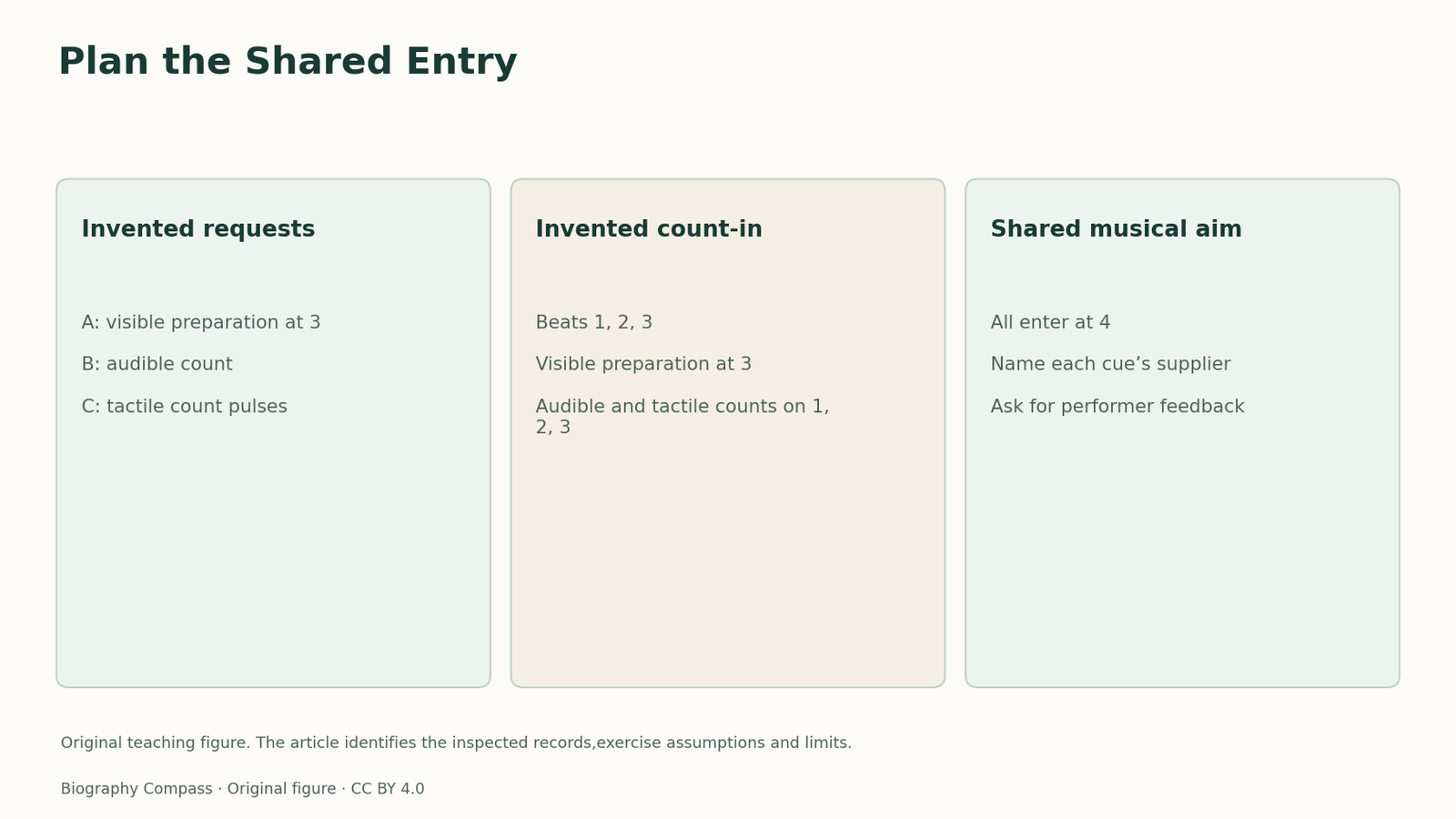
Assume a rehearsal count of beats 1, 2, 3, then a shared entry on beat 4. Performer A requests a visible preparation on beat 3. B follows an audible count. C requests a tactile pulse on each count beat. Write a cue sheet that satisfies these stipulated requests without changing the entry beat. A note saying only “say now at 4” is proposed instead: identify which requests it leaves unaddressed. No actual sound or vibration experiment is required.
Sources for this section: [1]
Reference answer
A possible sheet specifies visible preparation at 3, an audible count on 1, 2, 3, and corresponding tactile pulses on 1, 2, 3, with all performers entering at 4. It names who supplies each cue and asks the performers to confirm that they received the intended information. “Say now at 4” addresses neither A’s advance visual preparation nor C’s requested count pulses, and it omits B’s requested count-in.
The sheet is a proposal, not a demonstrated performance or a clinical method. Its value is that it makes the shared aim and the different requests visible. If feedback reveals a conflict, the ensemble can revise the cues while retaining the same musical goal.
Sources for this section: [1]
Continue the chronology
Related history guides
Biography context
Explore United Kingdom through connected lives
Connected biographies
Follow the working life

Quick answers
Common questions
- Does the sheet prove a real performer will enter successfully?
- No. It is an original proposal that still needs appropriate rehearsal feedback.
Primary and institutional sources
How this history was checked
The essay supplies a first-person practice account; the cue sheet is newly designed and reproduces no protected score instruction. This article was reviewed on 31 October 2026.