
The short answer
A detector samples a part of an angular distribution. Correcting that sample and extending it to a larger region are separate operations.
Selected record and original analysis
Separate the corrections
Read the stated model and observation separately.
| Question | Record or stipulated input | Interpretation |
|---|---|---|
| Count | 50 net detections | Background is stipulated already removed. |
| Acceptance | Efficiency×solid-angle fraction | A calculation under the declared uniformity model. |
| Missing condition | Unknown angular distribution | The whole-hemisphere result is no longer determined. |
Chronology
A timeline of the turning points
Joint report
Geiger and Marsden published the selected observations.
What was actually measured
Geiger and Marsden investigated metal dependence, thickness and the fraction reflected. Their report subtracts an air background and extrapolates from a fixed detector arrangement using an assumed uniform hemispherical distribution.
The reported fraction is therefore attached to a material, geometry and extrapolation. It should not be turned into a universal probability for any incident particle or apparatus.
Sources for this section: [1]
One original acceptance fixture
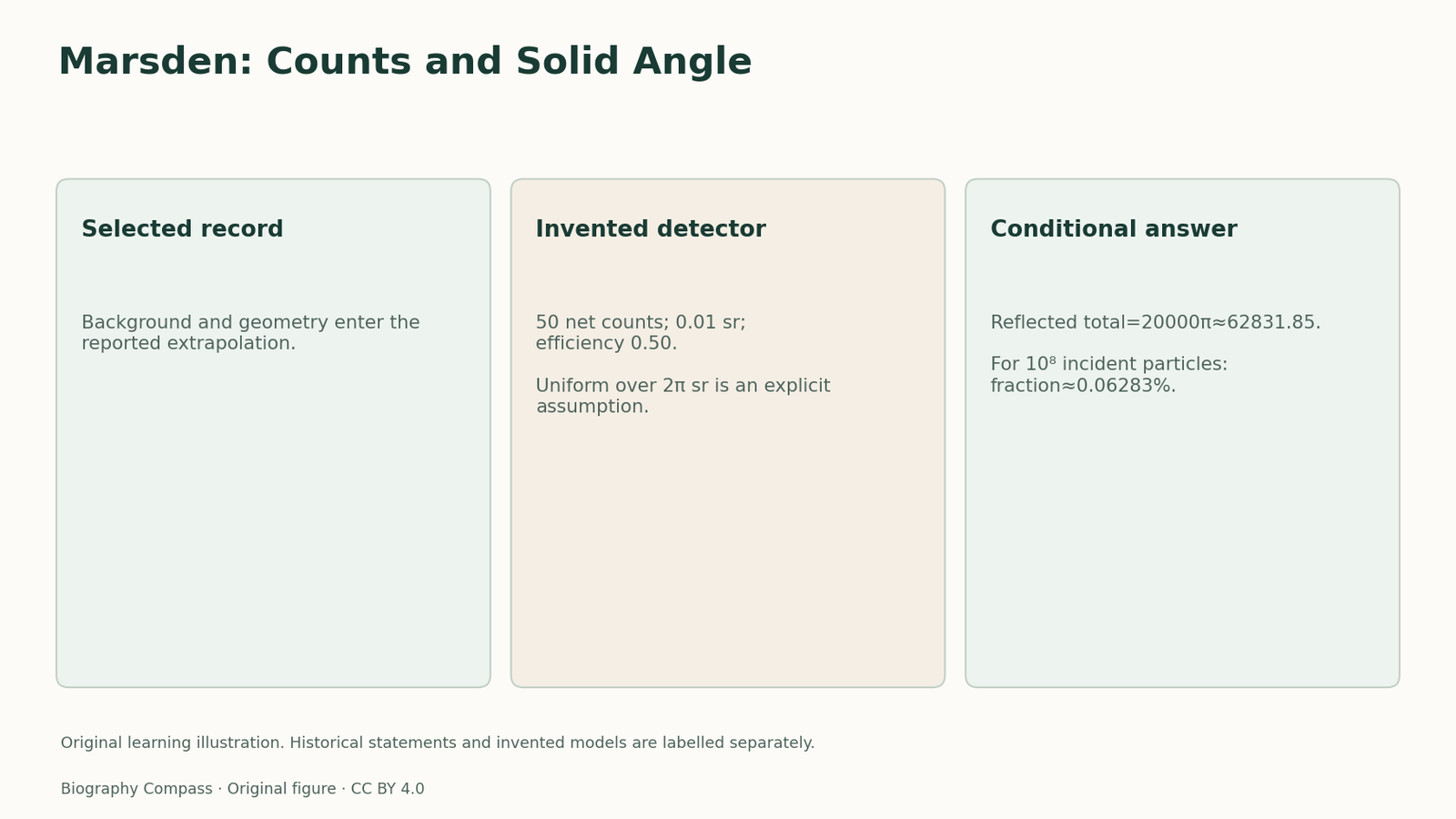
Invent a run with 50 net detector counts over ten minutes. The detector covers 0.01 steradian of a hemisphere and detects 50% of particles reaching it. The incident total during the run is 100,000,000. Assume no dead time or unremoved background.
First stipulate that the reflected particles are uniformly distributed over 2π steradians. Estimate the reflected total and its fraction of the incident total. Then remove only the uniformity assumption: can the same detector count still determine the total over the hemisphere? These are invented inputs, not the original apparatus or reported count.
Sources for this section: [1]
Reference answer: identify the extrapolation
The observed count is the reflected total multiplied by 0.50×0.01/(2π). Dividing 50 by that acceptance gives 20000π, approximately 62831.85 reflected particles. The conditional fraction is 0.0006283185, or about 0.06283%.
Without an angular-distribution assumption, only the detector’s sampled region has been constrained. Many distributions can agree within that region while differing elsewhere. Efficiency correction within the observed aperture does not supply the missing angular information.
The fractional estimate is not a new historical measurement. The fixture makes the role of the extrapolation visible and keeps its uncertainty separate from a counting error.
Sources for this section: [1]
Observation and later interpretation
The original work was a joint experimental report in Rutherford’s laboratory. The calculation above neither reconstructs that experiment nor proves a nuclear model. A physical explanation may account for an angular distribution, but choosing one is an additional scientific argument, not a consequence of multiplying a count by a geometrical factor.
Sources for this section: [1]
Continue the chronology
Related history guides
Biography context
Explore Manchester through connected lives
Connected biographies
The working life behind the record
Quick answers
Common questions
- Are the detector values historical measurements?
- No. Every numerical input in this fixture is invented.
- Does a small aperture determine the entire angular distribution?
- No. Extending it requires additional information or an explicit model.
Primary and institutional sources
How this history was checked
These selected records support the historical account. Invented inputs and their original reference answers are identified explicitly. This article was reviewed on 31 October 2026.