
The short answer
The same people can make the same kind of object under different arrangements of authority. Track permission to change the process before judging its results.
An explicit record and model comparison
Rights within the invented arrangements
Yes means an independent change right within the explicitly stated scope.
| Role and arrangement | Design / sequence / acceptance | Scope |
|---|---|---|
| Maker in H | Yes / yes / yes | Own complete item |
| Maker in P | No / no / no | Assigned stage |
| Coordinator in P | Yes / yes / yes | Overall process |
| Stage worker in hybrid | No / yes / no | Own stage sequence |
Chronology
A timeline of the turning points
Massey lectures
The book’s stated lecture origin.
Revised edition
The edition actually inspected.
The selected text is about organisation
Franklin distinguishes holistic specialization by product, with the doer controlling the process, from prescriptive specialization by process. Her Chinese-bronze example concerns coordinated labour and control, not simply the age of the tools.
An arrangement cannot be classified by counting machines alone. The useful question is who can modify a sequence, judge an intermediate result or decide that work must stop. That question can be asked without pretending to measure everything that matters in a workplace.
Sources for this section: [1]
Stipulate a small workshop
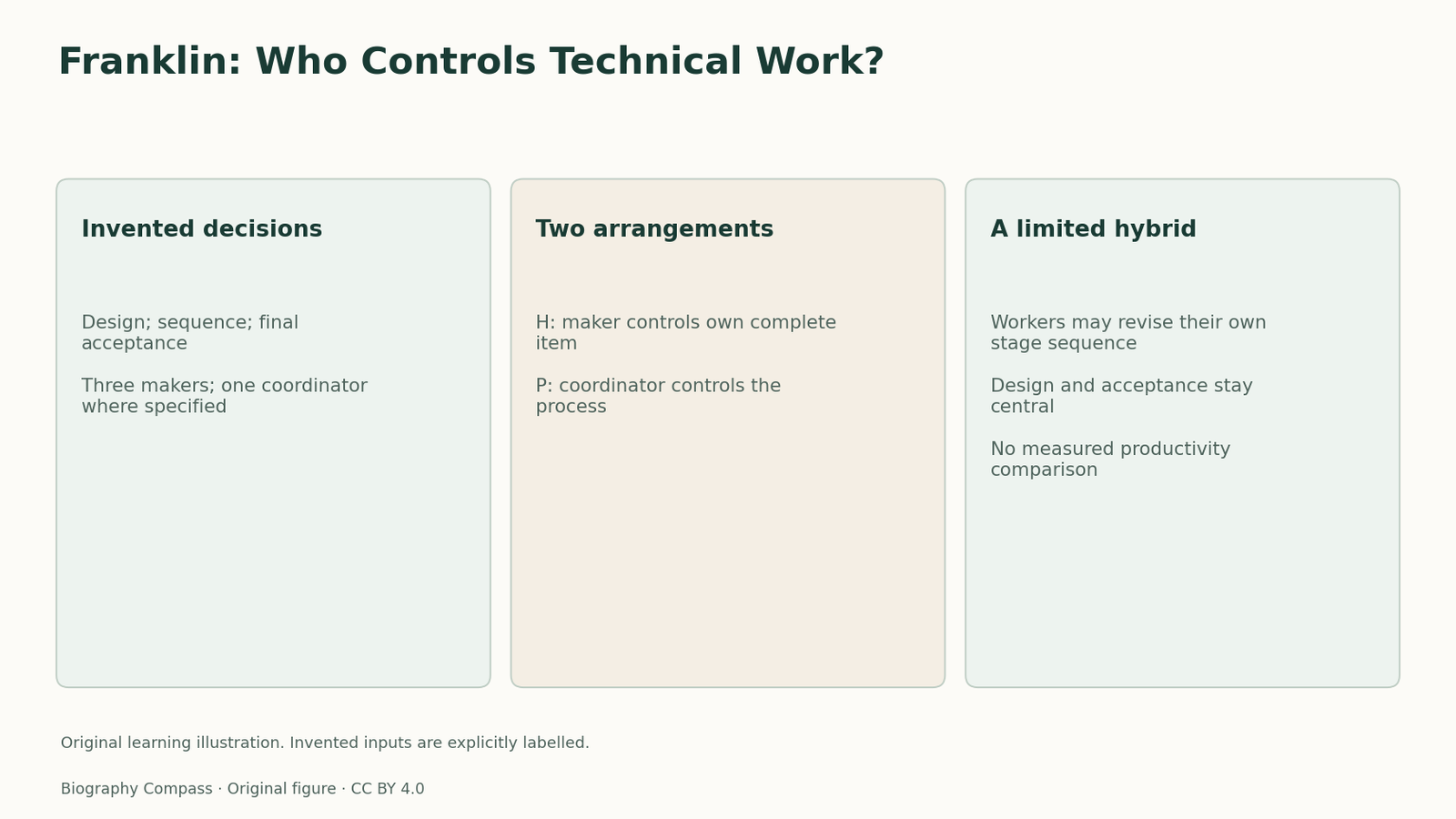
Invent three makers and three decision types: design, work sequence and final acceptance. In arrangement H, each maker makes a whole item and may change all three decisions for that item. In arrangement P, a coordinator controls all three decision types; each maker performs an assigned stage and must refer proposed changes to the coordinator.
Make a decision-rights matrix. Mark a right only when the stated arrangement grants it. Then propose a hybrid in which stage workers may stop and revise their own stage sequence, but may not change the design or final acceptance. Which entries change?
Sources for this section: [1]
Reference answer
For H, each maker’s row contains yes for design, sequence and acceptance, within that maker’s own item. For P, the coordinator has all three rights; each maker has no independent change right under the stipulated rule. Performing a task is not the same as being authorised to alter it.
In the hybrid, each stage worker gains a sequence-change right within the assigned stage. Design and final acceptance remain central. The hybrid does not become identical to H: scope matters, because a local sequence decision is not control over the whole item.
The matrix records authority, not observed speed or satisfaction. It cannot establish which arrangement produces more, pays fairly or suits a particular person. Those questions need evidence absent from this fixture.
Sources for this section: [1]
Use the framework without turning it into a score
The historical text helps identify a difference that a headcount or output total can conceal. The fictional matrix makes that difference explicit. It does not reduce a real workplace to a universal three-column checklist, and it does not show that every form of coordination is prescriptive in exactly the same way.
The inspected pages are a selected passage of the revised book. Neither the complete book nor lecture audio was consumed. The workshop and reference answer are original, rather than a reported factory study.
Sources for this section: [1]
Continue the chronology
Related history guides
Biography context
Explore Canada through connected lives
Connected biographies
A career behind the record
Quick answers
Common questions
- Does using a machine settle the classification?
- No. The exercise distinguishes decision rights and their scope, rather than classifying work by equipment alone.
- Is the hybrid equivalent to whole-item control?
- No. Changing one stage’s sequence is narrower than changing design, sequence and acceptance for a whole item.
Primary and institutional sources
How this history was checked
Selected original records and contextual histories are identified below. Invented examples are teaching models, not reconstructed experiments. This article was reviewed on 31 October 2026.