
The short answer
What did Pick’s whole-time appointment require?
A worked comparison
What each part contributes
Use the specific distinctions developed in the study.
| Part or record | What it establishes | Why the distinction matters |
|---|---|---|
| Salary | Annual stated remuneration | Subject to a temporary deduction |
| Whole-time service | Specific outside-work conditions | Different from Ashfield’s arrangements |
| Three-year review | Future reconsideration | Not a guaranteed increase |
What did Pick’s whole-time appointment require?
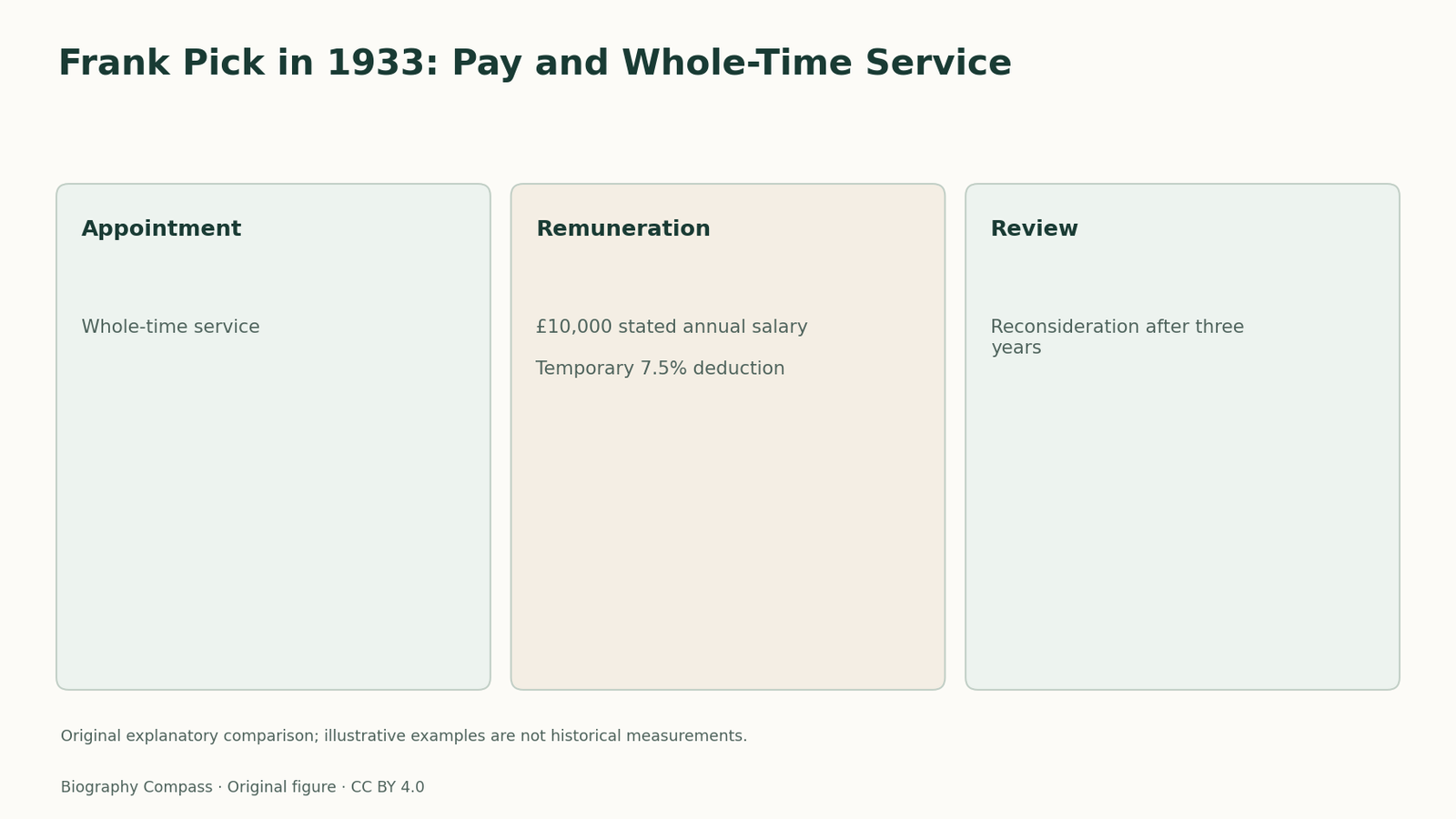
On 22 May 1933 the Minister of Transport explained the terms agreed for the new London Passenger Transport Board. Frank Pick’s appointment was whole-time and carried an annual salary of ten thousand pounds, subject to a temporary deduction. The useful documentary question is how pay, outside work and future review related to that appointment. It differs from asking who was legally eligible to become a board member. The parliamentary answer describes the negotiated employment arrangement, while the wider statutory selection machinery belongs to a separate question.
Sources for this section: [3]
A stated annual salary was subject to a temporary deduction
The minister reported a seven-and-a-half per cent temporary deduction from the remuneration of all board members. Pick’s stated salary and the amount after that deduction are therefore different figures. A historical comparison that quotes only the headline sum omits a condition expressly stated in the same answer. Conversely, the deduction should not be treated as proof of his exact take-home pay for an entire year. Tax, the period during which a temporary arrangement operated and any other relevant adjustment would require their own evidence.
Sources for this section: [3]
Outside appointments were governed by specific conditions
Pick was to relinquish his other paid appointments by 30 June. The answer also addressed future paid directorships or appointments and work that would conflict with his duties. Lord Ashfield’s arrangements were different and included conditions concerning certain directorships and the winding up of companies. The two men’s terms should consequently not be merged into one general rule. The comparison makes whole-time service concrete: a board could need experienced commercial administrators while also defining which external responsibilities they could retain and how competing work would be handled.
Sources for this section: [3]
A salary review was not an automatic increase
The minister said Pick’s salary would be reviewed after three years from 1 July 1933. That undertaking established a point for reconsideration, not a guaranteed rise and not, by itself, a three-year limit on the appointment. The statement also dealt separately with existing superannuation rights and settlement of claims under the Act. Finally, the minister characterised the formation arrangements as exceptional rather than a precedent for every future appointment. Reading each condition separately prevents a review date, a pension provision and a starting salary from becoming interchangeable descriptions of one entitlement.
Sources for this section: [3]
Pay-and-terms exercise with a checked answer
For a fictional annualised calculation, subtract seven-and-a-half per cent from ten thousand pounds. The deduction is seven hundred and fifty pounds, leaving nine thousand two hundred and fifty pounds before other adjustments. This arithmetic is not an assertion of Pick’s actual net pay. Now assess the claim that a three-year review guaranteed him a higher salary. It does not follow: review creates reconsideration, while an increase requires a further decision. Finally, can Ashfield’s permission concerning outside directorships simply be assigned to Pick? No. The answer states different arrangements for the two officeholders, so a reliable comparison must preserve those individual conditions.
Sources for this section: [3]
Continue the chronology
Related history guides
London 1829: Shillibeer’s Omnibus Service
Explore Shillibeer’s Paddington–Bank service through its route, full and half fares, museum model and prints, with a checked old-currency exercise.
Read the timeline1933London Transport 1933: Choosing the Board
Read the 1933 London transport board’s appointment rules, then test three invented candidates and distinguish eligibility from selection and service performance.
Read the timelineBiography context
Explore United Kingdom through connected lives
Connected biographies
People and wider context
1878–1941
Frank Pick
transport administrator and commissioner of public designFrank Pick was a transport administrator and commissioner of public design, known for London transport management and the commissioning of coherent passenger information and design.Read biographyQuick answers
Common questions
- Did the 1933 statement guarantee Pick a salary increase after three years?
- No. It provided for a salary review after three years from 1 July 1933, which is different from promising an increase.
Primary and institutional sources
How this history was checked
The source notes distinguish original records, institutional descriptions and later historical interpretation. Exercises and comparisons are original editorial analysis. This article was reviewed on 8 November 2026.
- John Elliot, revised Michael Robbins, Oxford Dictionary of National BiographyPick, Frank (1878–1941)
- European Route of Industrial HeritageFrank Pick biography
- House of Commons, Historic HansardLondon Passenger Transport Board, 22 May 1933, volume 278, columns 758–763
- Transport for London Corporate ArchivesResearch Guide No. 12: Frank Pick papers