
The short answer
A story can finish before a person’s life does. O’Connor’s interview offers a particular argument about that difference, which we can test through a new scene rather than imitate one of his plots.
Compare the selected record and the new task
Keep the choices visible
The historical premises and the invented response have different roles.
| Question | Selected argument | Original response |
|---|---|---|
| Scope | A short story may suggest continuing life. | The key scene stops before the relationship is explained. |
| Time | The novel requires a sustained relation to time. | The outline must connect changes, not merely list years. |
| Test | An attributed writer’s view. | Assess what a reader can infer; no universal genre verdict. |
Chronology
A timeline of the turning points
Interview
Whittier’s discussion of form with O’Connor.
One encounter
Keep an action legible and a larger history open.
A writer’s distinction, not a genre border
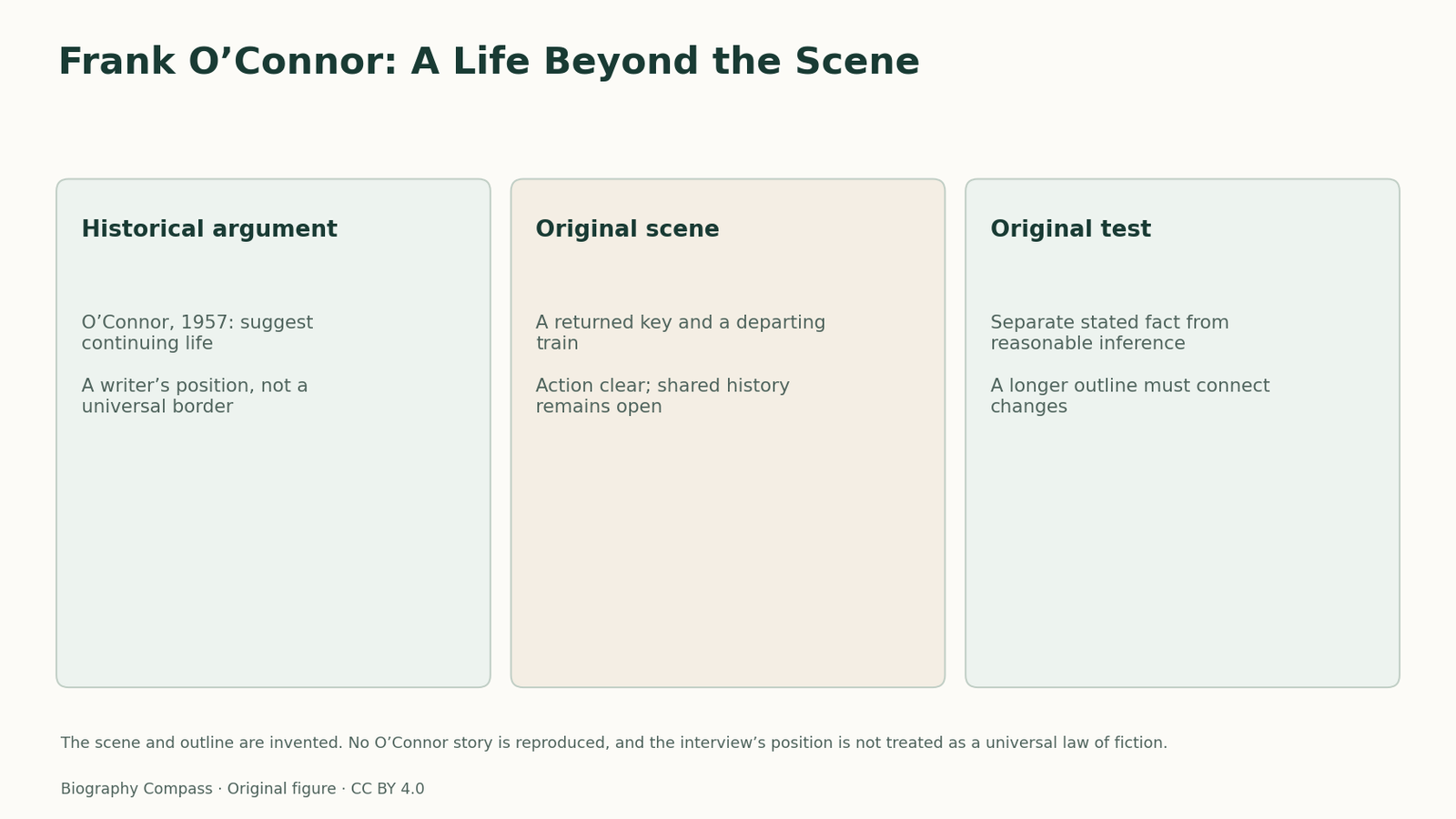
In the 1957 interview, Anthony Whittier asks why O’Connor prefers the short story. O’Connor associates it with lyric concentration and the suggestion of continuing life; he contrasts that with the novel’s sustained development of time and circumstance.
This is an aesthetic position, not a rule that invalidates every novel set during a single day. It asks us to notice a scale of explanation: what the scene establishes now, what it implies about a past, and what it leaves for a future the text never narrates.
Voice is also a selection
Ruth Sherry’s biography identifies his interest in the sound of a speaking voice and a moment of decisive change.
A voice can reveal a relationship through what it notices or avoids. That does not mean that a narrator must explain every relevant event. For this exercise, treat an implication as something a reader can reasonably infer while keeping it distinct from an explicit fact.
Original exercise: the returned key
Invent a railway-platform encounter: a person returns a key to another person just before a train leaves. Write 60–90 words containing one visible action, one line of dialogue and one object that could suggest a longer relationship. Do not explain their complete history. Then make a separate five-year outline with three linked changes that would be needed to sustain a longer narrative. The scene and outline are ours, not O’Connor’s.
Reference scene: “Mara put the key on the empty bench. Leon picked it up without looking at her. The blue thread was still wound around its handle. ‘You can leave it there,’ she said. He slipped it into the pocket that had once held both their tickets. When the train doors closed, he took the key out again and placed it beside the window.”
Reference diagnosis and an alternative
The key is returned, but its return does not establish the whole relationship. The thread and paired tickets suggest a shared past; neither proves whether this is a separation, a reconciliation or a practical errand. The last action changes the object’s place without resolving those possibilities.
A longer outline might connect a shared home, a period of absence and a later decision about returning. It would need to show how those changes affect the people rather than simply supply three dates. A different short scene can also work: test whether a reader can identify what happened while explaining which larger questions remain genuinely open.
Continue the chronology
Related history guides
Biography context
Explore Ireland through connected lives
Connected biographies
The wider working life
1903–1966
Frank O’Connor
Writer and translatorAn Irish writer whose work invites close attention to the voice carrying a story.Read biographyQuick answers
Common questions
- Is the key scene an adaptation of an O’Connor story?
- No. Its people, objects and actions are original classroom inputs.
Primary and institutional sources
How this history was checked
These selected passages and records supply the historical context. The exercise and reference response are original. This article was reviewed on 31 October 2026.