
The short answer
An assay can answer whether an effect is present without answering every question about its carrier or usefulness. Concentrating a preparation also need not preserve all of its measured activity.
Evidence and original analysis
Four claims need different information
All numerical values below are the original fixture.
| Claim | Available answer | Still absent |
|---|---|---|
| Concentration | 12/4=3 fold | Any clinical implication |
| Recovery | 24/32=75% | A mechanism for every loss |
| Purity or treatment | Not determined | Composition and clinical evidence |
Chronology
A timeline of the turning points
Selected record
Historical scope for this question.
Original exercise
Invented inputs and analysis, not reconstructed observations.
Several investigations, not one signal
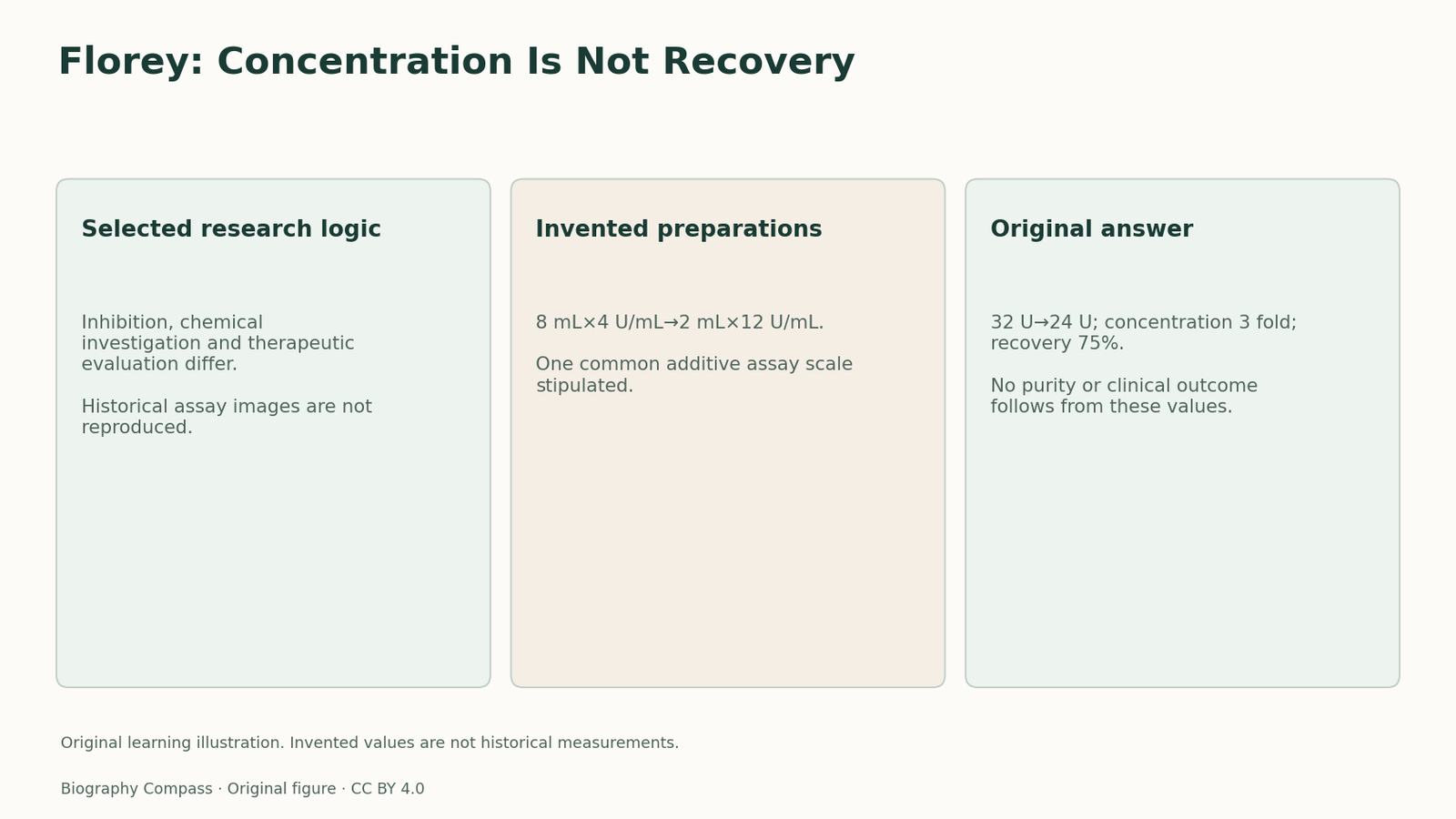
Florey’s lecture contrasts abundant observations of microbial antagonism with the need for coordinated chemical and biological work. It describes Heatley’s assay, extraction and concentration, while noting that strongly inhibitory isolated substances could still be too toxic for therapeutic use.
These are different evidential steps. Detecting inhibition, recovering activity and establishing composition do not by themselves determine clinical usefulness. No historical culture image is reproduced here.
Sources for this section: [1]
An original activity balance
Invent an initial preparation of 8 mL with assay activity 4 U/mL. A later preparation has 2 mL at 12 U/mL. Define U as one common, comparable arbitrary assay-activity unit and assume activity totals add linearly for this bookkeeping exercise. These are not doses, purity measurements or penicillin production data.
Calculate total activity at both stages, the concentration factor and the activity-recovery fraction. Does either result show that the material is chemically pure or safe to administer?
Sources for this section: [1]
Reference answer
Initially 8×4=32 U. Later 2×12=24 U. Concentration increased threefold, but activity recovery is 24/32=75%; the bookkeeping loss is 8 U, or 25%. Increased concentration and complete recovery are therefore different outcomes.
No mass or composition data were supplied, so purity cannot be calculated. No clinical evidence was supplied either. The threefold concentration factor is not a threefold therapeutic benefit. This conclusion follows from missing inputs, not a claim that all concentrated preparations are harmful.
Sources for this section: [1]
Credit the programme behind the evidence
The 1941 offprint catalogue names Abraham, Chain, Fletcher, Gardner, Heatley, Jennings and Florey.
The catalogue establishes authorship, not every experiment or individual role. Read beside the lecture’s account of technical coordination, it helps preserve the scale of collaboration without pretending that the original clinical paper was read.
Continue the chronology
Related history guides
Biography context
Explore United Kingdom through connected lives
Connected biographies
Researcher and context
Quick answers
Common questions
- Are U units a historical dose?
- No. They are arbitrary comparable assay units in an invented balance.
- Does more concentration mean more total activity?
- Not necessarily. The supplied smaller volume contains less total activity despite its higher concentration.
Primary and institutional sources
How this history was checked
Selected record passages ground the historical explanation. Original fixtures and answers are labelled separately. This article was reviewed on 31 October 2026.