
The short answer
A condition can be withdrawn while other conditions remain. Reading that change precisely also requires asking whose account describes the proposed arrangement and whose interests it advances.
The records answer different questions
Keep the measures separate
The question changes when the object, unit or reporting period changes.
| Record or measure | What it establishes | What it does not establish |
|---|---|---|
| Firestone letter | A participant’s conditional offer | Completed funding or neutral political judgment |
| Cecil message | An attributed criticism of leverage | A court verdict or a later reply |
| Original matrix | Whether stipulated conditions are jointly true | A disbursement or implemented plan |
Chronology
A timeline of the turning points
Diplomatic criticism
An earlier view of financial leverage.
Negotiations
The son represents the interests.
Conditional letter
A waiver with remaining requirements.
A participant’s offer retained conditions
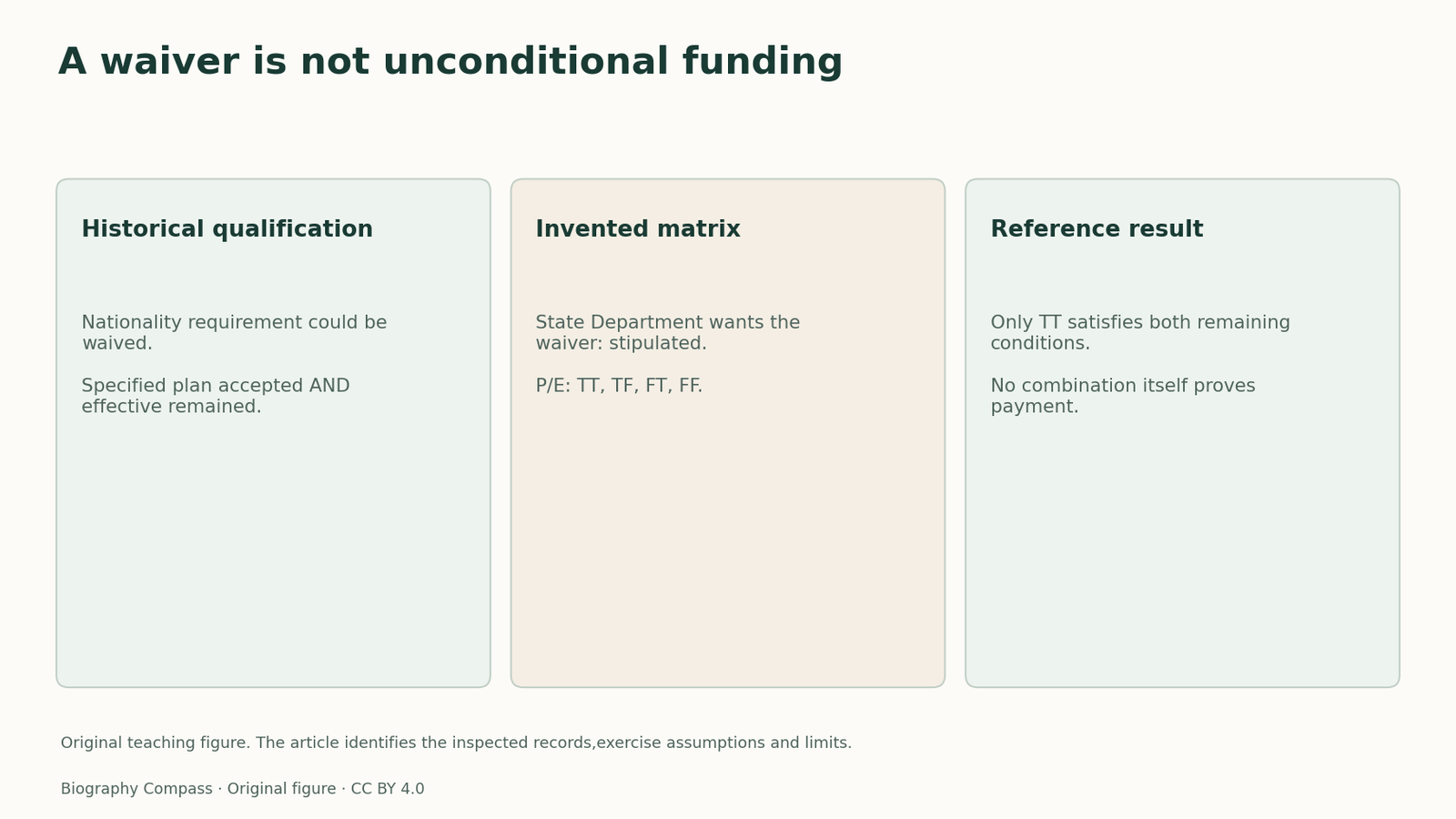
In his September letter, Firestone was willing, if the State Department desired it, to finance the League plan without insisting that its Chief Adviser be American. He still required acceptance of the specified plan and its becoming effective.
Removing the nationality condition did not turn the offer into unconditional funding. The letter is evidence of what the industrialist said he was prepared to support. It does not by itself establish acceptance, transfer of money or implementation.
Sources for this section: [1]
The political setting cannot be erased
In an earlier message, Lord Cecil criticised the Firestone interests’ cooperation and warned about the leverage created by an onerous financial arrangement.
Firestone’s own letter defended the preservation of American influence in Liberia.
These are different, attributed perspectives, not an agreed commercial assessment. The comparison reveals that advice, funding and sovereignty were entangled. It would be misleading to describe the proposed arrangement only as efficient supply-chain development or to treat one participant’s account as a judicial determination of responsibility.
Original conditional-offer matrix
Stipulate that the State Department wants the nationality waiver. Let P mean that the plan is accepted in the specified form, and E mean it becomes effective. Under the offer as described, test four invented cases: P/E = true/true, true/false, false/true and false/false. Which satisfies the two remaining conditions? Does satisfying them prove that a payment actually occurred?
Reference answer: only true/true satisfies P AND E. Waiving nationality does not remove either requirement. None of the four invented cases proves payment, because no disbursement record is supplied. The matrix isolates the offer’s stated conditions; it does not decide the legal enforceability of a historical promise or supply investment advice.
Sources for this section: [1]
Keep the chronology and participants straight
The report of the London negotiations identifies Harvey Firestone Jr. as the representative of the Firestone interests during the June meetings.
That is distinct from the senior Firestone’s later letter. The earlier diplomatic criticism should also not be narrated as a reply to a document written months afterwards. An adequate synthesis preserves the change in condition, the remaining requirements and the contested political purpose, without attributing every step to one person or declaring that the proposed arrangement was completed.
Continue the chronology
Related history guides
Biography context
Explore Washington, D.C. and Liberia through connected lives
Connected biographies
The connected careers
Quick answers
Common questions
- Did the nationality waiver remove every funding condition?
- No. Acceptance of the specified plan and effectiveness remained conditions.
Primary and institutional sources
How this history was checked
Read these dated records together; the original task states its own assumptions and separates them from reported facts. This article was reviewed on 31 October 2026.
- Office of the Historian, FRUS 1933, Volume II, document 711Harvey S. Firestone to Secretary of State, 22 September 1933
- Office of the Historian, FRUS 1933, Volume II, document 668Mellon to Secretary of State, 25 January 1933, conveying Cecil’s message
- Office of the Historian, FRUS 1933, Volume II, document 722London negotiations report, 1933, opening paragraphs