
The short answer
A count of arithmetic operations is a model of work. It becomes a performance claim only after the relevant implementation and measurement assumptions are supplied.
Original record and worked example
One historical row and one original calculation
Counts follow the handout’s multiplication model.
| Input | Conventional / FFT count | Saving from conventional count |
|---|---|---|
| Reported N=64 | 3,969 /192 | 95.2% displayed |
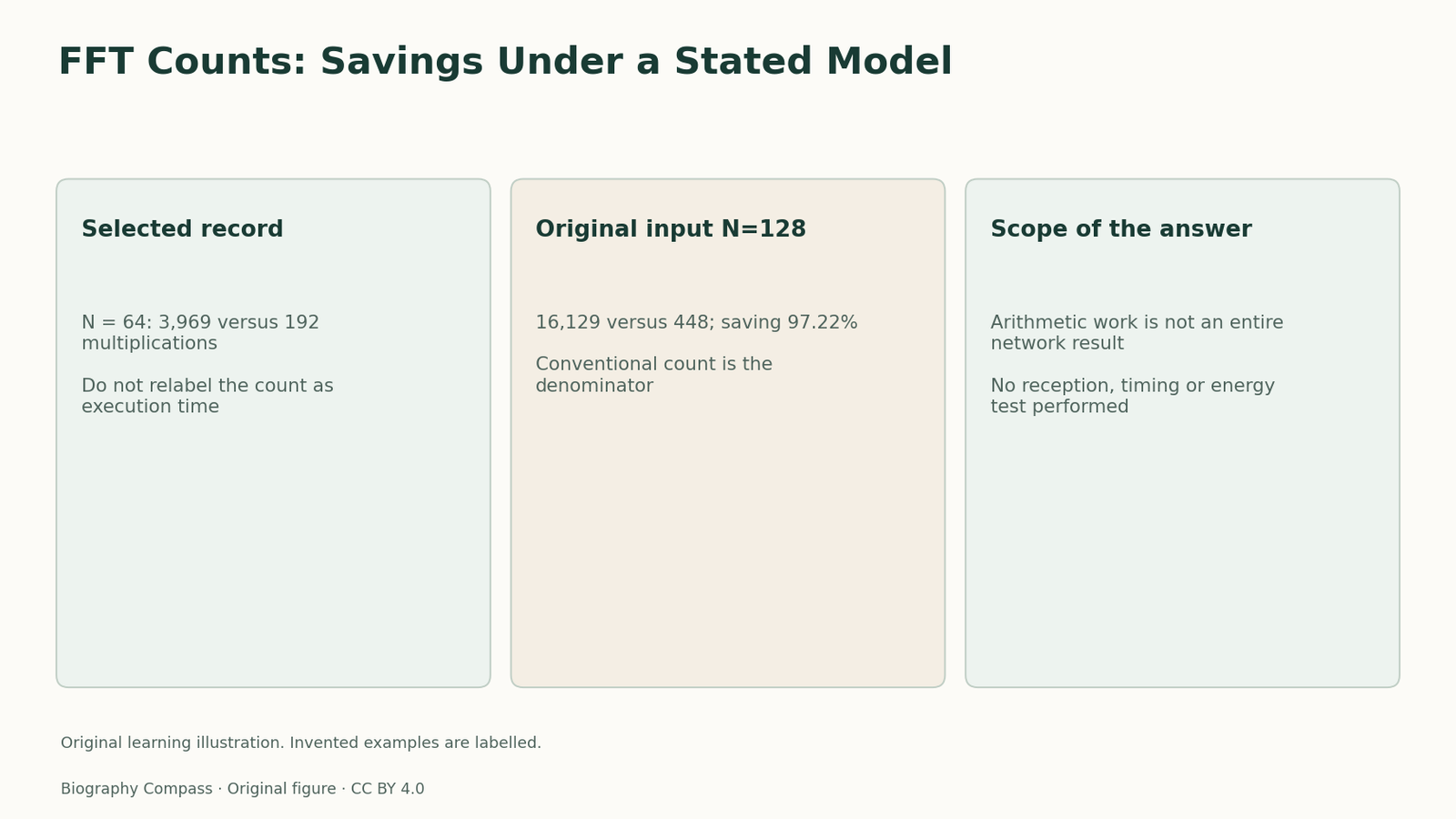
| Original N=128 | 16,129 /448 | 97.22% calculated |
Chronology
A timeline of the turning points
Research reference
Handout cites joint Anwar–Yamamoto RWS work.
Original calculation
N=128 is a new worked input, not a reported experiment.
Follow the column that is actually being compared
The handout compares CI generating/spreading with an FFT-based design. Its multiplication column uses C(N)=(N−1)² and F(N)=N log2(N)/2. At N=64 it lists 3,969 versus 192 multiplications.
These are the table’s counting conventions. They are not CPU cycles, elapsed seconds, battery lifetime or a complete communications standard. The other table columns address other resources; combining them without a common unit would create a meaningless total.
Sources for this section: [1]
An original power-of-two input
Let N=128 and apply the stated count model. Calculate C, F and the fractional saving (C−F)/C. Round the percentage only after calculating the ratio. Then state which new evidence would be needed to replace the phrase fewer counted multiplications with faster execution.
Use log2(128)=7. This exercise deliberately grants the model and its counting convention; it does not derive the cost of every possible FFT implementation.
Sources for this section: [1]
Reference answer
C=127²=16,129. F=128×7/2=448. The saving is 15,681/16,129, approximately 97.22%. The denominator is the conventional count, not the new count. Using the new count would answer a different ratio question.
For comparison, the table’s N=64 values give about 95.16%, which rounds to 95.2% as displayed. The original 128-input result is calculated from the formulas; it is not another measured row recovered from the handout.
Execution time would additionally depend on the implementation, hardware, data movement and what operations the count includes. A lower count under this model does not by itself establish lower reception error, higher throughput or less energy use in a deployed network.
Sources for this section: [1]
Keep credit and scope attached to the record
The source identifies a particular research comparison and a joint conference reference. It is not a record establishing one person as inventor of all technology inside a cellular generation. The biography discusses that separate attribution problem with a dated interview.
No standard, full conference paper or radio experiment is claimed as read or reproduced. The handout’s multiplication column is enough to support this specific learning task; it is not permission to invent claims about every other performance metric.
Continue the chronology
Related history guides
Biography context
Explore Japan through connected lives
Connected biographies
A career behind the record
Birth year unverified
Khoirul Anwar
Communications researcherWireless-communications researcher.Read biographyQuick answers
Common questions
- Can the resource columns simply be added?
- No. Operations and storage quantities are different measures; any combined cost needs an explicit model.
- Is the original N=128 row an experimental observation?
- No. It is a new calculation from the stated formulas.
Primary and institutional sources
How this history was checked
Selected original records support the historical discussion. Worked examples are original and explicitly bounded; they are not reconstructed experiments. This article was reviewed on 31 October 2026.
- Khoirul Anwar / NAIST Communications Laboratory seminar, February 2006 archiveA Fast Computation without Divisions for Combiners in Carrier Interferometry OFDM System
- Khoirul Anwar / JAIST personal archiveKhoirul Anwar: CV
- Rachmatunnisa / detikInet, 17 March 2016Khoirul Anwar clarifies the “inventor of 4G LTE” claim