
The short answer
A tune can travel across performers, broadcasts and editions. African Suite gives listeners several distinct examples within the same work.
Evidence comparison
Four kinds of source inside the suite
Use the work’s movement titles to keep attributions distinct.
| Movement | Documented source connection |
|---|---|
| Joyful Day and Onipe | Melodies by Ephraim Amu |
| Lullaby | Traditional song material |
| Nostalgia | Original movement by Sowande |
| Akinla | Highlife tune |
Composition and publication have different dates
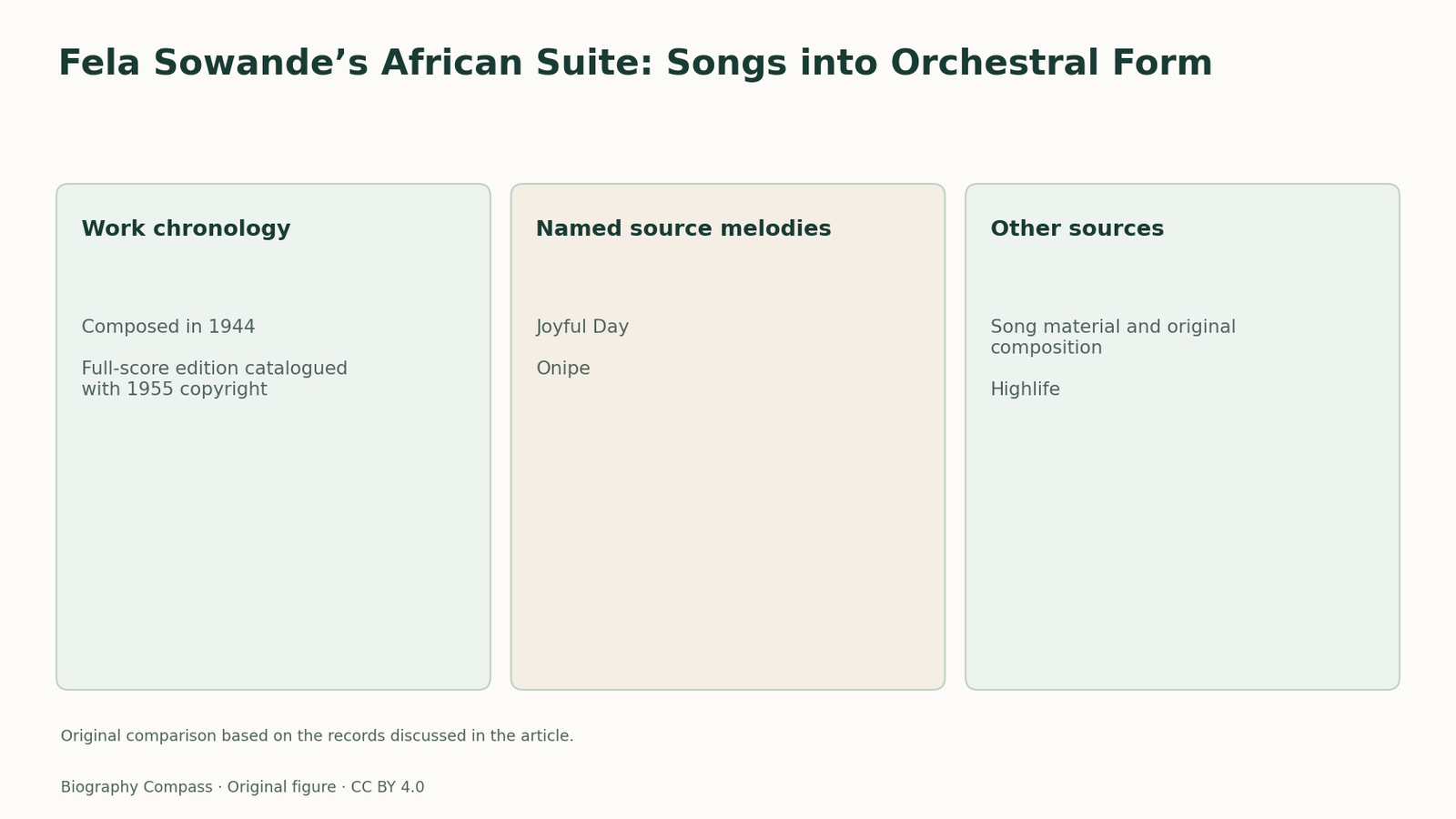
Programme accounts date African Suite to 1944. WorldCat catalogues a full-score edition with a 1955 copyright date. These are statements about different events. A piece can exist in manuscript or be heard on air before a particular edition is printed. When making a timeline, write the event next to the year instead of listing competing bare dates. The distinction makes the piece easier to find in library and concert records. It also preserves the wartime London context in which the programme places the music without treating the surviving catalogue item as the first public occasion.
The melodies connected to Ephraim Amu
The notes identify melodies by Ghanaian composer Ephraim Amu in Joyful Day and Onipe. That connection is important because an arrangement can make a known tune circulate under the name of the person who reworks it. Record Amu for the identified source melodies and Sowande for the suite and orchestral treatment. Both credits tell a reader something the other cannot establish. Where programme accounts differ about movement numbering, the titles and the score or recording sequence can be consulted directly. The underlying attribution is more useful than trying to deduce the source from a broad regional label.
Lullaby, Nostalgia and Akinla have different origins
The programme notes describe Lullaby in relation to a traditional song, Nostalgia as Sowande’s own contribution and Akinla in connection with highlife. Put those examples next to the Amu credits. The suite’s musical sources now represent several kinds of transmission: a named composer’s tune, a song described through tradition, an original movement and a popular dance idiom. Those categories help a listener distinguish questions of authorship from questions of arrangement. They also discourage assuming that a single description of the work applies equally to all five movements. Each title is a separate opportunity to ask where the material came from.
Look for what strings change about a melody
The full-score catalogue identifies the work as a suite for strings. For an initial listening exercise, follow a melodic idea through two statements in one movement. Describe whether its register, accompaniment or number of participating instruments seems to change, then listen again for what stays recognisable. That comparison keeps an attributed source melody distinct from the arrangement made around it. A listener can complete the exercise without copying a passage or identifying an original recording. If a score is available, its markings can then help check the impression. Keep that later evidence separate from what was heard.
A source card for a concert programme
Choose Joyful Day and one of the remaining movements. Write a card for each giving its title, the kind of source documented, the person or practice the notes associate with it and one feature to listen for. If sources give inconsistent numbering, leave the number off until you can check a score or a performance sequence. The resulting cards are short enough to use during a concert and detailed enough to retain more than one attribution. They also make it possible to update one entry without turning a correction into a claim about the entire suite.
Biography context
Explore Nigeria through connected lives
Connected biographies
People connected to the work
1905–1987
Fela Sowande
Composer, organist and teacherFela Sowande was a Nigerian composer and organist whose work crossed church music, popular performance, broadcasting and orchestral composition.Read biography1938–1997
Fela Kuti
Composer, bandleader and political activistFela Kuti built Afrobeat through bands, performance spaces and recordings that connected musical experiment with outspoken political argument. His career moved between Nigeria, London and the United States.Read biographyQuick answers
Common questions
- When was African Suite composed?
- Programme notes date it to 1944. The cited full-score edition has a 1955 copyright date.
- Which movements use melodies by Ephraim Amu?
- The programme and liner notes identify Joyful Day and Onipe.
Primary and institutional sources
How this history was checked
Dates, legal milestones and historical claims are checked against the official and institutional records below. This article was reviewed on 13 November 2026.