
The short answer
A shared polling day does not make two ballot questions the same proposal, nor does it reveal how individuals paired their answers.
Record and inference
Keep the questions separate
Each input establishes a different kind of evidence.
| Input | What follows | What does not follow |
|---|---|---|
| Recorded margins | Each question’s published aggregate result. | Individual paired choices are unknown. |
| Original cross-tables | Two joint patterns fit the same margins. | Neither is recovered polling data. |
| Campaign recollection | An organiser’s retrospective account. | It is not a cross-tabulation of ballots. |
Chronology
A timeline of the turning points
Separate ballot outcomes
Parliament proposal failed; Aboriginals proposal passed.
Two questions, two recorded outcomes
The AEC table gives 27 May 1967: Parliament, 40.25 per cent Yes, not carried, a majority in New South Wales; Aboriginals, 90.77 per cent Yes, carried, majorities in every state.
The constitutional changes in the latter question concerned the race power and population reckoning. The federal voting change preceded it, in 1962.
The two questions must remain separate before any explanation of campaigning or results begins. “The referendum won” is too imprecise when a poll contains different proposals.
An invented common-electorate exercise
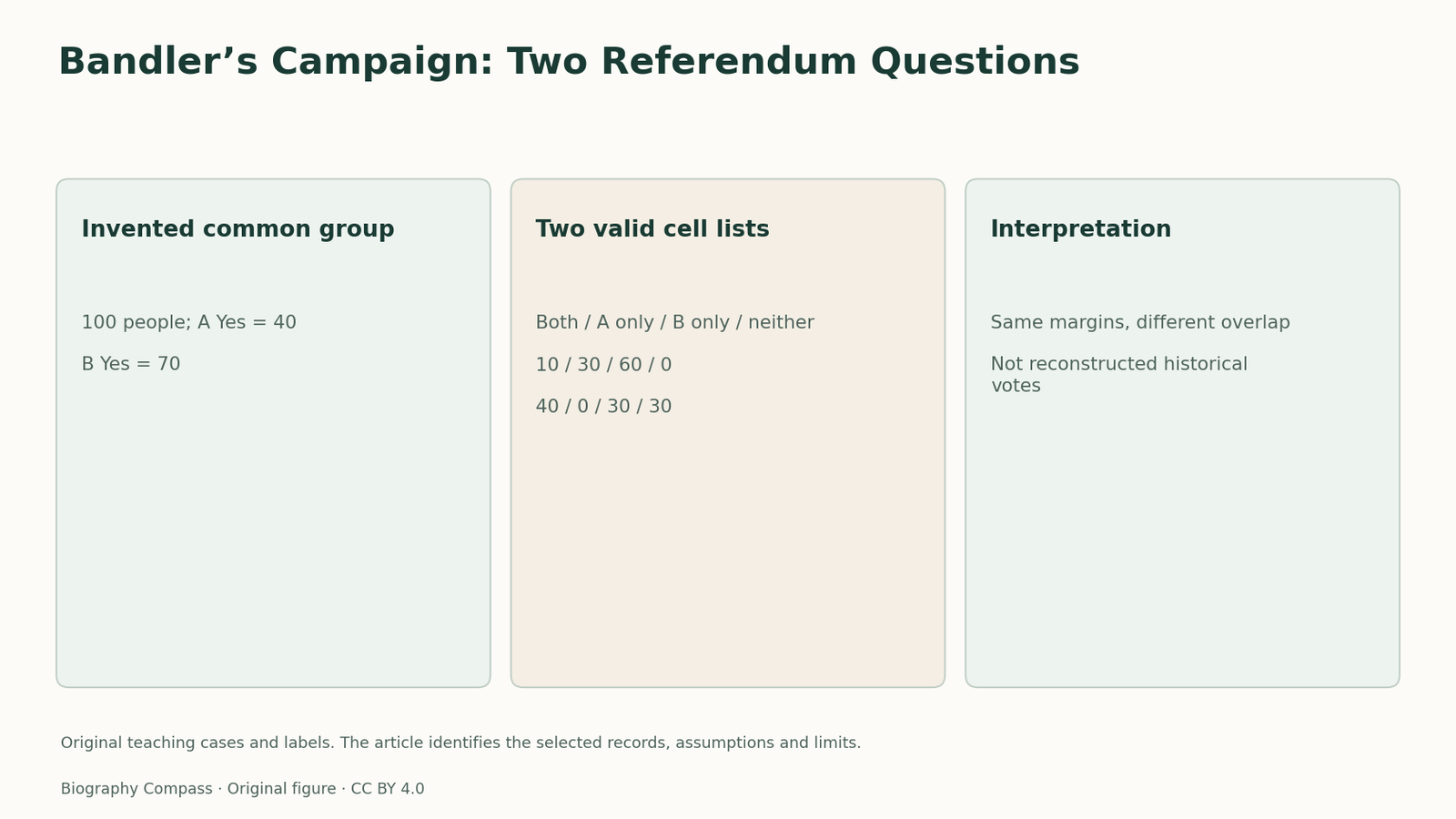
Use an invented group of 100 people who each answer both questions: 40 vote Yes on A and 70 vote Yes on B. These are deliberately different from the historical percentages. Construct one table with 10 Yes on both and another with 40 Yes on both.
For each, find A-only Yes, B-only Yes and neither. What can the shared marginal totals tell you about whether the same people supported both questions?
Sources for this section: [1]
Reference answer
With 10 Yes on both, the four cells are: both 10, A only 30, B only 60, neither 0. With 40 Yes on both, they are: both 40, A only 0, B only 30, neither 30. Both tables total 100 and preserve A=40 and B=70.
The margins therefore do not determine the overlap. The historical questions may also have different valid-vote denominators, so these common-100 tables are not reconstructions or rounded versions of their results.
Sources for this section: [1]
Use testimony without changing the results
The supplied ABC transcript records Bandler’s memories of the campaign.
A retrospective account can explain how an organiser understood the work. It cannot, on its own, establish each voter’s paired choices. We read the supplied transcript, not the video or a complete separately catalogued interview. The original exercise concerns aggregate inference, rather than repeating the constitutional double-majority calculation.
Sources for this section: [3]
Continue the chronology
Related history guides
Biography context
Explore Australia through connected lives
Connected biographies
The related public career
Quick answers
Common questions
- Are 40 and 70 rounded historical results?
- No. They are stipulated counts for a different, invented common electorate.
Primary and institutional sources
How this history was checked
Selected original records, retrospective testimony and invented exercises are identified separately. This article was reviewed on 31 October 2026.