
The short answer
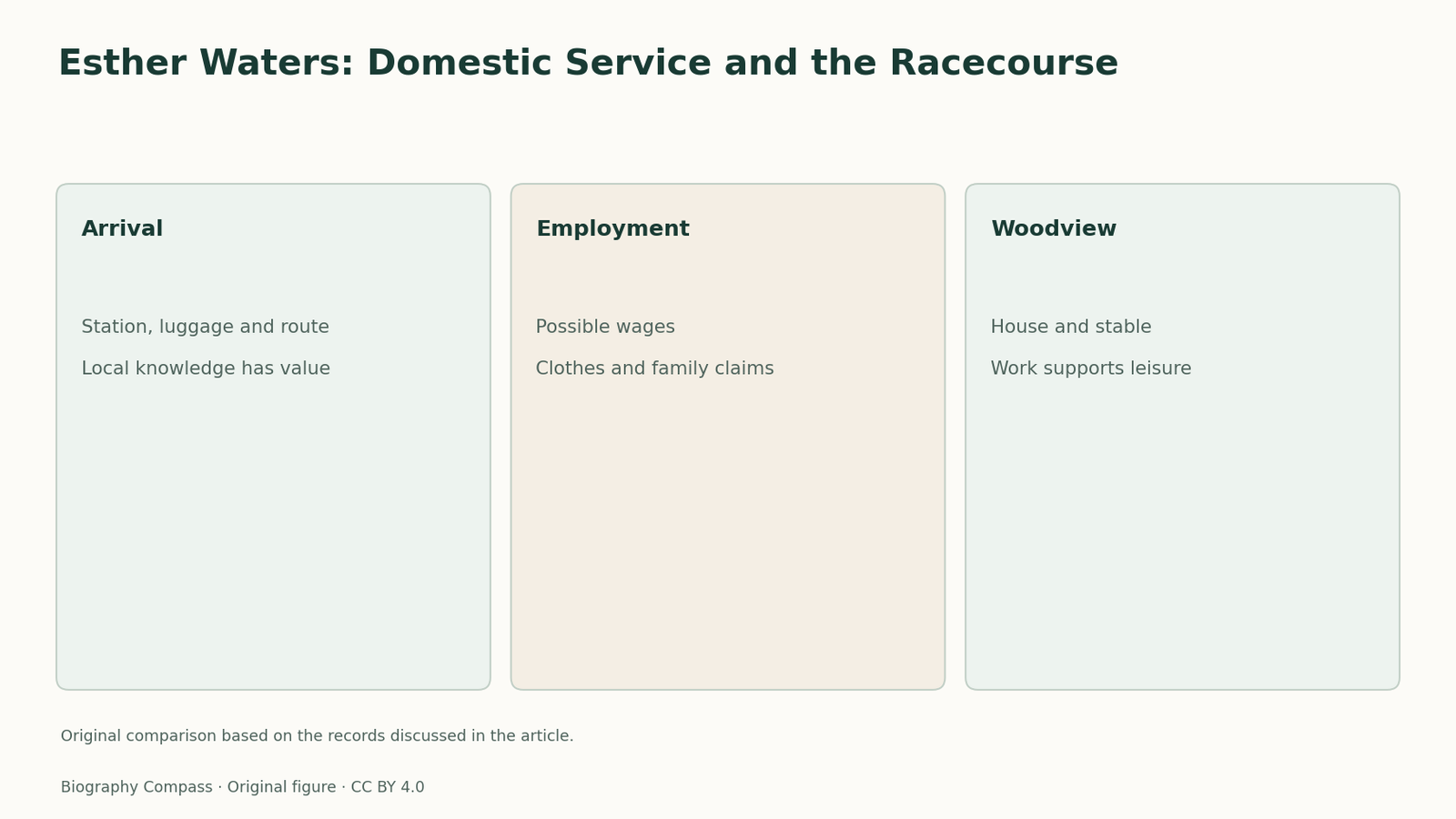
Esther Waters begins with a young woman arriving for a position at a racing household. Before she reaches her employer’s door, George Moore has already made the distance from a railway platform a measure of income, social knowledge and risk.
Evidence comparison
Three economies in the opening
Follow the movement of goods, wages and local knowledge.
| Detail | What it makes visible |
|---|---|
| Station and bundle | Travel requires directions and labour. |
| Projected wages | Family demands can claim money before it arrives. |
| Racing household | Leisure depends on organised work. |
Identify the edition before the close reading
Esther Waters first appeared in 1894, while the consulted Project Gutenberg text presents an 1899 date on its title page. The dates answer separate questions. One locates the novel’s first publication. The other identifies the text in which the following passages were inspected. An edition statement is especially useful when discussing a nineteenth-century novel whose public life extended across several printings. It permits a later reader to check a passage in the same version without requiring an argument about every revision the author may have made.
A railway platform establishes a point of view
The first chapter follows Esther as the train recedes. She has a box and a heavy bundle and needs to find Woodview. A porter’s directions turn the next stage of the journey into a practical sequence of gates, roads and buildings. The setting is much more than a picturesque background. Esther does not yet possess the local knowledge that makes these directions obvious. Her journey shows how the power to move through a place depends on small exchanges with people who are already part of it. The reader learns the route under conditions similar to hers.
Sources for this section: [2]
Money enters before the wage arrives
As Esther imagines the other servants, she imagines their clothes and the expense of joining their world. She weighs a wage that is still in the future against family demands and the chance that she might lose the position. This is a precise way for fiction to represent uncertainty. An account book can list earnings received. The opening can show a worker spending and withholding those earnings in her head before they exist. A reader therefore sees the cost of a mistake, even though the appointment has barely begun. The hypothetical arithmetic makes the page’s emotional stakes specific.
Reconstruct the choices at the start
Try making a three-line decision record for Esther before she sees Woodview. Record what she carries, what she expects to earn, and what she still needs to learn about the position. Each line has a different degree of certainty. The luggage is present, the wage is anticipated and the workplace still has to be understood. That mixture makes the opening a useful reading of employment from a worker’s side.
Biography context
Explore Ireland through connected lives
Connected biographies
People connected to the work
1852–1933
George Moore
Novelist, critic and memoiristGeorge Moore moved between Irish, British and French literary circles. His writing gave sustained attention to how work, money and personal circumstances shape choices.Read biography1852–1932
Lady Gregory
Playwright, folklorist, translator and theatre organiserLady Gregory was an Irish playwright, folklorist and theatre organiser whose work helped sustain the Irish literary revival. Her career included collecting, translating, writing, fundraising and the daily responsibilities of a theatrical company.Read biographyQuick answers
Common questions
- When was Esther Waters first published?
- Its first publication was in 1894. The online text used for this close reading identifies an 1899 edition.
- Why begin the novel at a railway station?
- The arrival lets a reader encounter unfamiliar routes, personal belongings and the prospect of paid work from Esther’s position.
Primary and institutional sources
How this history was checked
Dates, legal milestones and historical claims are checked against the official and institutional records below. This article was reviewed on 13 November 2026.