
The short answer
How does Scorned as Timber, Beloved of the Sky make a single tree the centre of attention?
Compare the records
What the sources allow us to say
Read the object record alongside the contextual account.
| Record | Evidence | Reading limit |
|---|---|---|
| Vancouver Art Gallery | Dates the work 1935 and situates it within forest painting. | Museum interpretation concerns an artistic vision. |
| Art Canada Institute,p 36 | Connects 1935 works with the threatened landscape. | A series context is not a site-specific ecological survey. |
The title establishes competing valuations
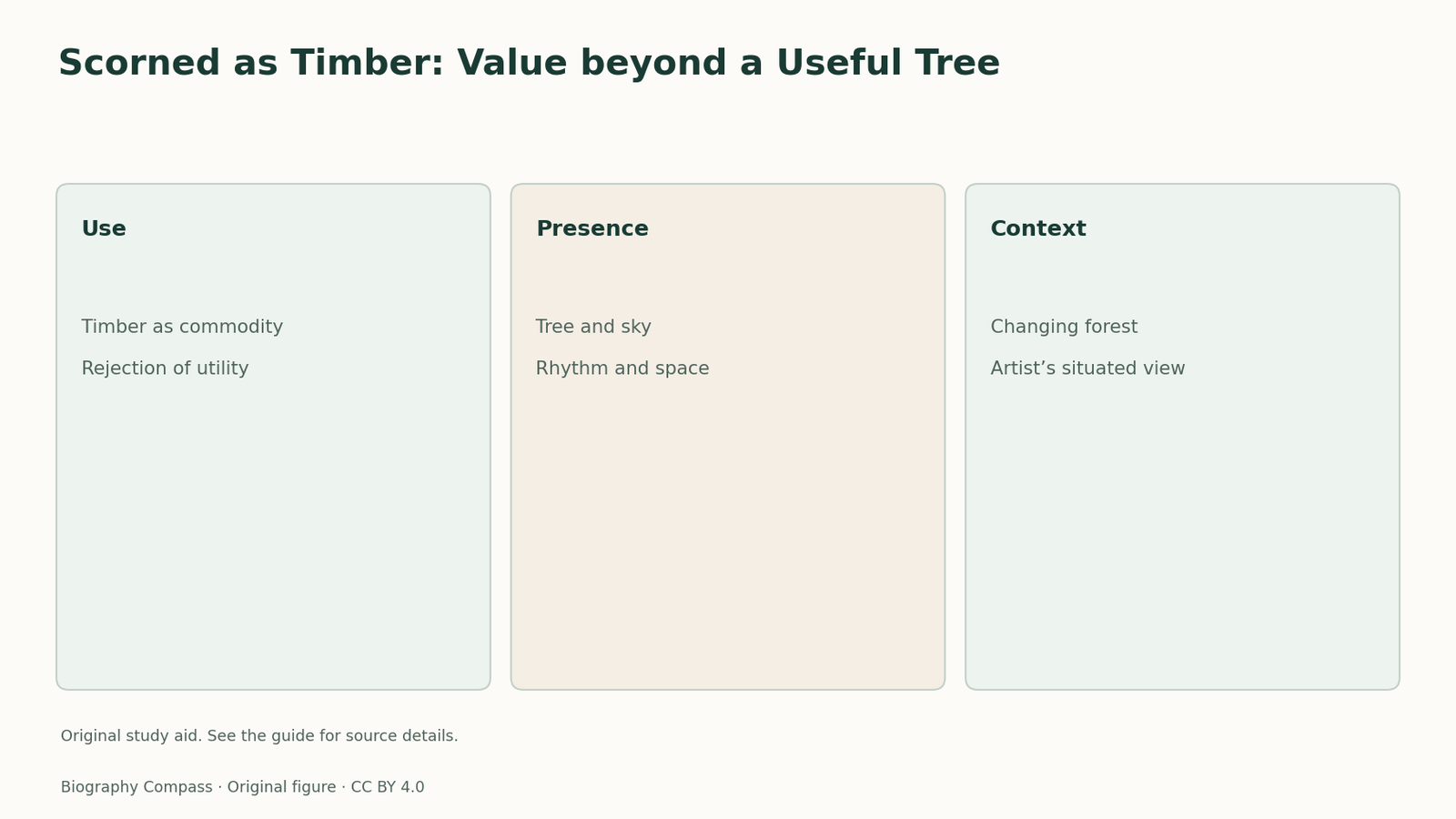
Vancouver Art Gallery dates Scorned as Timber, Beloved of the Sky to 1935 and places it among Carr’s forest paintings. The title itself sets two forms of value beside one another. A tree can be rejected as a useful commodity while remaining significant within the painting’s wider world. That contrast offers a starting question rather than a complete interpretation: what does it mean to look at a tree through something other than its potential use as material?
Sources for this section: [2]
A series supplies historical context
The Art Canada Institute places the picture beside Loggers’ Culls and later works concerned with damaged forest. This context helps connect an individual subject with Carr’s response to a landscape changed by extraction. The Vancouver exhibition instead stresses the vitality and spiritual inquiry present in her forest paintings. These emphases can coexist. One attends to a historical pressure on the landscape; the other describes the artistic vision through which Carr represented it. Neither requires treating the painting as a literal scientific report on one logging site.
Test an interpretation against the work
Make two headings, commercial use and painted presence. Under the first, place the title’s reference to timber. Under the second, describe the tree’s relation to sky, movement and surrounding space after consulting the museum image. A supported answer explains the contrast while distinguishing visible features from the larger historical reading. Add a final sentence locating the argument in Carr’s own perspective. This prevents the artist’s personal response from standing in for every inhabitant’s relationship with the forest, or from becoming evidence of an environmental outcome the painting itself cannot establish.
Continue the chronology
Related history guides
Biography context
Explore Canada through connected lives
Connected biographies
Read the artist’s biography
1871–1945
Emily Carr
Painter and writerA Canadian painter and writer whose modernist landscapes and autobiographical books emerged through an uneven, late-recognised career.Read biographyQuick answers
Common questions
- Is the painting an exact report of a logging site?
- The institutional accounts present an artistic response to forest and extraction; they do not establish a complete ecological record of a particular site.
Primary and institutional sources
How this history was checked
The listed records support the facts. Observation exercises and arguments are Biography Compass editorial interpretations. This article was reviewed on 7 November 2026.