
The short answer
How does Fox organise figures, shared light and the temporary social space of a ferry?
Read the evidence
Sources, interpretation and production roles
The records answer different questions about this work. The final exercise is an original teaching model.
| Record or question | Supported reading | Boundary or contrast |
|---|---|---|
| Outdoor studies | Rapid Trouville observations supplied material. | They are not identical to the finished canvas. |
| Studio construction | Paris completion followed in winter. | Studio work does not erase outdoor observation. |
| Public history | European display preceded Sydney in 1913. | Exhibition dates are not production dates. |
The painting did not emerge in one uninterrupted session
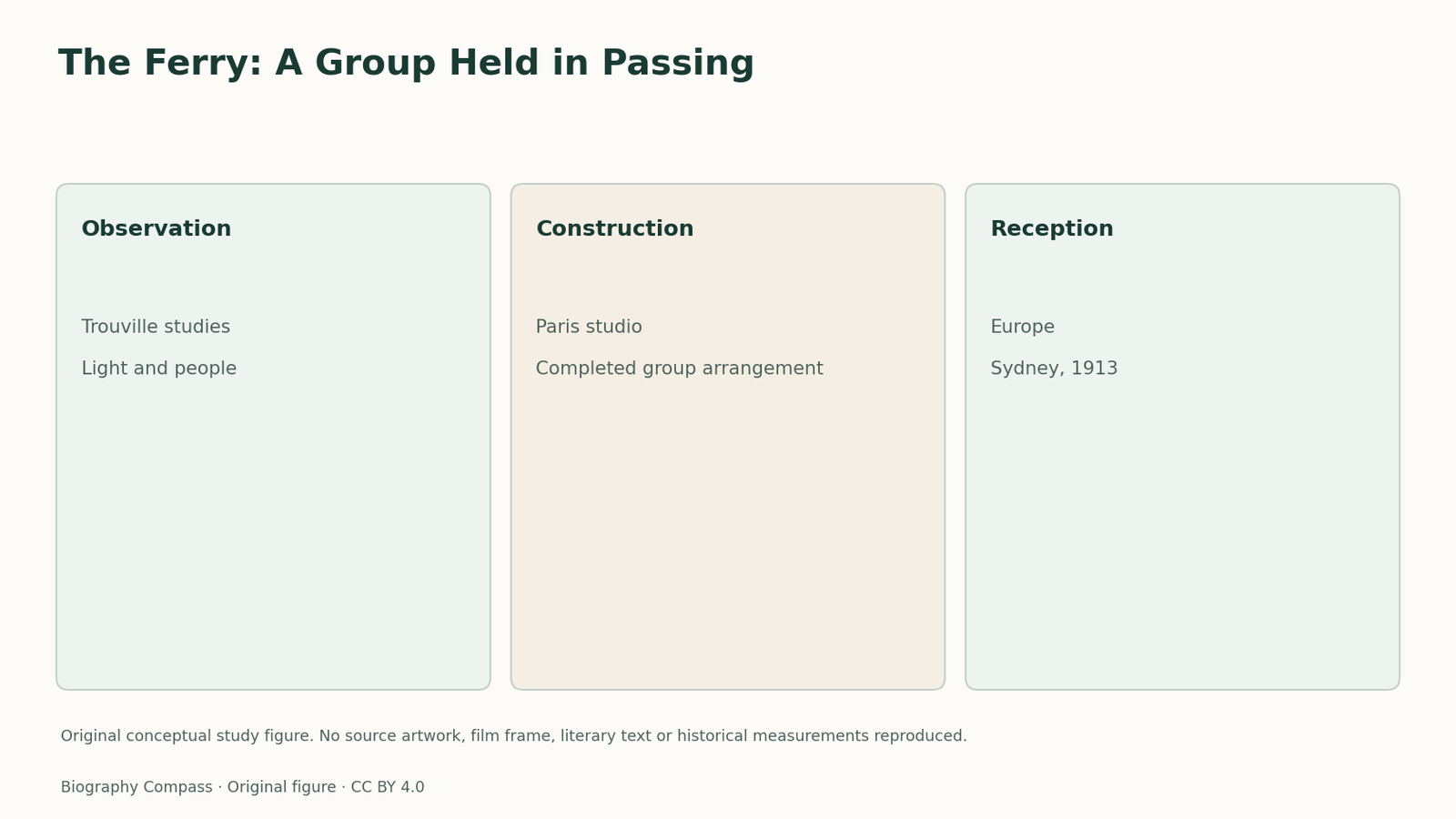
The Ferry is dated about 1910–11 in the Art Gallery of New South Wales account. The museum describes rapid outdoor studies at Trouville followed by completion in Fox’s Paris studio during the next winter. That is a specific production history. It connects observation with later construction instead of requiring a choice between them. The approximate date is retained, and the finished canvas is distinguished from the studies that helped make it possible.
Sources for this section: [3]
An elevated view organises a group
The institutional description identifies a downward-looking viewpoint over the ferry’s passengers. In this guide’s reading, that choice allows people, clothes and the boat’s space to become relations within a single pictorial field. The viewer encounters a group through an arranged vantage point rather than through a sequence of individual portraits. Observed sunlight can remain important even when the composition is developed elsewhere. A winter studio is a working condition, not proof that the painted experience lacks a basis in outdoor study.
Sources for this section: [3]
Production and reception involve different journeys
The work was exhibited in Paris and London before appearing in Sydney in 1913. Its route to viewers is different from the artist’s movement between the beach resort and his studio. One journey concerns making; the other concerns public reception. The later museum history adds another stage. Fox’s teaching and European training supply context for his methods, while Carrick’s separate work helps explain a shared professional environment. Neither context justifies claiming that a partner painted a passage or that a later audience saw the preliminary studies beside the canvas. The elevated viewpoint also changes how a viewer encounters the people as a group: spacing can become legible before any individual biography is known.
Original exercise: observation can remain active in a studio
Invent a view of a small tram platform seen from a staircase. Make a written field note about one changing light effect and another note about how people occupy the platform. Then propose a studio picture in which you alter their spacing while retaining the observed light relationship. A reference answer explains that a later compositional decision need not cancel the original observation. It changes what the observation is used to make. Now prepare two timelines, one from field note to studio work and another from first exhibition to later collection. State which question each answers. Return to The Ferry by naming Trouville, Paris and the 1913 Sydney exhibition in their appropriate roles. The exercise copies no passenger arrangement, boat form or source image. It gives a concrete way to discuss the connection between outdoor study and a carefully organised canvas, while preventing a lively surface from becoming unsupported proof of a one-session method. It also keeps production circumstances, public influence and eventual ownership from collapsing into one undifferentiated history of the picture.
Continue the chronology
Related history guides
Biography context
Explore Trouville and Paris, France through connected lives
Connected biographies
People and related creative practices
1865–1915
Emanuel Phillips Fox
Australian painter and art teacherEmanuel Phillips Fox combined European academic training, outdoor study and figure painting with teaching in Melbourne and a later Paris-based career.Read biography
1875–1963
Margaret Preston
Australian painter and printmakerMargaret Preston combined European training, Japanese print interests and Australian plant subjects while pursuing a contested vision of national art.Read biography1872–1952
Ethel Carrick
British-born painter active in France and AustraliaEthel Carrick developed a sustained practice of painting public activity across Europe, Australia, North Africa and India, continuing for decades after her husband’s death.Read biographyQuick answers
Common questions
- Was The Ferry completed entirely at Trouville?
- The museum describes outdoor studies there and later studio completion in Paris.
- Is the 1913 Sydney exhibition its creation date?
- No. The painting is dated about 1910–11.
Primary and institutional sources
How this history was checked
Sources include production records, institutional collections and the specifically identified passages discussed here. Interpretations and teaching models are distinguished from credits and publication facts. This article was reviewed on 8 November 2026.