
The short answer
The Universal Declaration of Human Rights emerged from years of drafting, debate and revision. Eleanor Roosevelt helped hold that work together, but its history belongs to a multinational group of delegates, specialists and advocates. Following the document through the United Nations explains both its achievement and the limits of what adoption meant.
How the work moved forward
Different bodies, different responsibilities
Following the draft through institutions keeps Roosevelt's leadership in view while showing where other delegates revised and adopted the text.
| Stage | Main responsibility | Contribution to the final document |
|---|---|---|
| Commission and drafting committee, 1947–1948 | Develop and revise proposals | Secretariat outline, Cassin redraft and debate among commission members |
| General Assembly Third Committee, 1948 | Examine the submitted draft in detail | Amendments, article-by-article discussion and review of language and style |
| General Assembly plenary, December 1948 | Consider the committee report and decide adoption | Resolution 217 A (III), adopted in Paris on 10 December |
Chronology
A timeline of the turning points
Roosevelt joins the U.S. delegation
President Harry Truman appoints Eleanor Roosevelt to the United States delegation to the new United Nations.
Preparatory commission meets
The nuclear Commission on Human Rights opens its first session in New York and elects Roosevelt chair.
Permanent commission begins
Roosevelt is elected chair, Peng-chun Chang vice-chair and Charles Malik rapporteur at the first session.
Drafting committee's first session
Delegates examine a Secretariat outline and proposals; René Cassin receives responsibility for redrafting a declaration from that material.
Third Committee debates the draft
The General Assembly's Third Committee examines the text through extensive meetings and proposed amendments in Paris.
Resolution 217 A (III)
The General Assembly adopts the Universal Declaration of Human Rights in Paris.
From postwar hopes to a working commission
The Second World War made the treatment of human beings a central problem for the new United Nations. Translating that concern into a document required institutions as well as aspirations. President Harry Truman appointed Eleanor Roosevelt to the American delegation in December 1945. In April 1946 she became chair of the small preparatory, or nuclear, Commission on Human Rights.
A permanent commission followed. At its first session in January 1947, members elected Roosevelt chair, Peng-chun Chang of China vice-chair and Charles Malik of Lebanon rapporteur. They debated whether to prioritize an enforceable legal instrument or a statement establishing shared standards. That unresolved question helps explain why the Declaration developed alongside separate work on a covenant and implementation.
Several kinds of authorship
Roosevelt's importance lay in chairing discussions, building agreement and advocating adoption. The text also depended on technical and intellectual work by others. Canadian John Humphrey, director of the UN Division of Human Rights, prepared the Secretariat's preliminary outline. At the drafting committee's first session in June 1947, a temporary group considered how to organize that material, and René Cassin of France was assigned to redraft a declaration.
Chang and Malik helped shape deliberations from their respective roles, while the expanded committee included representatives of Australia, Chile, France, China, Lebanon, the United Kingdom, the United States and the Soviet Union. These overlapping responsibilities make a single-author account misleading: compiling precedents, arranging articles, debating principles and negotiating agreement were different contributions.
Making universality include women
The language of universality needed scrutiny, including from delegates beyond the best-known drafting group. Hansa Mehta of India is widely credited with securing wording in Article 1 that referred to all human beings rather than all men. Her intervention made women's inclusion explicit in the opening statement of equality and dignity.
Crediting Mehta changes how the episode is understood. Roosevelt's leadership did not replace other participants' agency, and agreement across countries did not mean that every formulation was already inclusive. The drafting process allowed delegates to challenge inherited language. The final opening article was therefore the product of debate about who could be recognized within apparently universal words.
What the thirty articles brought together
The final Declaration linked civil and political freedoms with economic, social and cultural rights. Its protections concern life and personal security, equality before law, religion, expression and participation in government. Alongside those provisions stand rights concerning work, education, social security and an adequate standard of living. Reading only one category misses the document's breadth.
Its structure also connects individual freedoms with social conditions. Articles on work address fair conditions and equal pay; the education article concerns both access and the purposes of learning. The concluding articles address the wider social order, duties to the community and the protection of the rights themselves. The result offers a shared vocabulary for describing human dignity across different institutions and national settings.
The Third Committee's detailed scrutiny
The commission's draft still required consideration by the General Assembly. Its Third Committee examined the text in Paris between 30 September and 7 December 1948. The UN's drafting-history guide records eighty-one meetings devoted to the draft and 168 formal proposals containing amendments. This was a substantial stage of revision, not simply a ceremony approving a text already settled elsewhere.
A subcommittee reviewed language and style for consistency. The surviving amendment lists and meeting records show how many delegations participated in that scrutiny. They also provide a practical way to check claims about a particular dispute: a proposal, speaker's statement and final wording should be distinguished. The committee's report then carried the draft forward to plenary consideration on 9 and 10 December.
Adoption and the distinction between a declaration and a treaty
On 10 December 1948, the General Assembly adopted the Universal Declaration in Paris as resolution 217 A (III). Adoption established an international statement of principles. It did not turn the text into a binding treaty or supply a complete enforcement system. The distinction was part of the original institutional work, rather than an explanation added after the event.
Roosevelt believed a clear declaration could still exert moral and political influence. Its importance therefore lies partly in creating standards that people could invoke when assessing governments and institutions. The achievement should be measured alongside its limits: agreement on principles did not end abuses or settle how every right would be implemented. Roosevelt's contribution was helping a diverse group reach that shared starting point.
Biography context
Explore United States through connected lives
Eleanor Roosevelt's wider career
Follow the organizing, journalism and public service that preceded her work at the United Nations.
Explore the biographiesCompare approaches to equalityThurgood Marshall and civil rights litigation
Explore a different institutional route: building legal challenges to segregation in American courts.
Explore the biographiesConnected biographies
Explore public lives connected with equality and rights

1884–1962
Eleanor Roosevelt
First lady, reformer and United Nations human rights leaderA reformer who made the first lady a public advocate and helped diplomats from different countries agree on an international statement of human rights.Read biography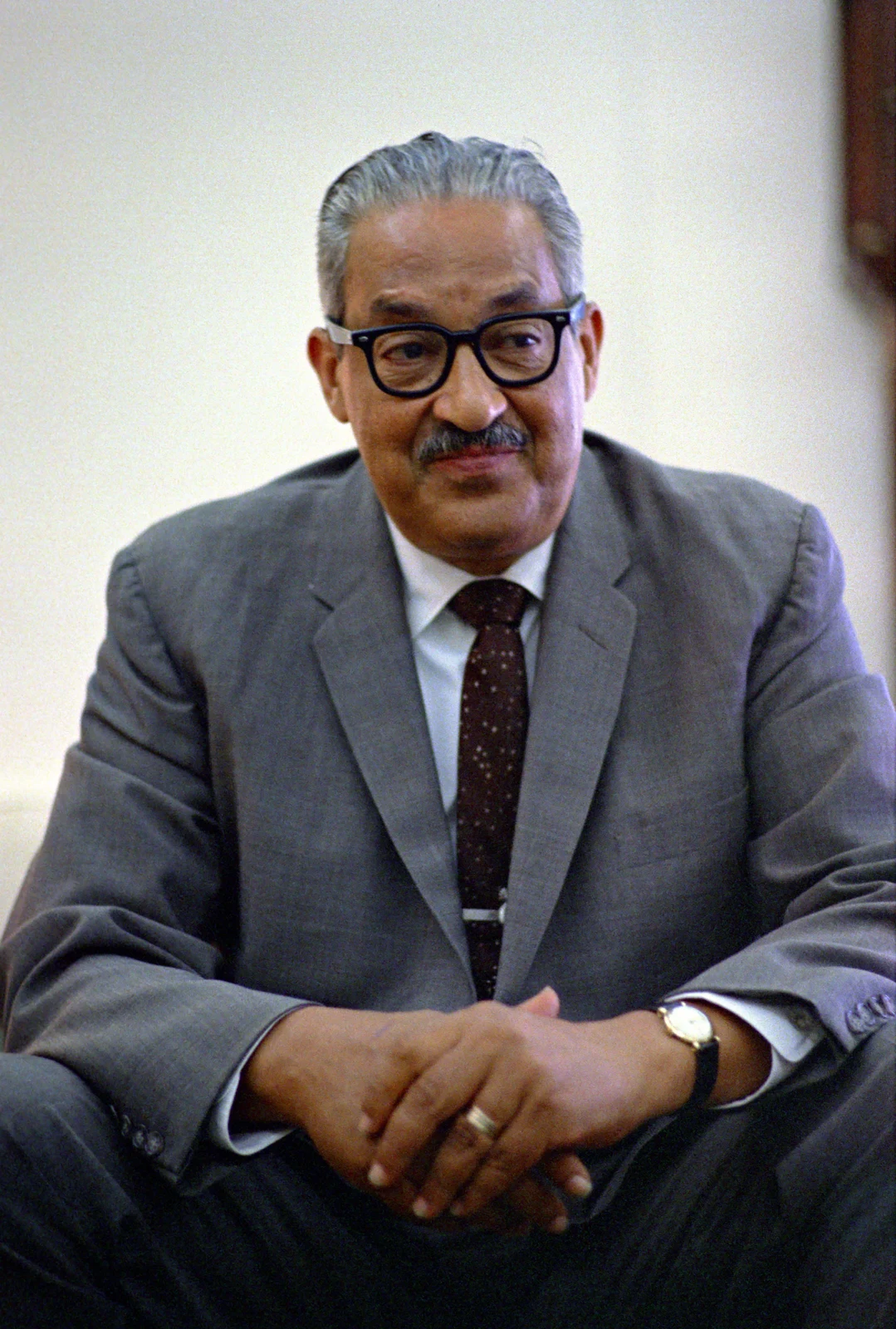
1908–1993
Thurgood Marshall
Civil rights lawyer, solicitor general and Supreme Court justiceA civil rights advocate who helped build a sustained legal campaign against segregation before serving as solicitor general and the first Black Supreme Court justice.Read biographyQuick answers
Common questions
- When and where was the Universal Declaration adopted?
- The UN General Assembly adopted it in Paris on 10 December 1948 as resolution 217 A (III). It contains thirty articles.
- Was Eleanor Roosevelt the sole author?
- No. She chaired the Commission on Human Rights and its drafting committee. Humphrey prepared a preliminary outline, Cassin redrafted a declaration, and Chang, Malik, Mehta and many other delegates contributed to the process.
- Why is Hansa Mehta part of this history?
- Mehta, representing India, is widely credited with pressing for wording in Article 1 that explicitly included all human beings, making women's inclusion clearer than the earlier reference to all men.
- Did adoption make the Declaration a binding treaty?
- No. The Declaration established common principles and standards. The original UN process also considered a separate covenant and implementation, reflecting the distinction between declaring rights and creating binding treaty obligations.
Primary and institutional sources
How this history was checked
The UN's drafting guides identify the records behind each institutional stage. Sources also distinguish Roosevelt's leadership from the contributions of other drafters. The contextual photograph is dated 1946, not the 1948 adoption. This article was reviewed on 21 October 2026.
- United Nations Dag Hammarskjöld LibraryCommission on Human Rights — First Session, 1947
- United Nations Dag Hammarskjöld LibraryDrafting Committee — First Session, 1947
- United NationsDrafters of the Declaration
- United Nations in IndiaSecretary-General's remarks to the Human Rights Council, 27 February 2023 — Hansa Mehta's contribution
- United NationsUniversal Declaration of Human Rights — text
- UN Human Rights Representation Office to the European UnionUniversal Declaration of Human Rights — original records and overview
- United Nations Dag Hammarskjöld LibraryGeneral Assembly Third Session — Third Committee
- United Nations Dag Hammarskjöld LibraryGeneral Assembly Third Session — Plenary
- United Nations Dag Hammarskjöld LibraryConventions and Selected Declarations Adopted by General Assembly Resolutions
- National Park ServiceEleanor Roosevelt and the Universal Declaration of Human Rights
- Franklin D. Roosevelt Presidential Library and MuseumEleanor Roosevelt and the Universal Declaration of Human Rights
- Harry S. Truman Library and MuseumEleanor Roosevelt and Julius Krug — photograph 73-2198