
The short answer
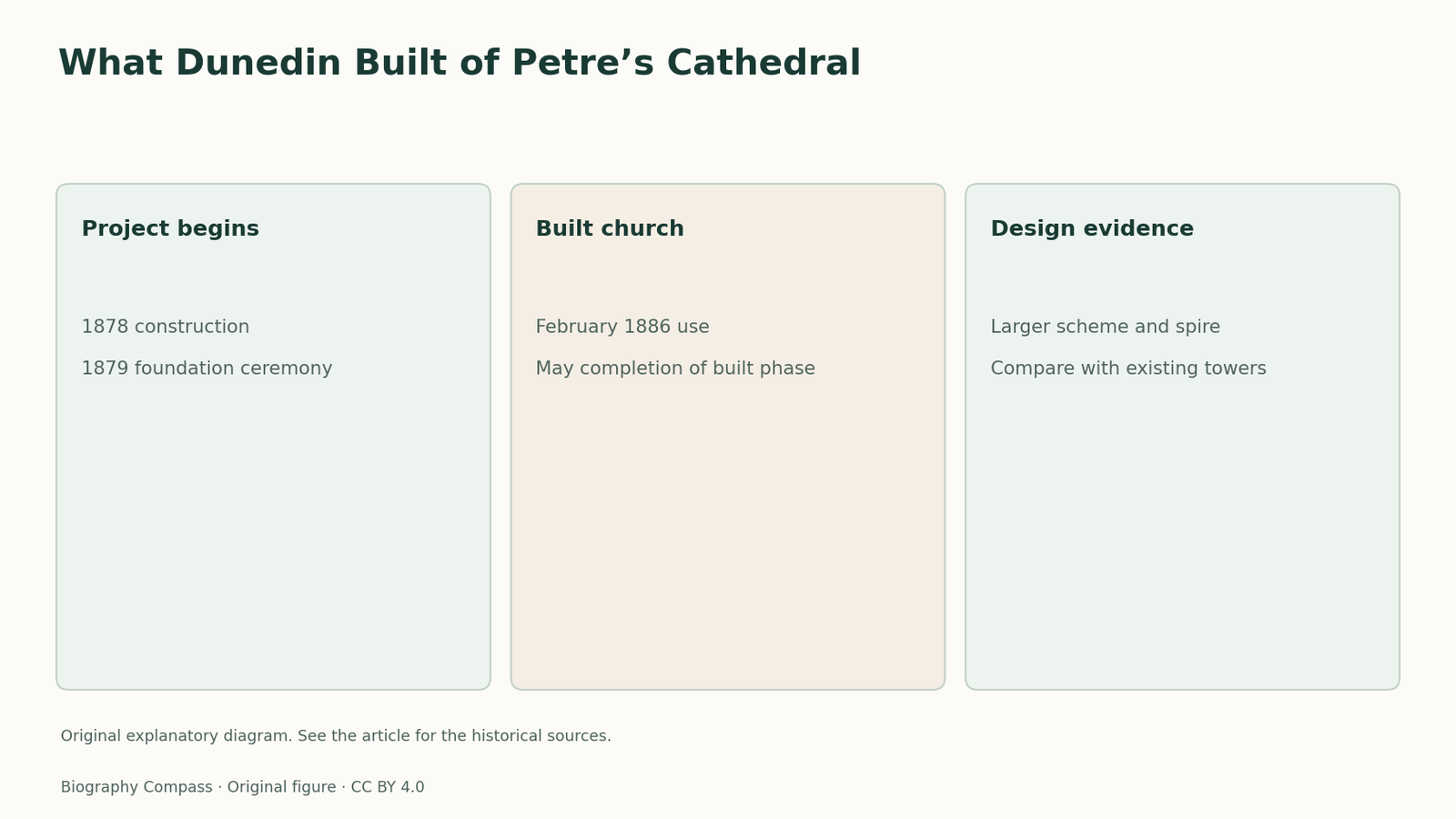
Dunedin’s St Joseph’s Cathedral opened and served its congregation even though the larger design was never fully executed. The original proposal and the built church have different kinds of records.
Compare the evidence
Decisions and their effects
The records describe different stages of the work.
| Country | Documented decision | What it explains |
|---|---|---|
| 1878–1879 | Construction begins and foundation stone is laid | Records identify Bishop Moran and Petre |
| 1886 opening | Congregation uses the church before built phase completion | Opening and completion refer to different moments |
| Larger proposal | A spire was intended over the transept | Read proposed features against surviving fabric |
The commission and foundation stone identify separate events
The cathedral dates construction to 1878 during the episcopacy of Patrick Moran. The New Zealand Tablet reported the laying of the foundation stone in January 1879 and identified Francis William Petre as architect. A foundation ceremony marks public recognition of a project, and its report can record names and language used at the time. It does not substitute for the construction chronology. The two records together identify the patron, architect and project and distinguish the start of work from a formal event held after construction had begun.
The proposed cathedral was larger than the building put to use
The cathedral’s account describes an intended building extending beyond the surviving work, with a tall spire above the transept. The full proposal is important evidence of Petre’s architectural plan. The heritage list describes the building that remains. Read the two together to distinguish features visible at the site from those shown or described in the original design. The spire proposal can explain why the design has a different silhouette from the existing cathedral. The available records should be used to identify that difference before trying to attribute specific causes to each omission.
Public use began before the built phase was complete
The cathedral dates the first church service to February 1886 and completion of the built work to May 1886. The New Zealand Tablet’s February coverage records the church’s opening and a dedication sermon. Those dates refer to occupation, ceremonial recognition and a construction milestone. The larger proposal remained incomplete. Consequently, an account that dates the cathedral to 1886 can be correct about its first use and the delivered phase. A reader interested in the original design still needs to specify which parts were completed and which belonged to an unrealised extension.
A tower preserves material from an earlier church
Heritage New Zealand identifies a stair in the southern tower leading to the choir and organ loft. It also records that the tower holds a bell from Dunedin’s earlier Roman Catholic church. The staircase describes circulation in the new building. The bell is a carried-over object linking two places of worship. Such a feature can be studied at more than one historical scale. The new tower has its own construction and use, while the object it accommodates preserves a connection with the institution before Petre’s design was built.
Sources for this section: [3]
A cost belongs to an identified construction phase
The cathedral reports £22,500 for the work completed in 1886. That figure is best attached to the built campaign described in its account. It can be compared with the opening date and heritage description to discuss the delivered part of the project. It cannot alone give the cost of the larger scheme, which would require estimates or contracts for elements that did not proceed. This distinction keeps a useful figure tied to the evidence and gives the architect’s unrealised design and the congregation’s functioning building their own historical identities.
Biography context
Explore Dunedin, New Zealand through connected lives
Connected biographies
People behind the work
1847–1918
Francis Petre
Engineer and architectFrancis William Petre trained as an engineer and returned to New Zealand to work on railways. His private practice designed churches and other major buildings.Read biographyQuick answers
Common questions
- When was the first service held?
- The cathedral dates its first service to February 1886.
- Which prominent feature was planned for the larger cathedral?
- A tall spire was proposed above the transept.
Primary and institutional sources
How this history was checked
Dates, legal milestones and historical claims are checked against the official and institutional records below. This article was reviewed on 13 November 2026.
- Dictionary of New Zealand Biography, Te AraFrancis William Petre
- St Joseph’s Cathedral, DunedinAbout St Joseph’s Cathedral
- Heritage New Zealand Pouhere TaongaCathedral Church of St Joseph (Catholic)
- New Zealand Tablet, via National Library Papers PastLaying the Foundation Stone of the Dunedin Cathedral
- New Zealand Tablet, via National Library Papers PastThe Visit of His Eminence the Cardinal Archbishop