
The short answer
How did Draft Article 306 A separate its proposed framework from the conditions for applying other constitutional provisions?
Compare the documents
Authority, evidence and limits
These records describe different responsibilities; one should not silently substitute for another.
| Record | What it establishes | What it does not establish |
|---|---|---|
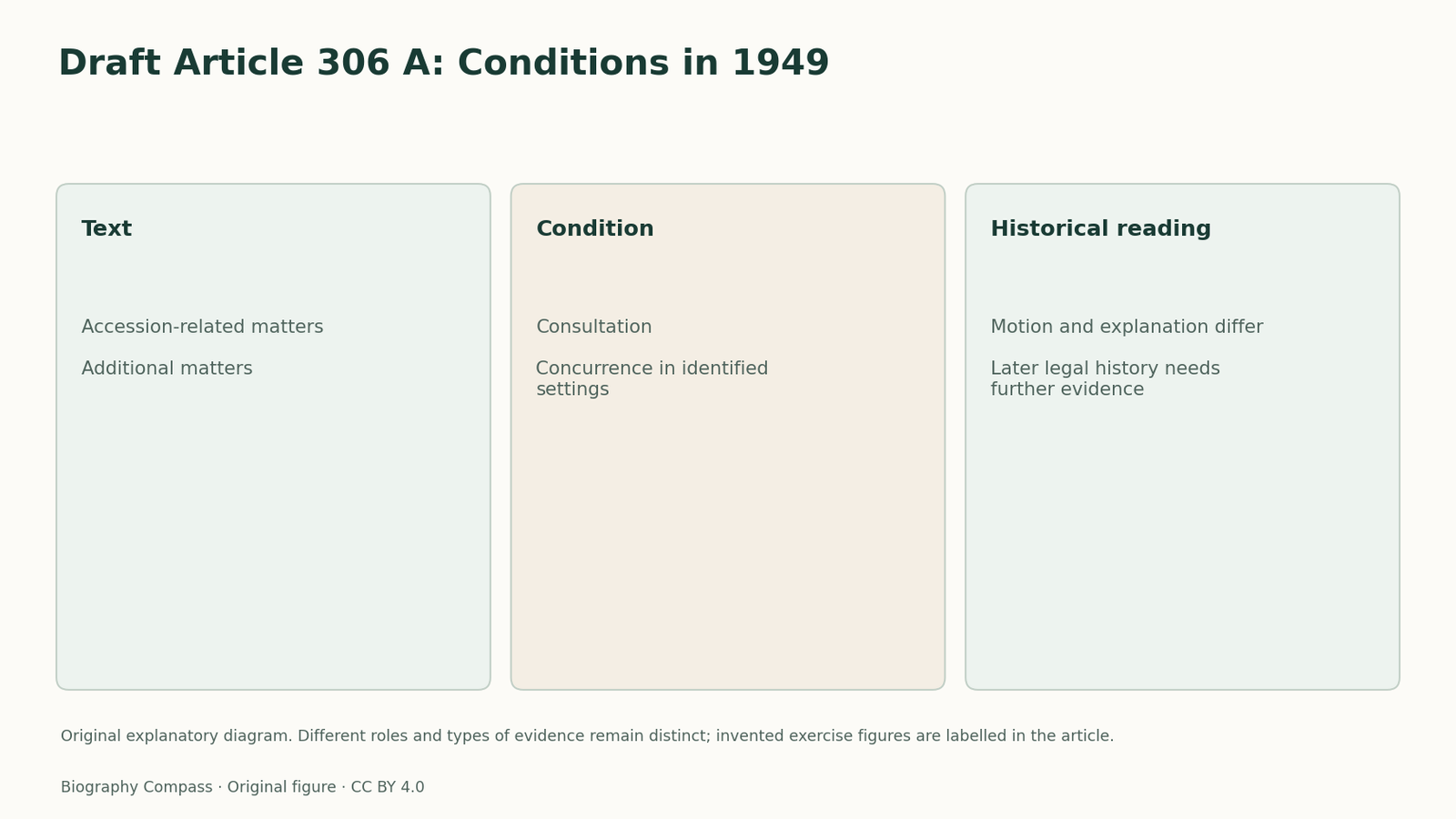
| Assembly motion, 17 October 1949 | Sets out different categories and conditions. | Consultation and concurrence should not be silently merged. |
| Ayyangar’s explanation | Explains the historical rationale and projected Assembly role. | One speech is not every member’s intention or every later outcome. |
| Supreme Court 2023 historical reproduction | Preserves and discusses identified earlier passages. | A selected historical passage is not a full present-law analysis. |
Read the proposal as a document from its own moment
Ayyangar introduced Draft Article 306 A on 17 October 1949. The Assembly record identifies both the motion’s wording and his explanation of why a special arrangement was being proposed for Jammu and Kashmir. The later number 370 should help readers locate the history without turning a 1949 reading into a summary of every subsequent constitutional change. The inspected 2023 Supreme Court passage reproduces historical material, but this guide does not attempt to analyse that entire judgment. Its question is narrower: which different conditions did the 1949 proposal attach to different kinds of constitutional application?
Consultation and concurrence were not interchangeable words
The motion distinguished matters corresponding to the Instrument of Accession from additional matters. It used consultation with the State Government in one setting and concurrence in another. A reader who paraphrases both as agreement may erase a deliberate difference in the proposed procedure. The wording also distinguished parliamentary lawmaking subjects from the application of other constitutional provisions. This does not require guessing the result of a later case. It requires following the categories and conditions written into the proposal before drawing a conclusion. The article’s structure is evidence that institutional relationships were being specified in more than one way.
The explanation supplied a rationale, not every later answer
Ayyangar’s speech discussed conditions in the State and the anticipated work of a State Constituent Assembly. It explained the relationship between a provisional arrangement and later decisions, but a speaker’s explanation is not identical to the operative words of each clause. Nor should one participant’s speech automatically be treated as every member’s private intention. Comparing motion and explanation preserves their different functions: the motion puts a text before the Assembly; the speech argues for understanding and adopting it. The modern judgment’s reproduction is a later source for that historical record, not an independent contemporary vote or a reason to collapse 1949 into the present.
Clause-map exercise and reference answer
Draw an original three-row chart headed accession-related matters, additional matters and the State Constituent Assembly’s role. Enter the corresponding condition or decision-maker from the motion and keep a separate margin for Ayyangar’s explanation. Now assess this invented summary: every constitutional application needed exactly the same procedure. A supported answer rejects it because the text differentiates categories and conditions. It also refuses to decide a contemporary constitutional dispute from the chart alone. The exercise’s result is a faithful map of the 1949 proposal, not a substitute for the complete later legal history. A strong response states which words belong to the proposed clause, which ideas belong to the speech, and which later questions the bounded sources do not answer.
Continue the chronology
Related history guides
Biography context
Explore India through connected lives
Connected biographies
People behind the collaboration
1882–1953
N. Gopalaswami Ayyangar
Administrator, constitutional drafter and cabinet ministerN. Gopalaswami Ayyangar brought civil-service and Kashmir administrative experience to India’s cabinet and Constituent Assembly, including the 1949 Draft Article 306 A proposal.Read biography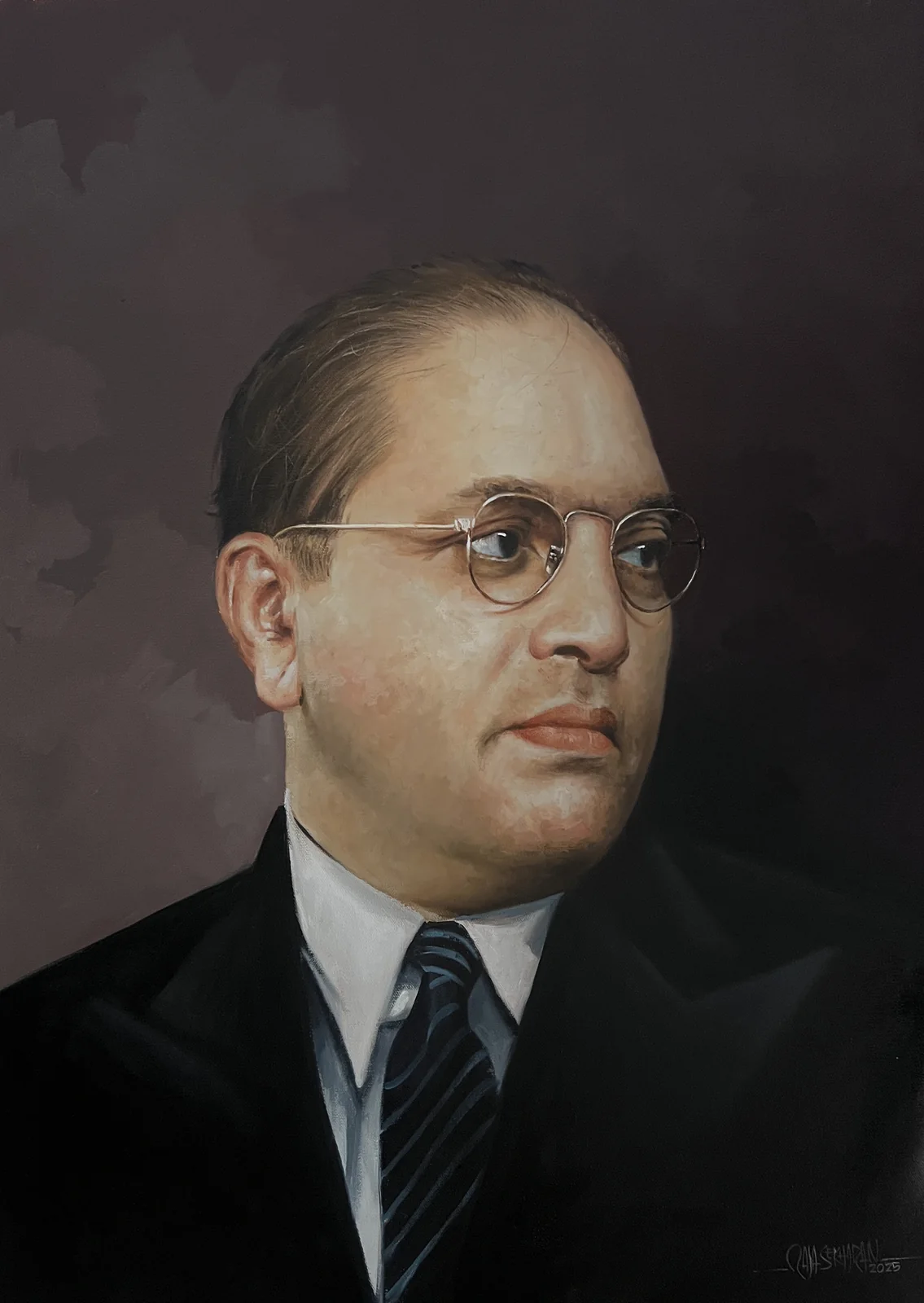
1891–1956
B. R. Ambedkar
Anti-caste leader, economist, jurist and law ministerBhimrao Ramji Ambedkar combined scholarship, anti-caste organising and constitutional politics. India’s first law minister and chair of its Drafting Committee, he argued that political democracy could not endure without social and economic equality.Read biography1883–1953
Alladi Krishnaswamy Ayyar
Jurist and constitutional drafting colleagueAlladi Krishnaswamy Ayyar brought an extensive legal career to India’s Drafting Committee and explained how different judicial powers fitted the new constitutional structure.Read biographyQuick answers
Common questions
- Does this guide explain the full current legal status of Article 370?
- No. It examines the 17 October 1949 proposal and its conditions. The later judgment is used only for identified historical passages, not as a complete current-law account.
Primary and institutional sources
How this history was checked
The bibliography distinguishes contemporary records, retrospective participant accounts and later institutional research. Access limits and uncertain attributions are identified in the article; the exercise is an original teaching example. This article was reviewed on 7 November 2026.
- Prime Ministers Museum and LibraryN. Gopalaswami Ayyangar: Bio-data
- Parliament of IndiaConstituent Assembly Debates, 17 October 1949
- Constitution of India / Centre for Law and Policy Research17 October 1949 debates, transcription
- Supreme Court of IndiaIn Re Article 370,11 December 2023, Part E historical passages