
The short answer
A factory name and an artist’s mark answer different questions. Reading them together makes the organisation of decorative production visible without assigning every creative act to the business owner.
The records answer different questions
Keep the measures separate
The question changes when the object, unit or reporting period changes.
| Record or measure | What it establishes | What it does not establish |
|---|---|---|
| Factory mark | Manufacturing identity | The owner’s personal decoration |
| Artist’s mark | A contribution tied to an object | The same team on every object |
| Qualified attribution | The catalogue’s stated confidence | A licence to remove uncertainty |
Chronology
A timeline of the turning points
First object
Probable assistance retained.
Second object
A wider named collaboration.
One material supported different markets
The V&A connects decorative stoneware with the strength and waterproof qualities of the firm’s utilitarian wares.
The connection is technical and commercial: a manufacturing capability could support a more elaborately decorated product. It does not make the employer the person who drew every scene. The maker, designer, decorator and assistant fields must be read as roles rather than interchangeable synonyms.
Two object records retain different detail
Vase 352-1874 names Hannah Barlow’s decoration and probable assistance by Miss Middlemiss; its inscription record also qualifies the latter identification.
The National Trust’s 1883 vase identifies Barlow, Lucy Anna Barlow, Mary Aitken and Jenny F. Weekes through roles and marks.
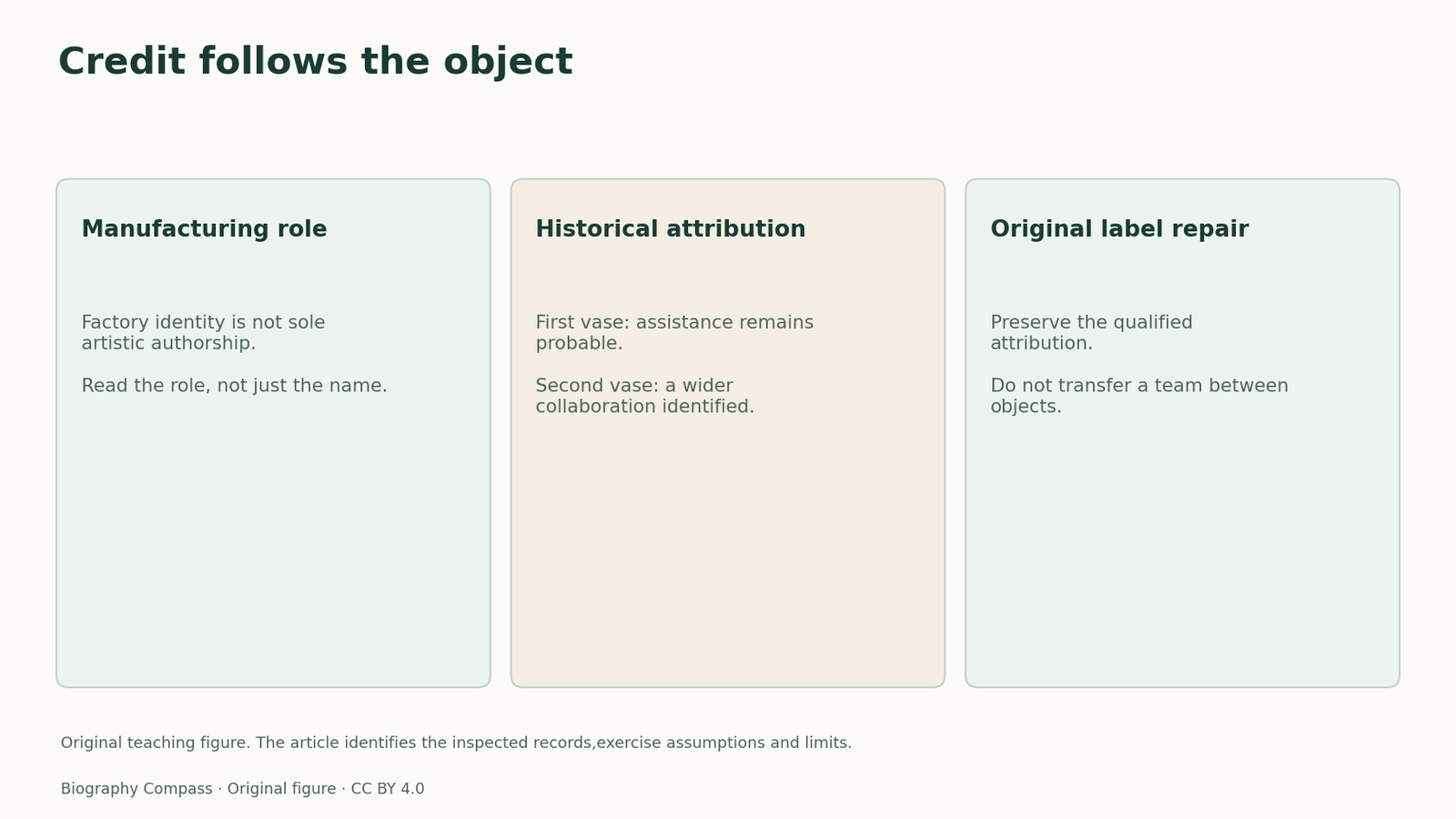
The richer list for one object cannot simply be transferred to the other. Nor should “probably” be removed to make a cleaner-looking attribution. Uncertainty is part of the catalogue’s claim, not an optional decoration.
On the second vase, the catalogue distinguishes an impressed factory mark and date from incised artist and assistant marks. It also leaves the meaning of other numbers unknown. The record thus differentiates types of mark without claiming that every inscription has been decoded.
An original credit-writing exercise
A fictional label says: “The factory owner personally decorated both vases; all assistants are known.” Repair it in two sentences. Keep the manufacturer distinct from artistic work and preserve the difference between a probable assistant and the documented collaboration on the second object. Do not copy a museum paragraph or invent new marks.
Reference answer: “The factory manufactured the objects, while the records attribute their decoration to named artists. One record retains probable assistance; the other identifies a wider collaboration, so its names should not be silently applied to the first.” The repair changes the structure of credit, rather than merely adding an artist’s name after an unchanged sole-authorship claim.
What this reveals about the business
A maker’s commercial identity could make a product recognisable while individual marks preserved contributions inside the firm. The records therefore show an industrial organisation capable of supporting differentiated artistic work. They do not supply a complete payroll, prove that every unmarked object had the same team, or make every decorative design an invention of the proprietor. The bounded comparison is more informative than a single “great manufacturer” attribution.
Continue the chronology
Related history guides
Biography context
Explore United Kingdom through connected lives
Connected biographies
The connected careers
Quick answers
Common questions
- Can the second object’s team be assigned to the first?
- No. Keep names and confidence attached to the particular object record that supports them.
Primary and institutional sources
How this history was checked
Read these dated records together; the original task states its own assumptions and separates them from reported facts. This article was reviewed on 31 October 2026.