
The short answer
How do separate colour impressions and rhythmic shapes build a print rather than a one-step picture?
Read the evidence
Sources, interpretation and production roles
The records answer different questions about this work. The final exercise is an original teaching model.
| Record or question | Supported reading | Boundary or contrast |
|---|---|---|
| AGSA object record | Music is a colour linocut dated 1927–28. | London or Paris remains a qualified production location. |
| Flight teaching account | Colour relationships could replace a dominant key block. | The general method is not a surviving block inventory for this impression. |
| Original shape exercise | Repetition and altered spacing can produce a readable rhythm. | The exercise is newly devised and does not copy Black’s composition. |
What the object record establishes
AGSA catalogues Music as a colour linocut on paper made in 1927–28, with London or Paris given as the place of production. The sheet is neither signed nor dated, so the catalogue date should not be presented as a date visibly inscribed by Black. These particulars establish an object and a working period. They also locate the print close to her encounter with Claude Flight’s teaching.
Rhythm without a soundtrack
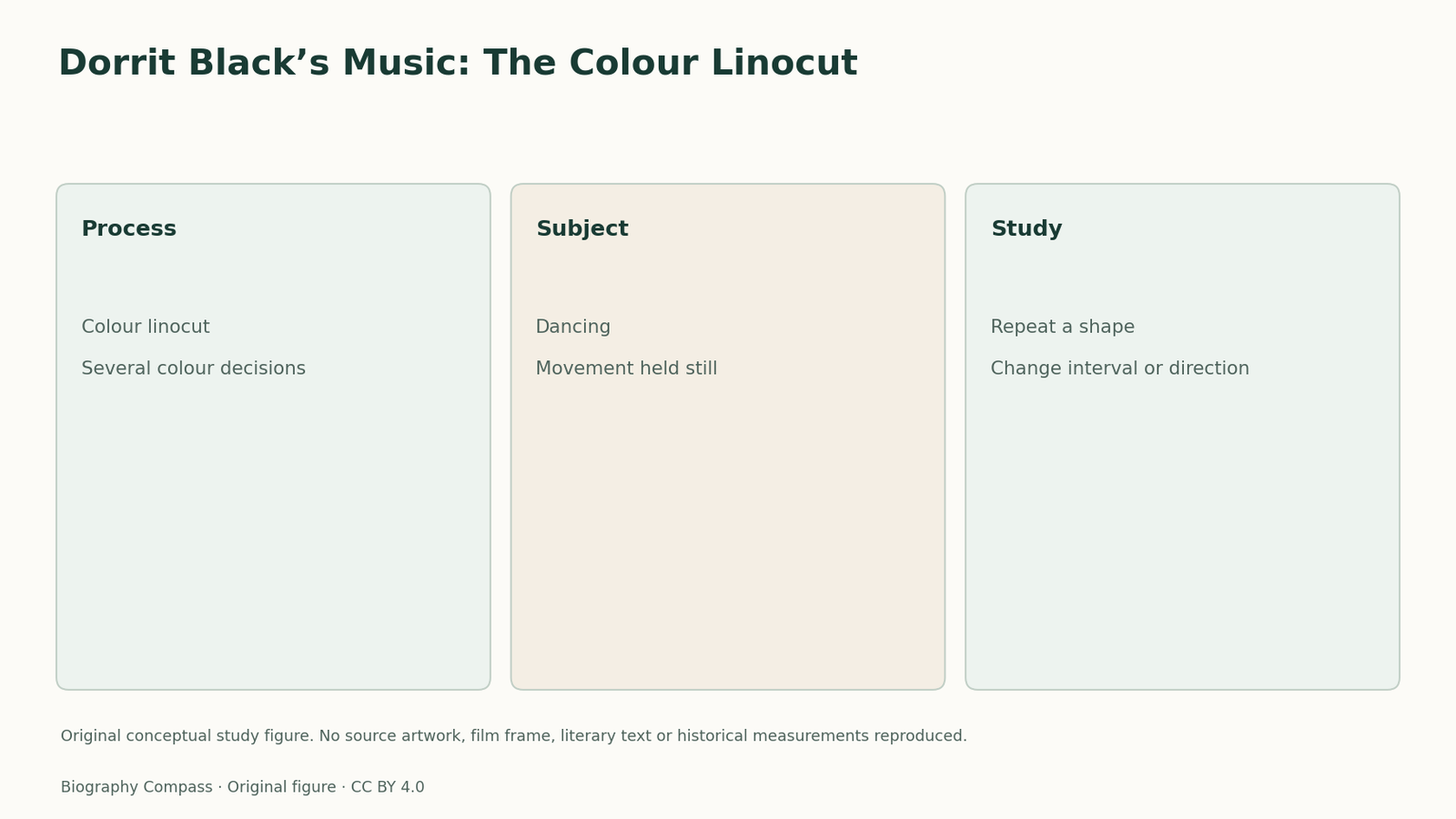
Stephen Coppel’s exhibition essay describes the dancers in Music through their energetic, agitated rhythm. This is a claim about pictorial organisation, not a recoverable recording of a particular tune. The print translates a time-based activity into a stationary arrangement. Repeated shapes can suggest recurrence; changes of direction can suggest interruption or acceleration. The viewer supplies movement through the relation between parts rather than through an actual sequence of projected frames.
Sources for this section: [5]
Colour blocks as an organising method
Flight’s teaching replaced a dominant outline block with several colour blocks of comparable importance. That general account helps explain why colour relationships mattered to his circle. It should not be turned into an unverified inventory of the exact blocks used for this particular impression. The contrast with Preston is useful: hand colouring and colour-block printing can both create vivid sheets, while distributing decisions across the process differently. The contrast between repeated order and altered intervals also gives a precise use for the word rhythm: it concerns relationships within a visible arrangement, not an unsupported claim about the tempo of a particular performance. A print’s silence does not prevent it from being organised through repeated visual events. That is the point of the comparison, rather than an attempt to translate a particular song into a measurable sequence of marks.
Original exercise: design a silent rhythm
Use three plain shapes unrelated to any artwork: a square, a short bar and a circle. Arrange four groups of them across a strip. Repeat the order in the first two groups, then alter spacing in the third and direction in the fourth. Describe which changes create an impression of continuity and which create a break. A possible answer treats repeated order as a stable pattern and closer spacing as greater visual pressure; another reading may explain a different response through the actual arrangement. Now relate the exercise to Music using only the documented dancing subject and rhythmic design. The point is to give a concrete account of how a still image may organise movement, not to assert that Black followed this invented classroom procedure. A print can address the experience of music without illustrating identifiable notes or reproducing a performance.
Continue the chronology
Related history guides
Biography context
Explore Australia through connected lives
Connected biographies
People and related creative practices
1891–1951
Dorrit Black
Australian painter, printmaker and modern-art organiserDorrit Black brought experiments from London and Paris into Australian painting, printmaking, teaching and exhibition organisation.Read biography1869–1947
Frances Hodgkins
Painter and art teacherFrances Hodgkins was a New Zealand-born painter whose long working life centred increasingly on Europe. Teaching, travel, friendships and commercial support helped sustain a career that moved from figure painting towards a distinctive modernist language.Read biography
1875–1963
Margaret Preston
Australian painter and printmakerMargaret Preston combined European training, Japanese print interests and Australian plant subjects while pursuing a contested vision of national art.Read biographyQuick answers
Common questions
- Is Music dated on the print itself?
- The AGSA record says it is unsigned and undated; 1927–28 is the collection’s assigned date.
Primary and institutional sources
How this history was checked
Sources include production records, institutional collections and the specifically identified passages discussed here. Interpretations and teaching models are distinguished from credits and publication facts. This article was reviewed on 8 November 2026.