
The short answer
How do relief and later unstretched supports change the relation between painting and object?
Read the evidence
Sources, interpretation and production roles
The records answer different questions about this work. The final exercise is an original teaching model.
| Record or question | Supported reading | Boundary or contrast |
|---|---|---|
| 1972 object | Wood, plastic and enamel | Not the separate Fletcher relief |
| Relief | Actual projection | Different from painted perspective |
| Later canvas | Sewn and flexible structures | Continuity through changed materials |
An identified construction, not a generic abstract image
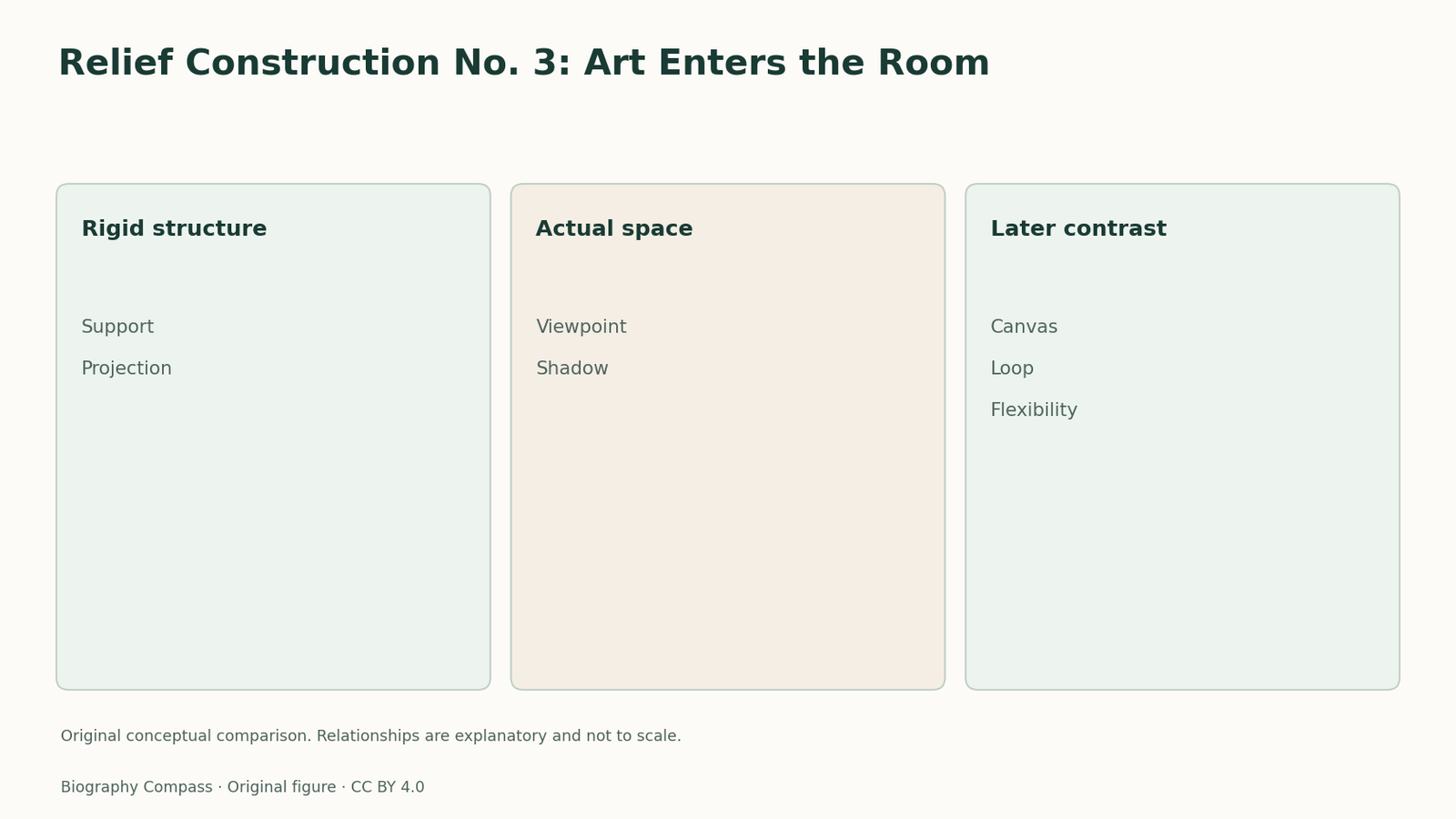
Christchurch Art Gallery’s exhibition record identifies Don Peebles’s Relief Construction No. 3 as a 1972 work in wood and plastic, purchased in 1973. The curatorial material also describes enamel as part of its material construction. These details distinguish it from another similarly named 1972 relief in the Fletcher collection. The title asks a viewer to consider a made object rather than search immediately for a hidden landscape subject. Our reading question is how the relationship between support, projection and surrounding space changes what a wall-based work can do. Wood and plastic give the work actual depth: its structure is an object extending from a surface, not merely a picture of depth.
Depth belongs to the object
The gallery explains that Peebles’s reliefs emerge from the wall. Our interpretation is that this makes depth an actual property rather than solely a painted illusion. A raised element can cast a shadow and appear differently from another viewpoint, even when it contains no representation of a recognizable object. The wall is consequently part of the encounter, not merely an invisible place to hang the work. This helps explain why the move towards construction was consequential. It altered the relationship among a flat support, the things attached to it and the space occupied by a person looking, while paint could continue to organize the surfaces.
Later canvas provides a useful material contrast
The collection account of Untitled A4 from 1985 describes painted canvas fins sewn onto a backing. In that later work, flexibility and layering offer a different way to create relief from the rigid wood and plastic of the earlier construction. Our comparison concerns material behaviour, not a claim that the two objects share an identical composition. A wooden projection holds its form differently from loose canvas, which can fold and drape. The continuity is a question about presence beyond a flat plane; the change is in how the materials answer it. Peebles’s career therefore offers more than a simple opposition between painting and sculpture.
Sources for this section: [4]
Exercise: compare rigidity with flexibility
Use paper models to compare a rigid-looking folded strip and a loose loop resting on a backing. Keep their approximate height the same and view them from the front and the side. A possible answer observes that actual projection remains present in both, while the loop suggests flexibility and the folded strip a more fixed structure. Now imagine a light source moving sideways and explain why their shadows might change without any painted shading. Connect the first distinction to the documented wood-and-plastic relief and the second to the later canvas account. The model makes stiffness, flexibility and projection available for comparison before any attempt to assign a subject or emotional meaning to abstract forms.
Continue the chronology
Related history guides
Biography context
Explore New Zealand through connected lives
Connected biographies
People and related creative practices
1922–2010
Don Peebles
Abstract artist and art teacherDon Peebles moved from painting towards constructions that made materials, depth and the space around an artwork part of its visible form.Read biography1919–1987
Colin McCahon
Painter, gallery worker and art teacherColin McCahon was a New Zealand painter whose work joined landscape, religious questions and written language. Employment in galleries and teaching ran alongside an evolving practice that drew on local places and international art.Read biography1935–2019
Bill Culbert
Artist working in sculpture, installation and photographyBill Culbert moved from painting towards art that made light and ordinary discarded objects newly visible through sculpture, photography and installation.Read biographyQuick answers
Common questions
- When was Relief Construction No. 3 made?
- The gallery identifies it as a 1972 work, acquired in 1973.
- Why compare it with later canvas?
- The comparison shows how different material behaviour can address a continuing question about depth and presence.
Primary and institutional sources
How this history was checked
The material comparison uses object captions and the selected account of later canvas works; no physical examination of the constructions is claimed. The reading exercises and comparisons are original analytical models. This article was reviewed on 8 November 2026.