
The short answer
How does the changing scale of bird and landscape join formal design with a lived environmental concern?
Read the evidence
Sources, interpretation and production roles
The records answer different questions about this work. The final exercise is an original teaching model.
| Record or question | Supported reading | Boundary or contrast |
|---|---|---|
| Collection identities | Two Te Henga works have distinct dates and supports. | One is not automatically a study for the other. |
| Artist’s relational account | Creature and environment affect each other. | A bird need not function as a detached emblem. |
| Critical identity reading | Skinner interprets the naming of places and birds. | The interpretation does not erase other questions. |
Two named works resist a generic coastal label
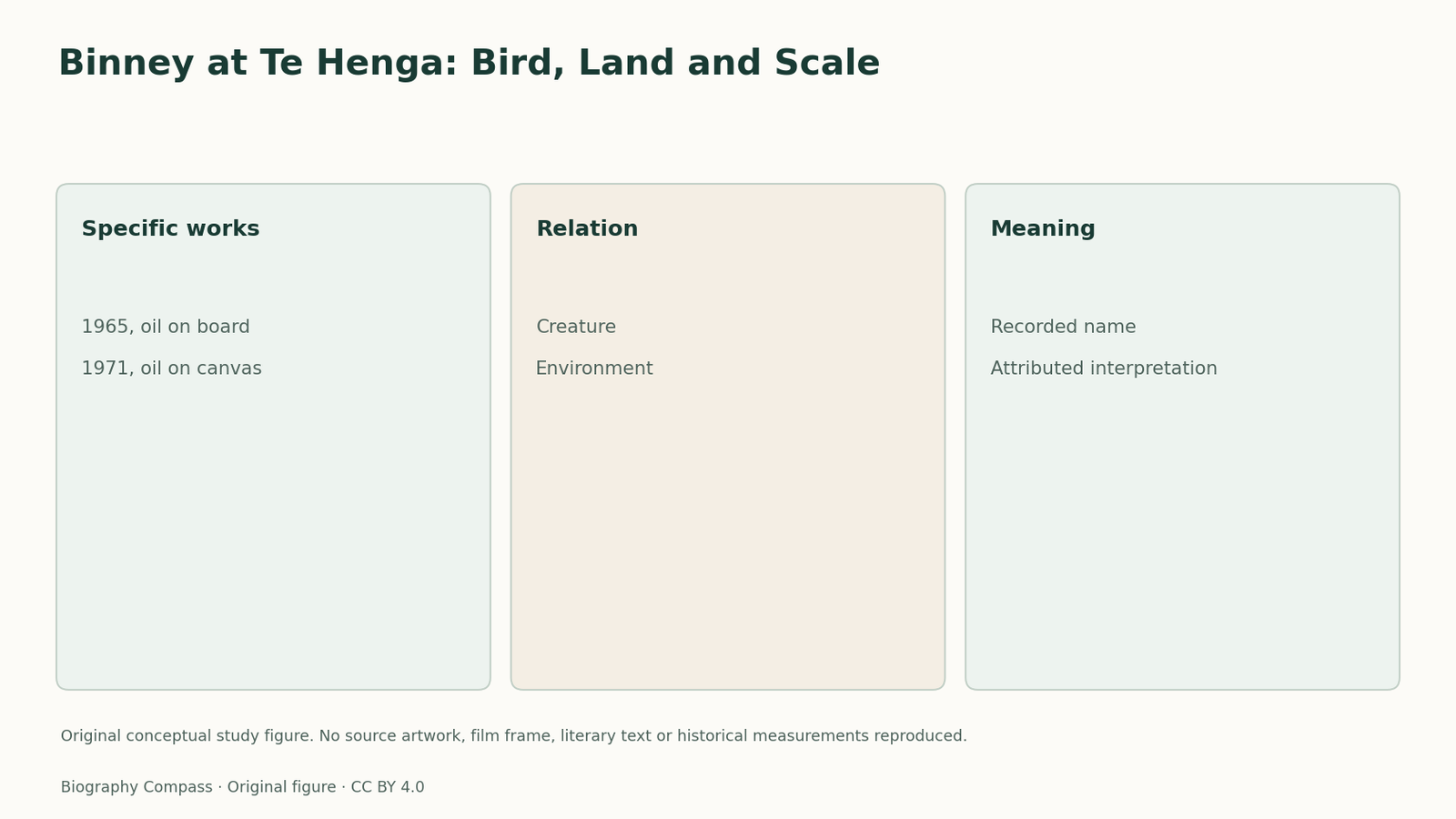
Green Autumn Te Henga is a 1965 oil on board in Aigantighe Art Gallery. Te Henga from Man’s Head III is a separate 1971 oil on canvas in the Fletcher Trust collection. The different titles, dates and supports establish distinct objects. Reading them together does not mean inventing a developmental sequence from one into the other. It makes the repeated naming of a place visible within a practice often described only through its recognisable birds and coastal forms.
A creature and its environment are relational subjects
The Aigantighe account and Binney’s published interview connect his work with the mutual relationship of an inhabitant and its surroundings. In this guide’s reading, that provides a useful alternative to describing a large bird as an isolated symbol pasted over scenery. A change in relative scale can alter how land and creature share attention. The environment can seem to sustain, frame or press against the inhabitant, while the creature changes how the place is encountered. Those are interpretive possibilities to test, not measurements established by the catalogue.
Naming and identity require attributed arguments
The Fletcher record cites Damian Skinner’s interpretation of Binney’s use of Māori place and bird names within a developing Pākehā identity. The argument is presented as a critical reading, not as a claim that a title by itself settles cultural ownership or every question of relationship to whenua. Naming still matters: Te Henga is more precise than an anonymous coast. A strong account can acknowledge that specificity while distinguishing an object’s recorded title, an artist’s explanation of method and a later writer’s account of identity.
Original exercise: scale without a detached emblem
Invent an island and a bird, using no historical outlines. Write two plans for a picture: in one the bird is small within a broad setting; in the other it occupies much more of the same field. Keep the named creature and place unchanged. A reference answer explains that the second plan could make the inhabitant a stronger organising presence, while the first could make the setting’s extent more prominent. Neither arrangement automatically proves care, domination or a conservation message. Now give the invented place a specific fictional name and explain what the name adds that colour and scale cannot. Return to Binney by separating the verified titles from the interview’s relational account and Skinner’s attributed identity interpretation. The exercise makes scale, naming and meaning available as connected questions. It does not reproduce a source painting, turn a collection description into an unseen visual analysis or require a single political meaning for every bird. The aim is a more particular account of how a recognisable pictorial language can remain attached to different places and arguments.
Continue the chronology
Related history guides
Biography context
Explore New Zealand through connected lives
Connected biographies
People and related creative practices
1940–2012
Don Binney
New Zealand painter, conservation advocate and teacherDon Binney made birds and New Zealand places into a distinctive pictorial language, alongside teaching, travel and a sustained interest in conservation.Read biography1908–1970
Rita Angus
PainterA New Zealand painter whose precise compositions make ordinary signs of human presence unusually visible.Read biography1946–present
Robin White
New Zealand painter, printmaker and collaborative Pacific artistRobin White’s career extends from New Zealand painting and printmaking to long-term Pacific relationships and collaborative work in customary materials.Read biographyQuick answers
Common questions
- Does a larger bird prove a particular political message?
- No. Relative scale supplies an interpretive question, not a universal code.
- Is Skinner’s complete book reviewed here?
- No. The guide uses the specifically identified excerpt published by the collection.
Primary and institutional sources
How this history was checked
Sources include production records, institutional collections and the specifically identified passages discussed here. Interpretations and teaching models are distinguished from credits and publication facts. This article was reviewed on 8 November 2026.