
The short answer
A strong signal in one condition is not enough to identify the condition responsible. Comparisons have to preserve the controls needed to distinguish interacting factors.
Evidence and original analysis
Retain the uninfected controls
All signals are original arbitrary units.
| Compatibility group | Infected / uninfected | Within-group contrast |
|---|---|---|
| Compatible | 80 / 10 | 70 |
| Incompatible | 12 / 8 | 4 |
| Difference of contrasts | (80−10)−(12−8) | 66 |
Chronology
A timeline of the turning points
Selected record
Historical scope for this question.
Original exercise
Invented inputs and analysis, not reconstructed observations.
What varied in the selected account
Doherty describes immune T cells tested against infected targets with different H-2 backgrounds. Compatibility mattered, and further target comparisons established reciprocal exclusions. He distinguishes those restriction findings from competing explanations of the receptor.
The result concerns a relationship among immune cells, infection and target identity. It is not simply a claim that infection alone makes every target equivalent. Nor did the first comparison independently settle every molecular explanation.
Sources for this section: [1]
An original two-factor record
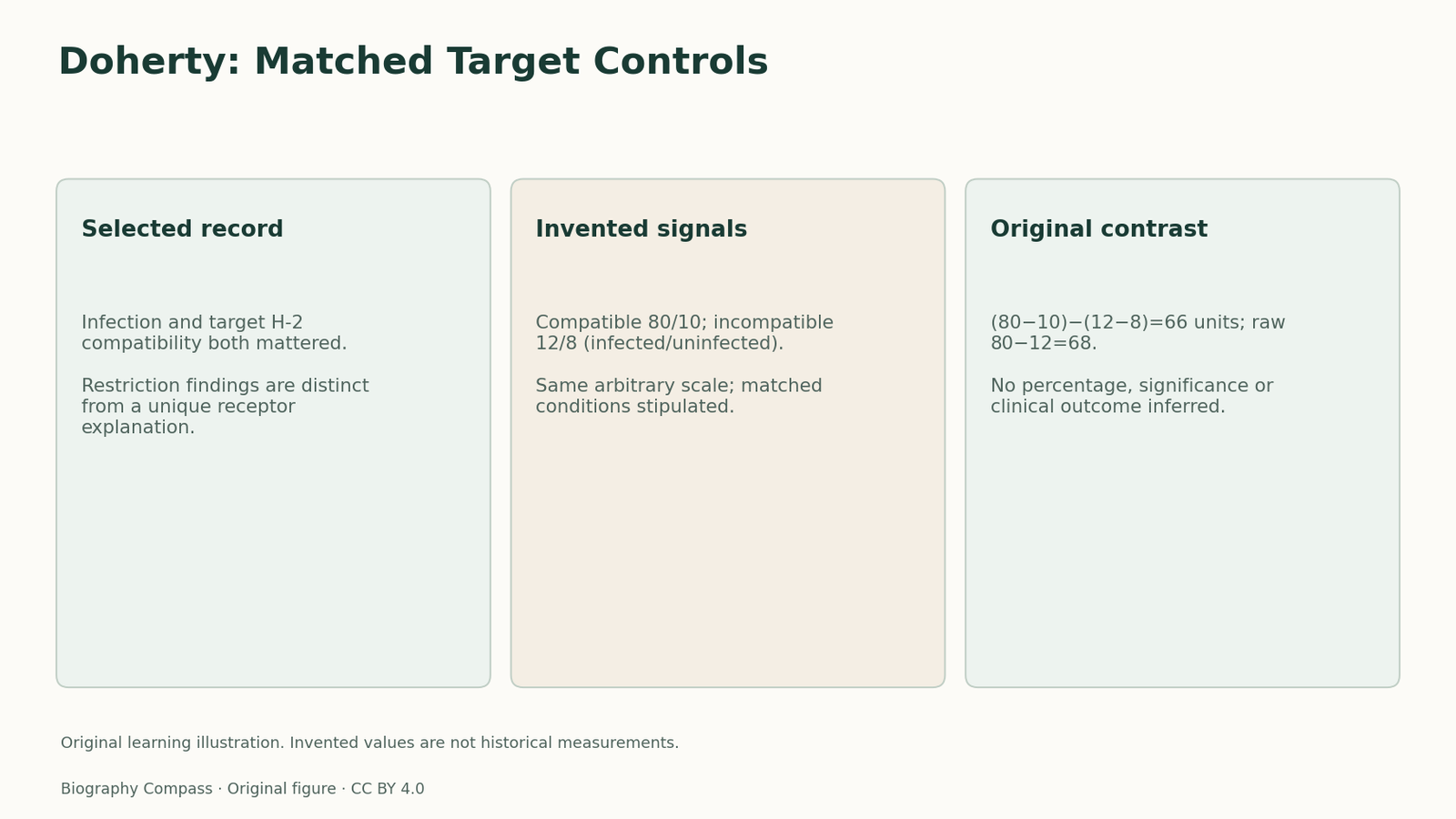
Invent four response signals in a nonclinical assay, on one common arbitrary scale. For compatible targets, infected=80 and uninfected=10. For incompatible targets, infected=12 and uninfected=8. Stipulate comparable background handling and otherwise matched conditions. These are not the historical experimental values.
Calculate the infection-associated contrast within each compatibility group. Then subtract the incompatible contrast from the compatible one. Compare that interaction contrast with the raw difference 80−12. What information does the second calculation discard?
Sources for this section: [1]
Reference answer
Within compatible targets the difference is 80−10=70 signal units. Within incompatible targets it is 12−8=4. The difference of those differences is 70−4=66 units.
The raw infected-only difference is 80−12=68. It omits the unequal uninfected backgrounds, 10 and 8. The 66-unit contrast explicitly adjusts for those supplied controls under the fixture’s assumptions. It is not a percentage killed, a receptor count or a clinical outcome.
Sources for this section: [1]
A contrast still needs a model of the experiment
The arithmetic reveals an interaction in the stipulated means, not its statistical significance: no replication or variability was supplied. It cannot identify a unique receptor mechanism from four numbers. That distinction echoes the lecture’s separation of a restricted response pattern from later molecular explanations without recreating an animal protocol.
Sources for this section: [1]
Continue the chronology
Related history guides
Biography context
Explore Australia through connected lives
Connected biographies
Researcher and context
Quick answers
Common questions
- Is 66 a percentage of cells killed?
- No. The fixture supplies arbitrary response signals, not a calibrated percentage.
- Does the contrast prove statistical significance?
- No. Replication and variability were not supplied.
Primary and institutional sources
How this history was checked
Selected record passages ground the historical explanation. Original fixtures and answers are labelled separately. This article was reviewed on 31 October 2026.