
The short answer
What is preserved when an architectural interior is remade in fabric?
Compare the records
What the sources allow us to say
Read the object record alongside the contextual account.
| Record | Evidence | Reading limit |
|---|---|---|
| Museum record | Fabric architecture carries details of a particular home. | A portable work is not a habitable replacement building. |
| Artist interview | Explains memory and the experience of moving between places. | The title alone does not specify every installation. |
The replica changes a building’s material life
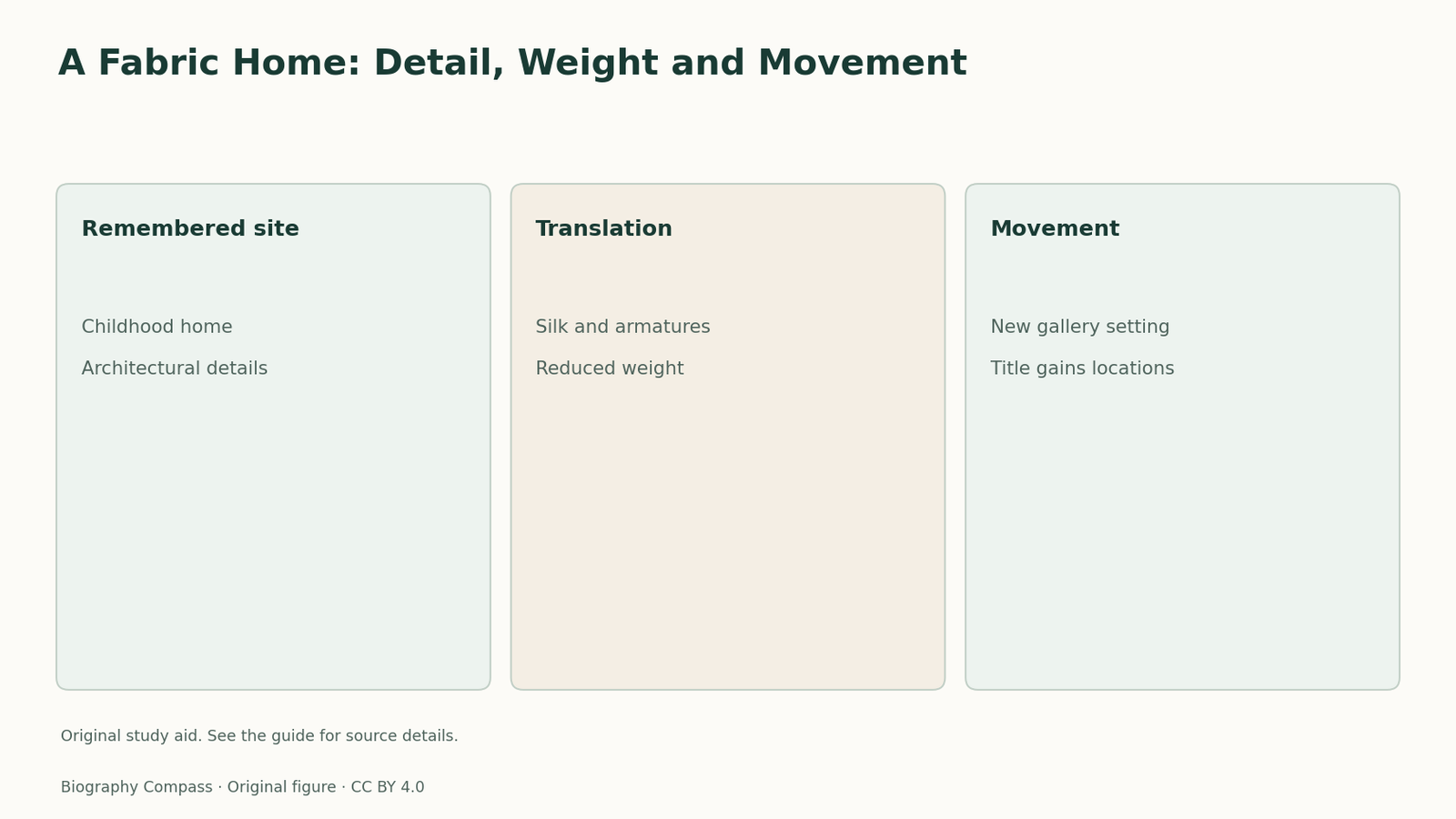
MOCA’s 1999 Seoul Home record identifies silk and metal armatures. The sculpture evokes a childhood hanok but hovers within the gallery instead of functioning as an occupied house. Its translucent surface preserves recognisable details while altering weight and enclosure. That exchange is central to the work. A building normally fixes shelter to a site. The fabric structure gives an impression of that site a portable form, making the relation between home and location available for reconsideration.
Sources for this section: [1]
Scale can be entered or inspected
The Smithsonian describes Hubs as connected rooms and passageways that visitors can enter, while Specimens isolate smaller household features. The two forms involve different relations with the body. An entered corridor surrounds the viewer at architectural scale. A small fixture invites close inspection of an object normally encountered almost without thought. Sewing and mapping connect those scales through careful detail. The work makes habitual familiarity noticeable by changing the material through which the familiar thing is experienced.
Sources for this section: [2]
A title becomes a travel record
MOCA explains that new exhibition locations are appended to the 1999 work’s title. The name therefore accumulates a history even while the sculpture refers back to an earlier home. Draw separate tracks for remembered site, portable object and exhibition locations. A supported answer keeps all three present, explaining that the original house does not physically move into each gallery. The sculpture travels, and its title records those encounters. This gives a precise account of how memory and portability operate together without reducing the work to a general metaphor of displacement.
Continue the chronology
Related history guides
Biography context
Explore South Korea through connected lives
Connected biographies
Read the artist’s biography
b. 1962
Do Ho Suh
Sculptor and installation artistA Korean artist whose fabric architectures connect remembered interiors with migration, measurement and the body.Read biographyQuick answers
Common questions
- Does each exhibition location change the title?
- MOCA explains that the 1999 work’s title accumulates the places where the sculpture has been exhibited.
Primary and institutional sources
How this history was checked
The listed records support the facts. Observation exercises and arguments are Biography Compass editorial interpretations. This article was reviewed on 7 November 2026.