
The short answer
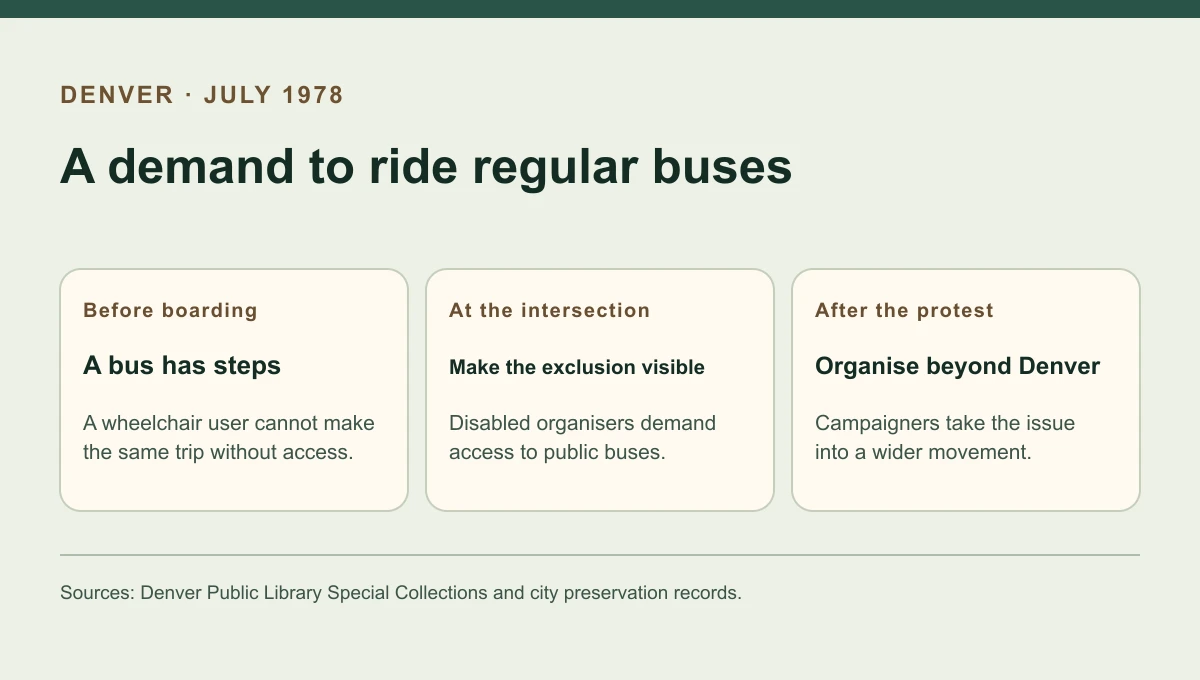
On 5 and 6 July 1978, disabled Denver residents protested the inaccessibility of Regional Transportation District buses at Colfax Avenue and Broadway. The activists became known as the Gang of 19. Their demand concerned access to ordinary city buses, a practical part of living and travelling independently.
Access to an ordinary trip
Three levels of the Denver demand
A request for a boarding feature was also a demand for greater choice in daily life.
| Level | Barrier or demand | Consequence |
|---|---|---|
| Vehicle | Many wheelchair users could not board RTD buses. | The ordinary vehicle restricted where and when a person could travel. |
| Route network | Activists called for accessibility across public bus services. | Boarding an ordinary bus would open more of the city to independent trips. |
| Organising | Denver participants built a wider movement. | Accessible transit became a demand directed at institutions beyond one route. |
Chronology
A timeline of the turning points
The Atlantis Community supports independent living
Transportation becomes one of the wider issues facing people living in the community.
The Gang of 19 brings its demand to ordinary buses
Organisers make the lack of wheelchair boarding visible in central Denver.
Activists continue wider transit organising
Denver Public Library connects this history with the campaigns of ADAPT.
Why independent living made buses important
Denver Public Library traces the protest to the Atlantis Community. People organising for independent living faced a practical problem. A home, job or public meeting may be available, while attending depends on being able to get there. Ordinary buses offered access to the city for other riders. The Gang of 19 demanded the ability to make those trips too.
What happened at Colfax and Broadway
The library gives 5 and 6 July for the foundational protests and the city’s preservation report identifies the intersection near the civic centre. Activists stopped buses to make the problem visible. Their demand focused on the ordinary vehicles of the Regional Transportation District. The location has since been recognised as part of the city’s disability history.
How the issue travelled beyond the intersection
The library connects the Denver campaign to ADAPT and later activities in other places, including demands for lifts directed at transport associations and intercity bus companies. The transport question stayed concrete. A rider needs a way onto the same vehicles that carry other passengers through the city. The 1978 action belonged to a longer effort involving advocates, transit authorities and changing equipment and legislation.
Continue the chronology
Related history guides
How Singapore Introduced Wheelchair-Accessible Buses
Compare the later introduction of wheelchair-accessible buses in Singapore.
Read the timeline1973–1977How the 1977 San Francisco Sit-In Pressed for Section 504
Read about the San Francisco campaign for implementation of Section 504.
Read the timeline1973–1994The ADA in 1990: Activism, Congress and Bush’s Signature
Place the protest within the wider history of campaigning before the ADA.
Read the timelineConnected biographies
People connected to this history
Quick answers
Common questions
- When and where did the Gang of 19 protest?
- The Denver Public Library dates it to 5 and 6 July 1978 at Colfax Avenue and Broadway.
- What were the activists demanding?
- They wanted wheelchair users to be able to board and use ordinary public buses.
Primary and institutional sources
How this history was checked
Dates, legal milestones and historical claims are checked against the official and institutional records below. This article was reviewed on 19 November 2026.
- Denver Public Library Special Collections and ArchivesThe origins of Denver’s accessible transit activism
- Denver Public Library Special Collections and ArchivesWade Blank, the Atlantis Community and access to buses
- City and County of DenverPreservation staff report documenting the Gang of 19 protest location