
The short answer
Decision to Leave offers a specific case of collaboration across languages and departments. Its makers describe how casting, recorded dialogue, storyboards and visual proposals changed the work, allowing preparation and discovery to operate together.
Original collaboration comparison
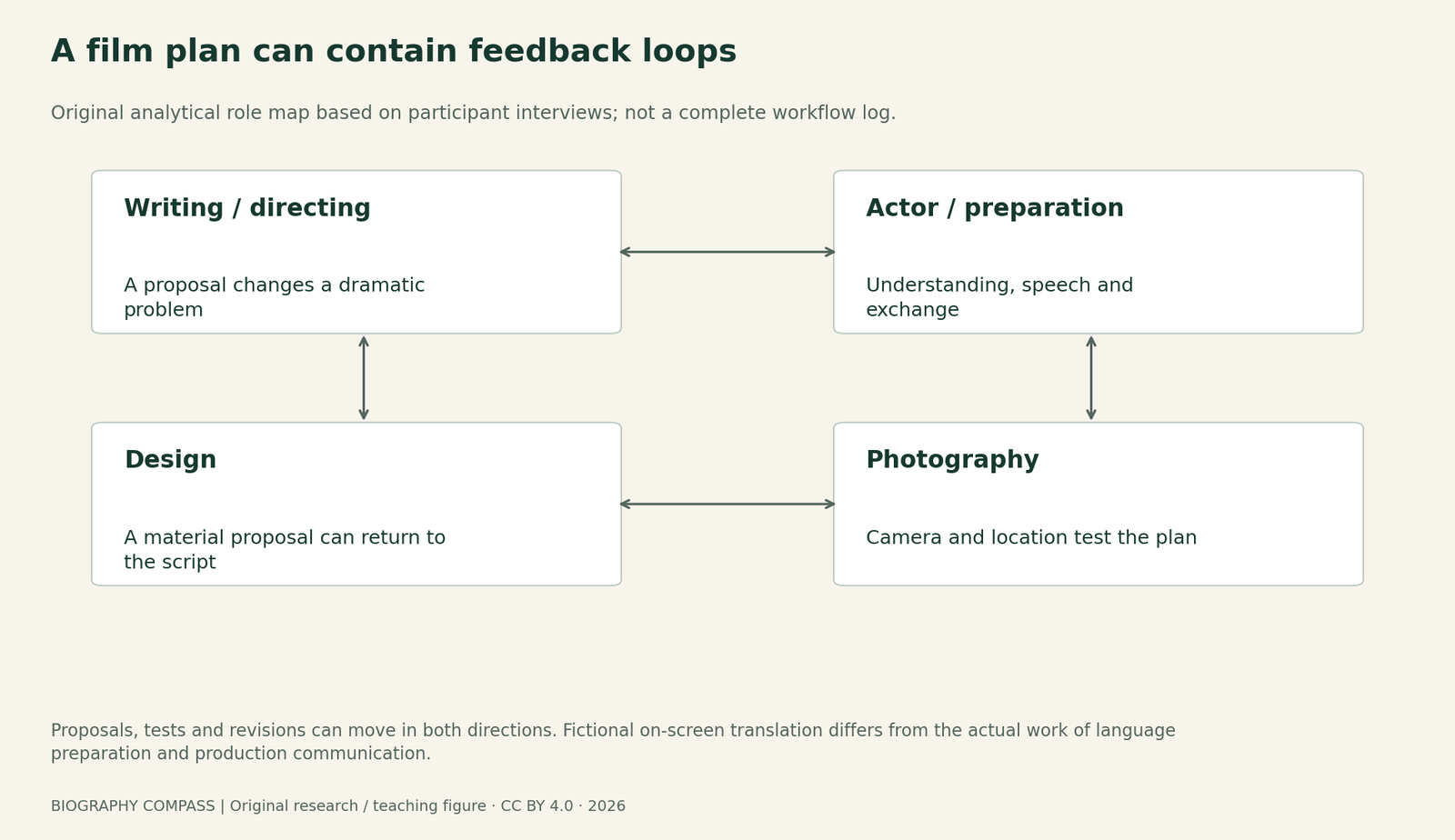
Preparation can contain feedback
A finished image can conceal the exchanges that made it possible.
| Country | Documented kind of contribution | Record that helps | Question still open |
|---|---|---|---|
| Co-writing and casting | A desired performer affects a character’s language. | Credited writers and director interview. | What changed between drafts? |
| Language preparation | Recorded dialogue and discussion support performance. | Tang Wei’s dated interview. | How were alternative deliveries selected? |
| Design feedback | A material proposal returns to the script. | Park’s account of department exchanges. | What do the actual draft and design dates show? |
| Camera preparation | Listening, questions and proposals become storyboards. | Kim Ji-yong’s interview. | How did shooting conditions alter the plan? |
| Fictional translation | An app is a dramatic device in a constructed world. | Director’s explanation. | Its screen behaviour does not test a real product. |
Chronology
A timeline of the turning points
Production record
Moho Film’s international press kit credits Chung Seo-kyung and Park Chan-wook as writers, with Tang Wei and Park Hae-il in the lead roles.
Actor and director testimony
Separate interviews explain language preparation, technological devices and exchanges with designers.
Cinematographer testimony
Kim Ji-yong discusses the sustained dialogue behind storyboards and camera ideas.
The credits identify a network before a signature style
The international press kit identifies a 2022 Republic of Korea production in Korean and Chinese, written by Chung Seo-kyung and Park Chan-wook and made by Moho Film. Tang Wei and Park Hae-il head the cast. Kim Ji-yong, Ryu Seong-hie, Kwak Jung-ae and Cho Young-wuk are among the department leaders named in the production account. This establishes a network of roles. It does not divide creative ownership into percentages or mean that a director’s recognisable style has no collective basis. A more useful question is where a proposal moved between roles and changed form as somebody else worked on it.
Sources for this section: [1]
Casting helped generate the language problem
In the press-kit interview, Park recalls Chung proposing a Chinese female lead in order to cast Tang Wei. The decision thus joins writing to a desired performer, rather than beginning as an abstract thesis about linguistic isolation. Park’s Slant interview makes a similar distinction between a practical or personal starting point and the thematic possibilities that later develop. A production question and an interpretive question can therefore have different answers. “Why was this actor sought?” need not be answered with the same statement as “What can a spectator read in the character’s use of language?” Keeping both questions active makes the creative process more interesting.
Recorded dialogue supported an actor’s preparation
Tang’s October 2022 interview describes learning Korean lines from recordings made by Park and her co-star and using the director’s detailed storyboard guide. She presents this as extensive preparation rather than an automatic benefit of being married to a Korean speaker. The work included the other character’s dialogue and alternative versions, so preparation concerned exchanges as well as isolated pronunciation. Her account also describes discussing her understanding of the role with Park. It is a record of an actor’s working experience, not a general prescription that performers should imitate a recording exactly. Nor does reading the interview give this guide independent access to the actual rehearsal recordings.
Sources for this section: [3]
Design conversations could send an idea back into writing
In Slant, Park describes a costume suggestion whose colour could appear different under different light and says that the exchange subsequently entered the script. He also recounts responding to Ryu’s wallpaper proposal, whose forms could evoke mountains or water. These examples show a feedback path rather than a simple chain from completed screenplay to obedient execution. The director’s taste remains active, but a department’s material proposal gives it something new to respond to. For research purposes, distinguish the first draft, a later written change, a designed object and the eventual photographed result. A single interview connects these stages without supplying every surviving version.
Sources for this section: [2]
Camera planning was also a conversation over time
In his December 2022 interview with Ricky Valero, Kim says he spent an extended preparation period listening to Park, asking questions and then offering his own ideas as they developed storyboards. He also recalls a playful camera-point-of-view proposal being taken further. Trevor Hogg’s interview supplies a related technical account: the collaborators sought a restrained, classical texture and carefully planned movement, with location conditions and later image work affecting what could be achieved. These are accounts from the people making choices. They make a stronger explanation than assuming that a camera device came directly and unchanged from the director’s first written treatment.
Language inside the story differs from language on set
Park’s interview explains that the translating app developed partly from a writing problem about how characters would communicate, and he acknowledges its unusually effective translation as part of the film’s world. Tang separately describes language learning, recorded guidance and nonverbal interaction with her co-star. These should not be collapsed. A fictional device mediates characters; interpreters, preparation and communication practices support actual workers. The difference prevents a misleading technical claim that a film demonstrates the real-world accuracy of a translation product. It also preserves the actor’s labour, which an apparently smooth screen conversation can easily conceal.
Exercise: trace an invented change across four roles
Imagine an original production in which an actor finds a line difficult to speak naturally in a second language. A designer proposes an object that lets the character communicate differently, while the cinematographer suggests a viewpoint that keeps both participants visible. Draw a loop connecting writer, actor, designer and cinematographer. For each arrow, state what information or proposal travels along it. Then identify two records you would want before claiming who originated the final idea. Finally, write a short credit sentence that acknowledges an exchange without inventing equal authorship or attributing a finished scene to the first person who happened to describe it in an interview.
Reference answer: distinguish contribution, adoption and realisation
The actor can explain the performance obstacle to the writer; the writer can revise the dramatic requirement; the designer can propose a usable object; photography can test how it reads, and each test can return new information to the others. Dated draft changes, design correspondence or preparation notes could help distinguish a proposal from its adoption. A careful sentence might say that the scene developed through an actor’s practical concern, a revised script and a department’s visual solution, if the records support those actions. This is an original analytical exercise. It does not describe an unexamined incident from Decision to Leave or allocate legal authorship.
Continue the chronology
Related history guides
How Do Nigerian Bands Shape Records?
Compare Fela Kuti and Tony Allen’s band history with Sunny Adé’s recording decisions through participant testimony, an original comparison and exercise.
Read the timeline2019–2020How Was Parasite’s Space Constructed?
Examine Parasite’s set construction, sightlines, lighting and department credits through production testimony, with an original spatial-planning exercise.
Read the timelineBiography context
Explore South Korea through connected lives
Bong Joon-ho
Bong Joon-ho connects popular genres, social observation and precise collaborative production. His films range from Korean investigations and family dramas to international science fiction.
Explore the biographiesBiographyPark Chan-wook
Park Chan-wook developed a cinema of intricate images and unstable moral relationships through criticism, screenwriting and production. His career spans Korean features, English-language work and television.
Explore the biographiesConnected biographies
Artists and collaborators
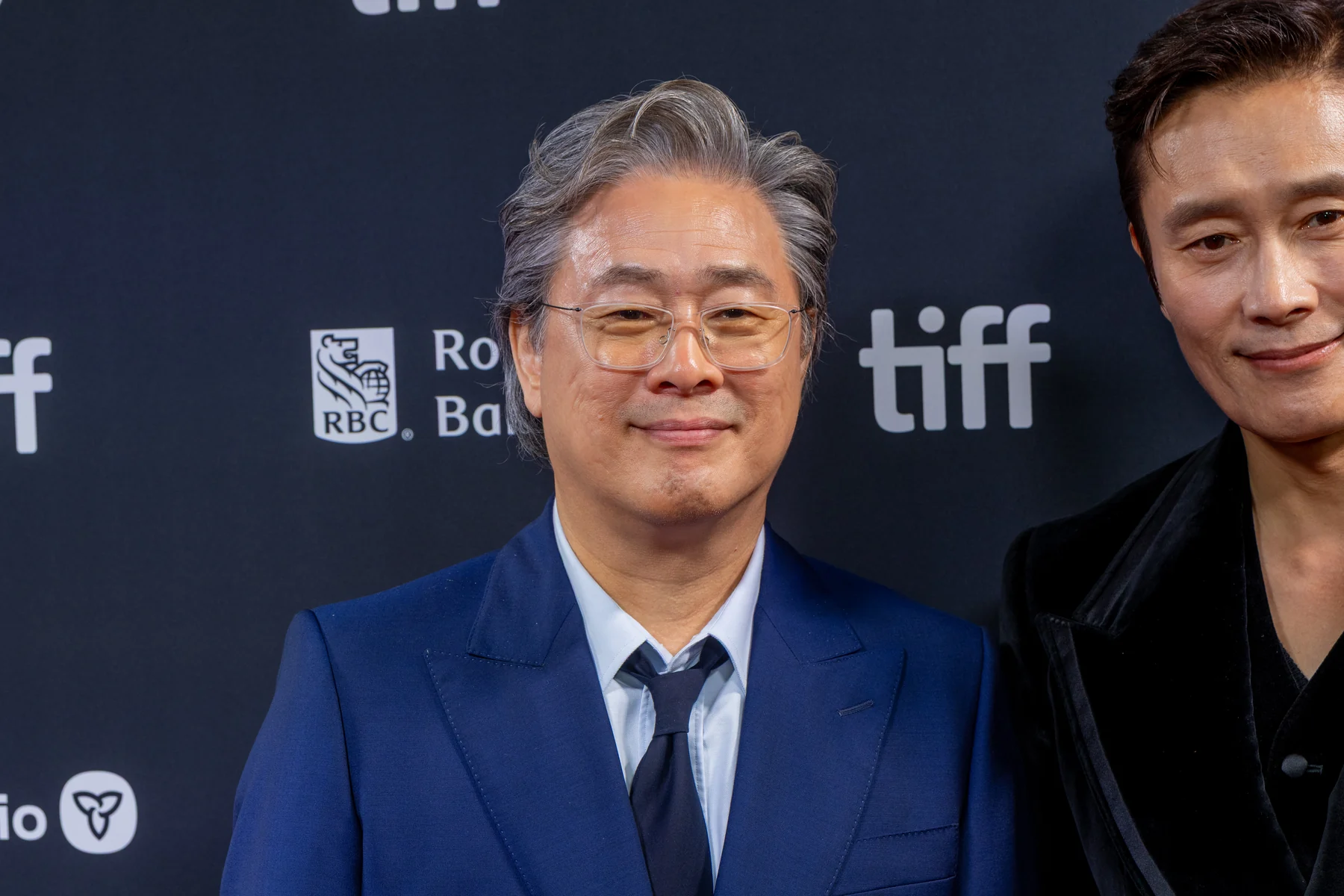
Born 1963
Park Chan-wook
Film director, screenwriter, producer and former criticPark Chan-wook developed a cinema of intricate images and unstable moral relationships through criticism, screenwriting and production. His career spans Korean features, English-language work and television.Read biographyQuick answers
Common questions
- Does the guide assess the film’s Korean or Chinese accuracy?
- No. It examines makers’ statements about preparation and communication. It does not claim linguistic verification from an unviewed film or unheard rehearsal recording.
- Were the original storyboards and rehearsal audio accessed?
- No. Their use is described in participant interviews. No storyboard, recording or screenplay passage is reproduced.
Primary and institutional sources
How this history was checked
Read the participant accounts and original institutional records alongside the comparison and exercise. No film or recording was watched or listened to for this guide; claims about making remain tied to the named speakers and documents. This article was reviewed on 27 October 2026.
- CJ ENM / Moho Film; Cannes archiveDecision to Leave: international press kit,2022
- Slant MagazinePark Chan-wook on Duality and Dissonance, Marshall Shaffer,13 October 2022; translation by Jiwon Lee
- Little White LiesAnimal Instincts: a conversation with Tang Wei, David Jenkins,14 October 2022
- Offscreen CentralDecision to Leave cinematographer Kim Ji-yong: interview by Ricky Valero,6 December 2022
- British CinematographerKim Ji-yong / Decision to Leave, Trevor Hogg