
The short answer
Cham sculpture came to the Da Nang museum site before the first building opened to the public in 1919. Henri Parmentier and the French School of the Far East helped develop the institution. The gallery’s practice of grouping sculpture by where it was found gives modern readers a way to connect exhibited works with temples and settlements.
Compare the records
How to read a label at the Cham museum
The building houses material from several ancient sites. The object record lets a reader locate a specific work.
| Label field | Example | What it explains |
|---|---|---|
| Findspot | E1 Tower at Mỹ Sơn in Quảng Nam | Which sanctuary and tower the work came from. |
| Material and period | Sandstone, seventh to eighth centuries | What the work is made from and how the museum dates it. |
| Object identifier | BTC 6 | Which catalogue record to use when comparing images or descriptions. |
Chronology
A timeline of the turning points
Collections and museum proposal
The French School of the Far East and Henri Parmentier pursued a building for sculptures already being assembled.
First building constructed
Work began in 1915 and the first building was completed the following year.
Museum opens to visitors
The building admitted the public to its collection of Cham sculpture.
Why construction and opening have distinct dates
The city’s institutional overview places construction in 1915 and completion of the first building in 1916. It records a public opening in 1919. The collection had begun to accumulate before there was a building. Parmentier’s work with the French School of the Far East helped turn it into a museum. These dates refer to a project, a structure and a public collection respectively.
How galleries preserve provenance
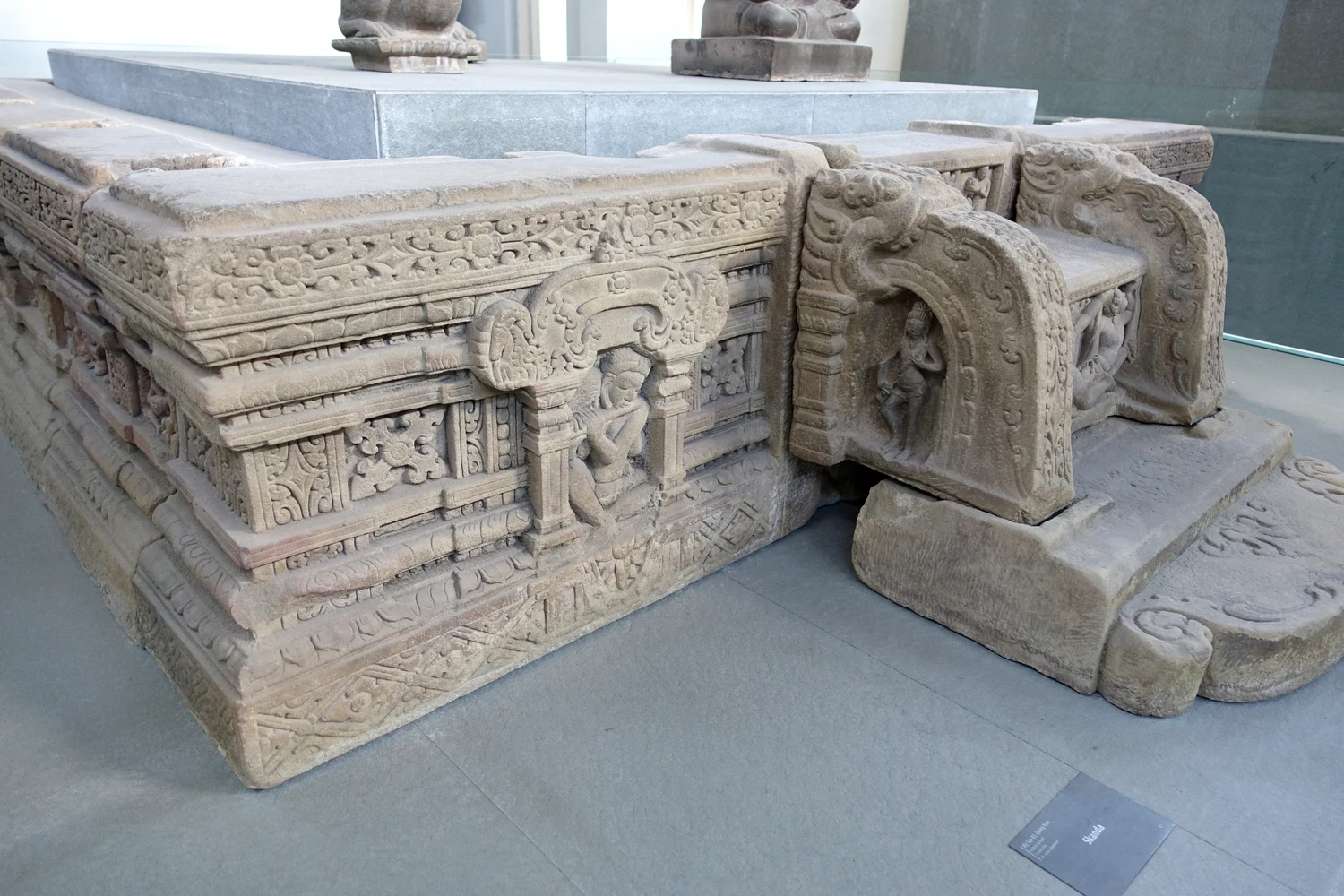
Displays draw material from several places, including Trà Kiệu, Mỹ Sơn and Đồng Dương. For an example, the Mỹ Sơn E1 altar is numbered BTC 6. The catalogue assigns it to the seventh or eighth century and identifies the material as sandstone. It records fourteen surviving blocks out of sixteen. These details help distinguish the assembled object on view from the reconstructed account of its form.
Reading the object and the sanctuary together
The altar’s findspot ties its figures and architectural details to one tower in the Mỹ Sơn sanctuary. The corresponding World Heritage record describes the valley and the whole group of monuments. Use the object record to follow the material, date and condition of the altar, then use the property map to see how its original building related to other groups. Consult both records to follow the piece from temple to gallery.
Continue the chronology
Related history guides
Connected biographies
People connected to this history
Quick answers
Common questions
- When did the Da Nang Museum of Cham Sculpture open?
- Its first building was completed in 1916. It opened to members of the public in 1919.
- What is the Mỹ Sơn E1 altar?
- It is a sandstone altar from the E1 tower at Mỹ Sơn, displayed in the museum and identified as BTC 6.
Primary and institutional sources
How this history was checked
Dates, legal milestones and historical claims are checked against the official and institutional records below. This article was reviewed on 19 November 2026.