
The short answer
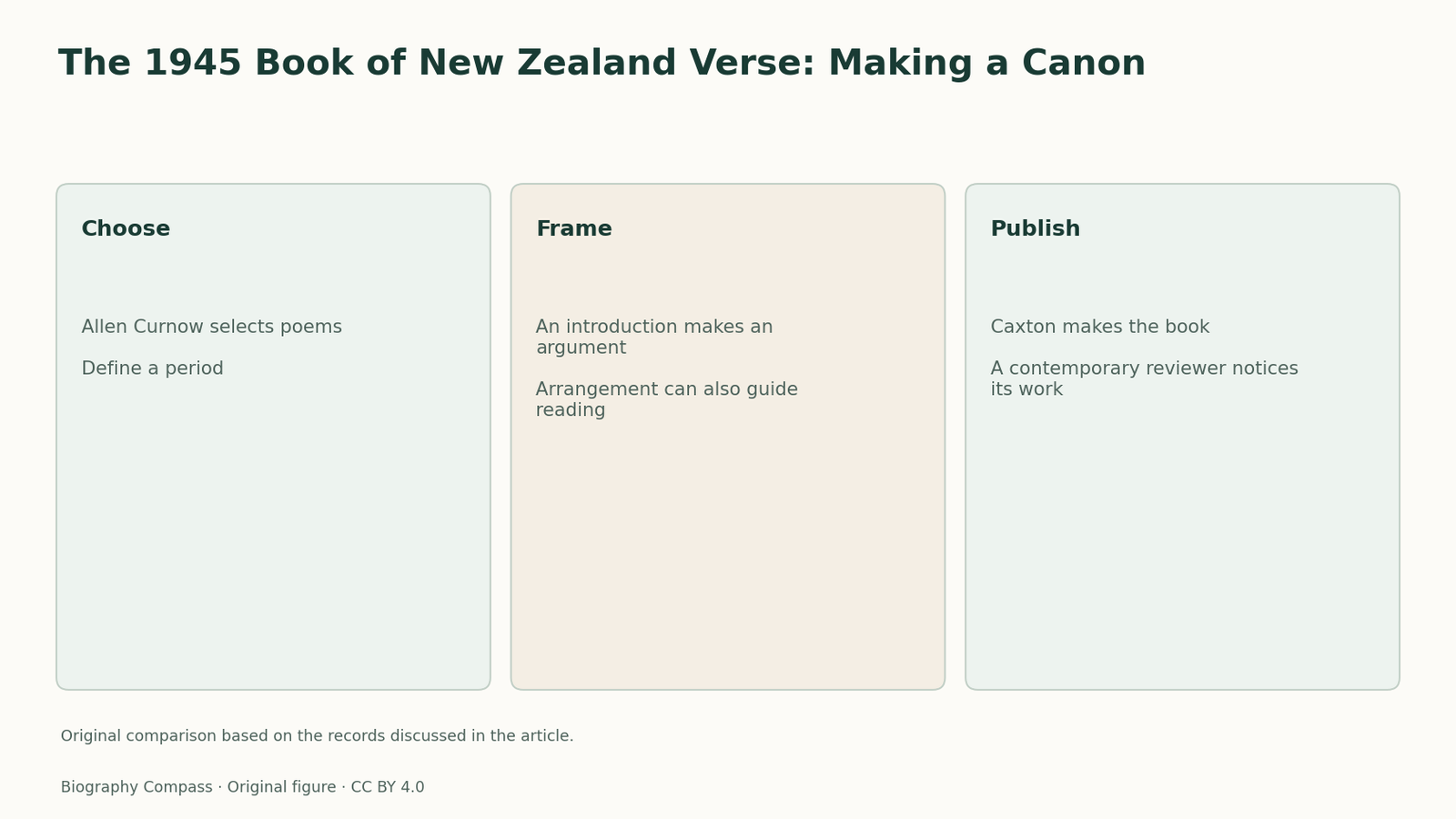
The title A Book of New Zealand Verse announces a collection, and the contemporary review names Allen Curnow as its chooser. That word gives a precise question to ask of the 1945 book. What can selection accomplish that a list of all available poems would not?
Evidence comparison
Three jobs in the anthology
Follow the credit appropriate to each job.
| Job | Effect on reading |
|---|---|
| Selection | Determines which poems enter the book. |
| Introduction | Proposes how the selection can be understood. |
| Publication | Turns the editorial work into an available printed object. |
Locate the physical and editorial object
The 1945 Listener identifies A Book of New Zealand Verse, 1923–45 and credits Curnow with choosing its contents. Caxton Press in Christchurch is named as publisher. This supplies a starting point for reading an anthology as a constructed object. The date range defines a period, the editor chooses what readers see within it, and the publisher produces the result. The choice of one poem can look decisive when seen alone. The sequence and the company in which the poem is placed can make it representative of something it did not need to represent in its original publication.
Selection and introduction have different powers
The biographical account describes Curnow’s introduction as an argument about problems of imagination. An introduction can propose a relation among texts before the reader encounters them. The contents can support, complicate or exceed the proposal. A reader therefore has at least two kinds of evidence for the editor’s project. The prose makes some of its assumptions visible. The choice and order of poems reveal how those assumptions were put into practice. A comparison that examines only the introduction might miss the importance of a poem included for reasons that the prose does not settle.
A contemporary reviewer notices the publisher
Holcroft’s review draws attention to the overlap between writers supported by Caxton and writers gathered in the book. It also notices the quality of printing. Those observations make a connection between literary selection and the institutions able to produce a volume. They do not require readers to imagine that publication by Caxton was a formal condition of selection. They identify a useful historical question: if a small press has spent years making writers available, how does that earlier work affect what an editor and an audience can recognise as a literature?
Use the reprint to ask the right question
The biography identifies a later reprint in 1951 and a different Penguin anthology at the end of 1960. Keep those items distinct when discussing the editorial project. A later reader can compare which poets or works appear only after identifying the edition being held. The point is not to pretend that the 1945 contents were merely an early draft of another book. It is to make the act of choosing visible at different times and in relation to different publishers. That gives a more precise history of changing literary judgment.
A group exercise for an anthology
Choose three poems from a hypothetical decade. Write an introduction that describes the strongest connection among them. Then reverse the order and check whether the introduction still fits the experience of a first reader. This model separates editorial explanation from editorial arrangement. It suggests why the Curnow anthology can be studied for what it places beside what, as well as for the claims its introduction makes.
Continue the chronology
Related history guides
Biography context
Explore New Zealand through connected lives
Connected biographies
People connected to the work
1911–2001
Allen Curnow
Poet, journalist, editor and teacherAllen Curnow wrote poetry and newspaper satire and edited influential anthologies. His career makes the difference between writing a poem and shaping a collection especially clear.Read biography1912–1980
Denis Glover
Poet, printer, publisher and typographerDenis Glover made books as a poet, printer and publisher. The Caxton Press brought several of those jobs together with the work of business and artistic collaborators.Read biographyQuick answers
Common questions
- Who published the 1945 anthology?
- The Caxton Press in Christchurch.
- Why use a contemporary review?
- It shows what one early reader noticed about selection, printing and the role of the publisher.
Primary and institutional sources
How this history was checked
Dates, legal milestones and historical claims are checked against the official and institutional records below. This article was reviewed on 13 November 2026.