
The short answer
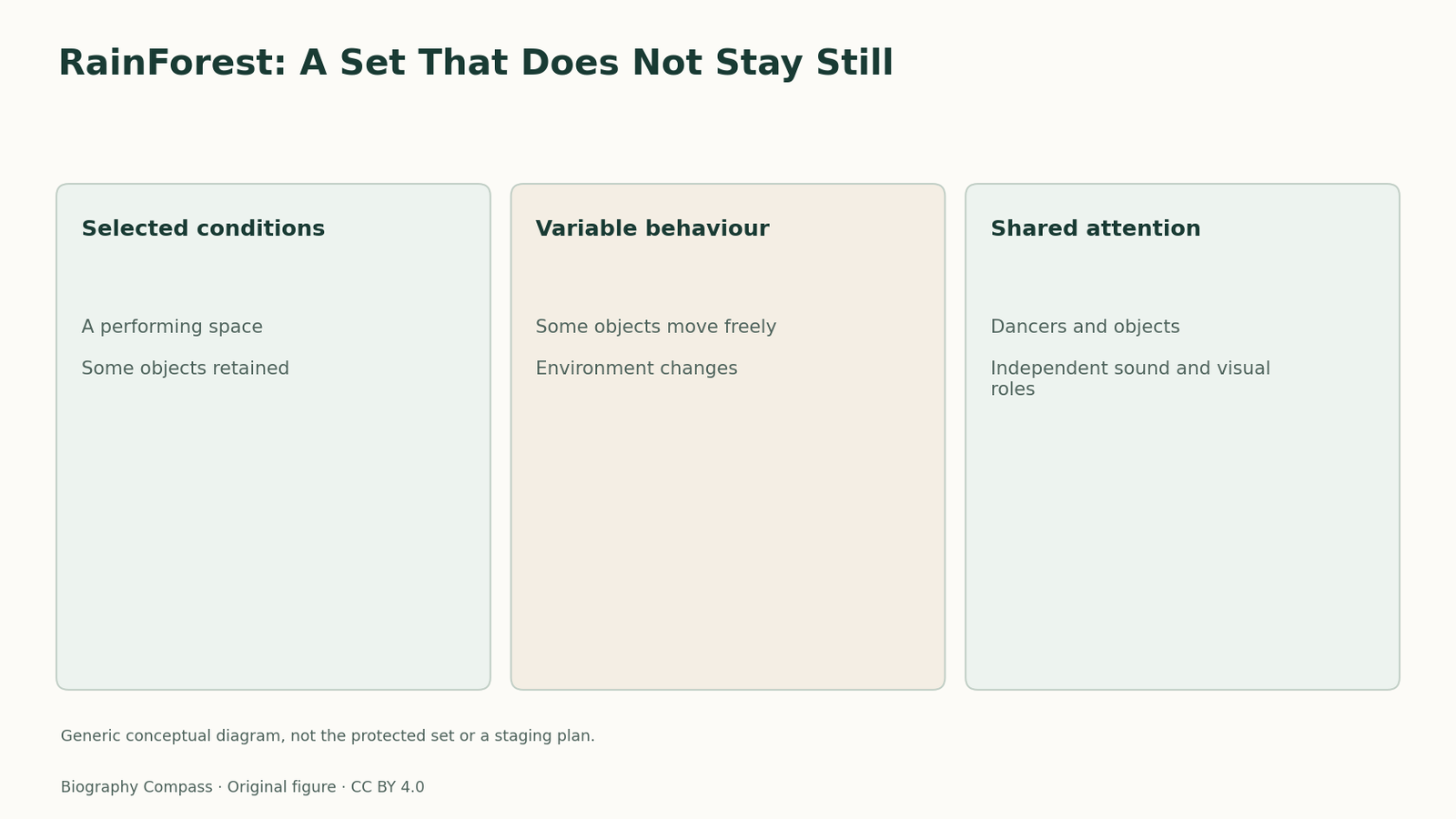
Stage design can do more than provide a fixed image behind performers. RainForest put dancers in a space partly occupied by objects whose movement could not be completely predicted. Its written records describe how that variability entered the collaboration.
A working comparison
What changes between these records?
Use each record for the question it can answer. The distinctions below are our synthesis of the cited materials.
| Record or element | What it establishes | What remains separate |
|---|---|---|
| Design decision | Objects and some restraints were selected. | Preparation does not imply a fixed position at every moment. |
| Material behaviour | Some pillows could move freely. | The account supplies no quantitative motion model. |
| Dance and sound | Independent practices share a space. | Independence does not erase collaboration. |
Independence is not absence of preparation
Cunningham and Cage’s practice allowed music and dance to remain separate rather than requiring a shared illustrative narrative. RainForest gives that principle a material setting, with sound and visual design meeting the dancers in performance.
The account describes both decisions and contingencies. Choosing objects, a quantity and ways of retaining some of them is preparation. Accepting that freely moving objects will occupy different positions is a further choice. Calling the result random would conceal those boundaries between what was selected and what was allowed to vary.
Sources for this section: [3]
An environment creates a practical question
Imagine an original teaching diagram with a fixed floor boundary and a movable obstacle. The useful question is not where the obstacle will be at every instant, but which parts of the plan require that certainty. A fixed scenic photograph cannot answer it. A dancer’s account or rehearsal record might show how attention and adjustment operated.
This fictional comparison is not a RainForest staging instruction. It helps separate the visual identity of an object from the way an object behaves in a shared space. Reproducing a picture of the famous set would not itself explain that relationship.
What the records let us say
The work brought named artists into a performance whose components retained different responsibilities. The written account supports an environment that varied between occasions. It does not support an exact reconstruction of a particular evening, a universal temperature formula or a claim that the dancers followed every sound as a cue.
Continue the chronology
Related history guides
Biography context
Explore United States through connected lives
Connected biographies
Explore the creators
1919–2009
Merce Cunningham
Choreographer and dancerA choreographer exploring independent relations among dance, sound and design.Read biographyQuick answers
Common questions
- Does the diagram reproduce Warhol’s Silver Clouds?
- No. It is a generic diagram of fixed choices and variable behaviour; no artwork or set photograph is reproduced.
Primary and institutional sources
How this history was checked
Selected written records, with the scope of the comparison stated in the article. No complete performance or work is claimed to have been consumed. This article was reviewed on 4 November 2026.