
The short answer
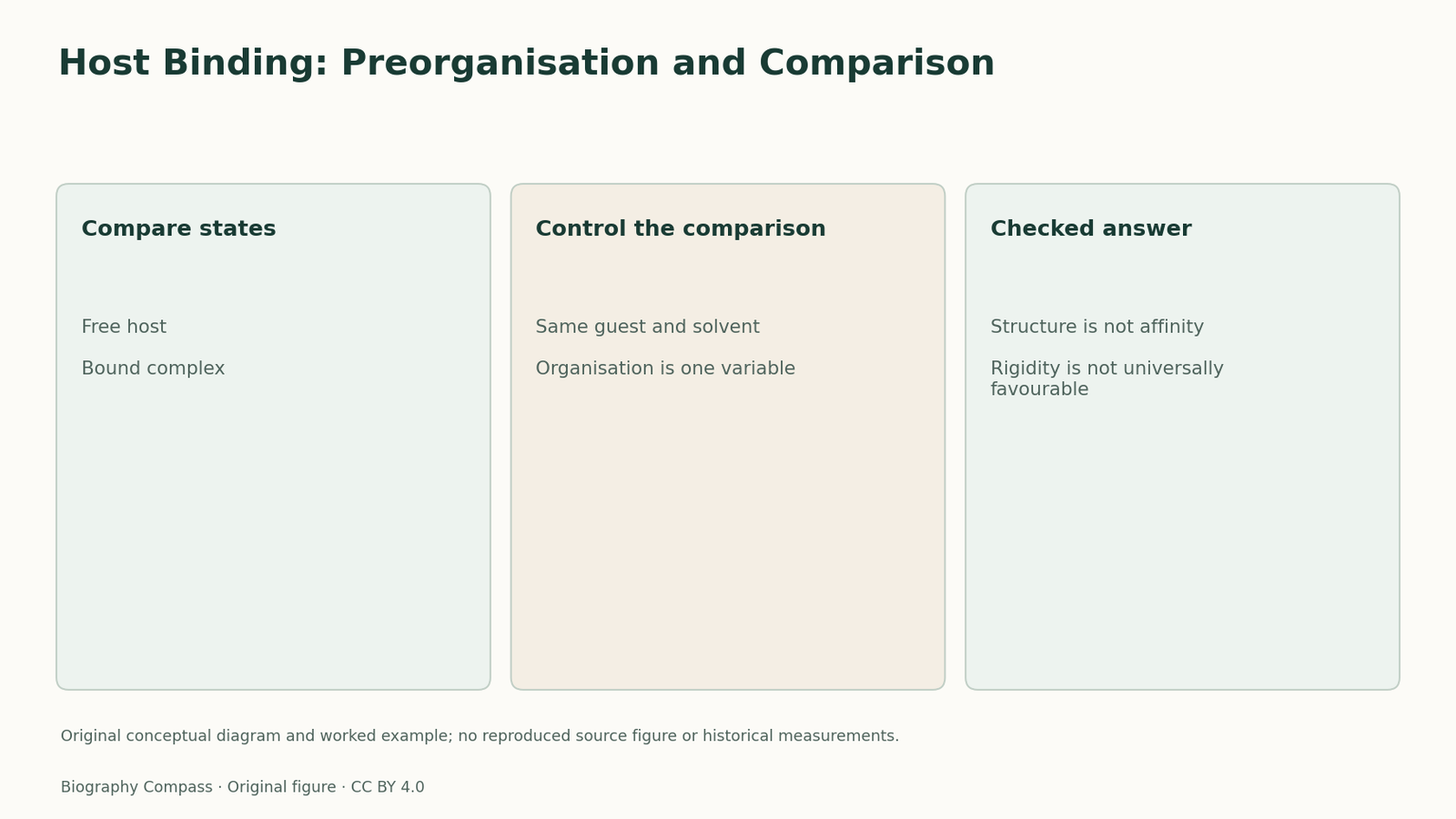
How can a matched host comparison test preorganisation without confusing stronger binding with a universal selectivity rule?
Read the evidence
Different records within the same investigation
The following comparison distinguishes the specific questions answered by the inspected records.
| Record or test | What it establishes | What remains different |
|---|---|---|
| Free-host structure | Shows organisation before binding | Must not be inferred solely from a complex |
| Solution affinity | Measures binding under stated conditions | Does not alone determine every structural detail |
Compare the host before and after binding
Cram’s lecture asks how the free state of a host relates to the arrangement present in its complex. Some hosts reorganise their binding sites during complexation; a more preorganised host supplies much of that arrangement in advance. His spherand programme used deliberately constrained structures to investigate the difference. This is distinct from asking only whether a guest fits a cavity in a finished drawing. A meaningful comparison includes the unbound host, because a structure appearing around a bound guest may not describe what was present before binding occurred.
Sources for this section: [2]
What the 1985 record contributes
The original publication identifies spherands as preorganised ligand systems within Cram and colleagues’ host–guest research. His lecture discusses structural comparisons and the relationship between organisation and complexation. These records support a design argument, not a universal statement that rigidity always improves binding. A constrained host may organise the right arrangement for one guest and the wrong arrangement for another. Solvation and the conditions of measurement still matter. This keeps the topic distinct from a simple size-matching account: the energetic and structural cost of reaching a binding arrangement is part of the question, as is the arrangement itself.
Exercise: identify the fair comparison
Imagine invented hosts A and B tested with the same guest in the same solvent and at the same temperature. A changes shape substantially upon binding; B is already close to its bound arrangement. If B binds more strongly in this example, has preorganisation been proved to be the only cause? No. The comparison is informative, but other structural differences could remain. Now change both guest and solvent for B. The resulting difference becomes less specific, because several variables have changed. These are classroom cases, not reported spherand measurements. The answer distinguishes a suggestive contrast from a uniquely isolated explanation.
Sources for this section: [2]
Structure and affinity are not one measurement
Suppose a fictional crystal structure shows B holding the guest in the expected geometry. Does that alone supply its solution binding constant? No. It establishes a structural observation in the stated crystal setting. Conversely, a stronger solution affinity does not automatically determine every atom’s position in the complex. Reading both kinds of evidence is valuable because each constrains a different part of the account. The exercise also explains why a free-host structure should not be silently inferred from the bound structure. The molecular state being described must remain attached to the observation.
Sources for this section: [3]
Continue the chronology
Related history guides
Biography context
Explore United States through connected lives
Connected biographies
Researchers and related approaches
1919–2001
Donald J. Cram
Organic chemist and molecular-recognition researcherExplore Donald Cram’s education, UCLA career and molecular-recognition research, with a comparison of preorganisation, binding and structural evidence.Read biography1904–1989
Charles J. Pedersen
Industrial organic chemistCharles Pedersen discovered crown ethers during a long DuPont career, connecting ring-shaped molecular structures with selective metal-ion complexation.Read biographyQuick answers
Common questions
- Does rigidity always improve binding?
- No. The constraint must be appropriate to the guest and comparison.
- Does a crystal structure supply a solution binding constant?
- No. Structure and affinity are different observations.
Primary and institutional sources
How this history was checked
The references below distinguish the original study from later explanations. The worked exercise and comparison are newly written for this article. This article was reviewed on 8 November 2026.