
The short answer
A membership reward needs a rate, an eligible spending base and a ceiling. Comparing the dated fee notice with the reward terms shows why “two percent of my spending” is too imprecise even before a household asks whether an upgrade would suit it.
The records answer different questions
Keep the measures separate
The question changes when the object, unit or reporting period changes.
| Record or measure | What it establishes | What it does not establish |
|---|---|---|
| Dated fee notice | Historical tier prices and changed ceiling. | Eligibility of every transaction. |
| Reward terms | Qualified base, exclusions and cap. | A personal recommendation. |
| Invented annual cases | $70 or capped $1,250. | Measured household outcomes. |
Chronology
A timeline of the turning points
Historical fee change
Read alongside the separate reward conditions.
Study retrieval
A dated comparison, not an assurance of future terms.
The historical price change
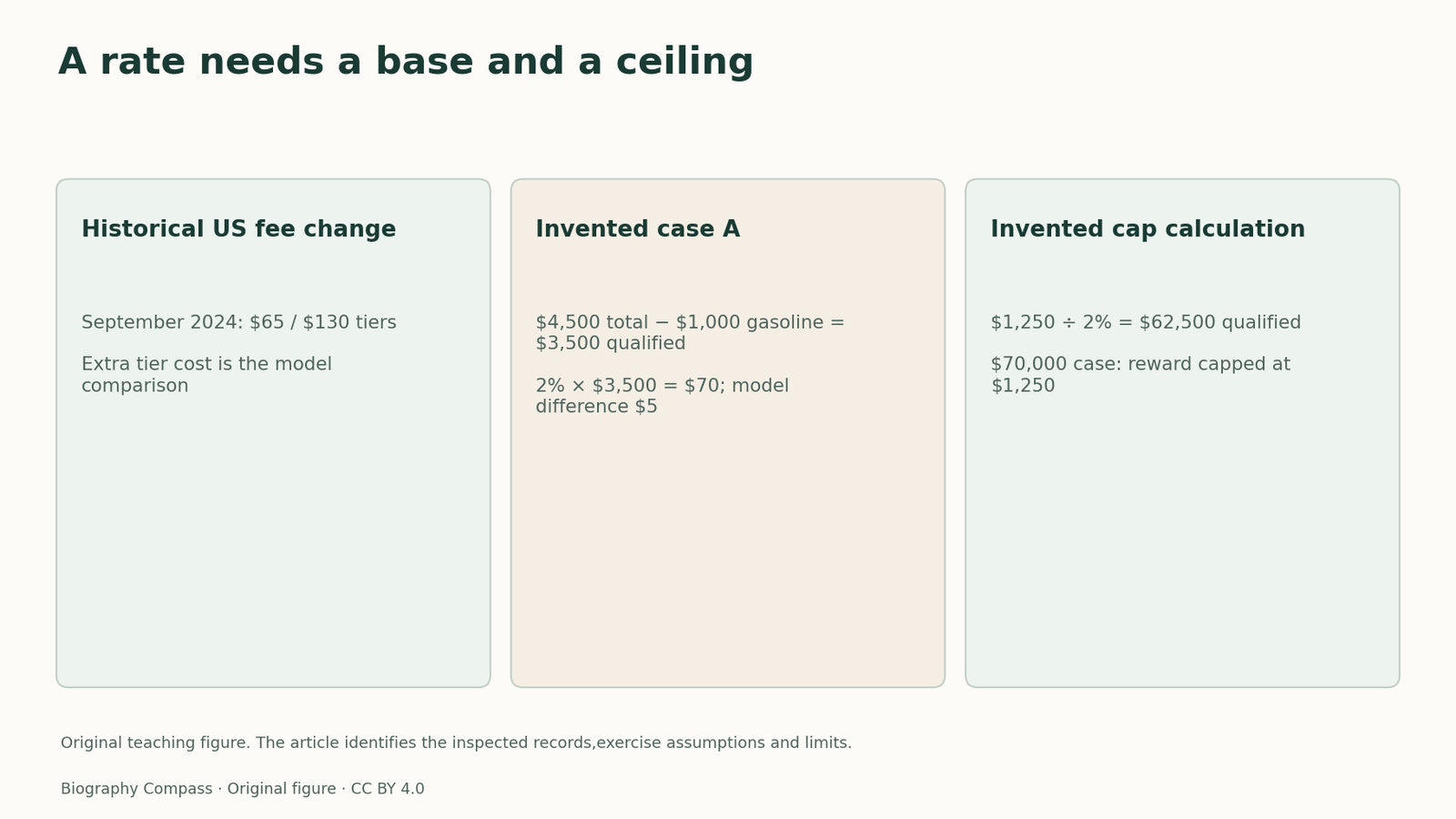
Effective 1 September 2024, Costco’s US notice raised Gold Star membership from $60 to $65 and Executive membership from $120 to $130. The maximum annual Executive reward rose from $1,000 to $1,250. The relevant comparison for an existing basic member is the additional tier cost, rather than the whole Executive fee. The notice supplies a dated price change; it does not establish that the resulting reward applies to every purchase or that every member benefits equally.
Sources for this section: [1]
The percentage has a qualified base and a cap
The selected reward terms specify 2% on qualified purchases, a $1,250 annual ceiling and a $65 upgrade fee. Exclusions include gasoline, membership fees and taxes; purchases before upgrading do not qualify. Those exclusions are enough to invalidate an unqualified “everything bought at the warehouse” calculation. They are not the full list of conditions. The model below deliberately supplies a complete eligible base and assumes a full post-upgrade year, so it does not need to guess at transaction dates or other benefit values.
Sources for this section: [2]
Original task: separate total spending from qualifying spending
Invented US case A: $4,500 total spending includes $1,000 of gasoline; all remaining $3,500 is stipulated to qualify. Assume no refunds, no taxes in those amounts, one full model year of post-upgrade purchases, no value assigned to other benefits and no certificate-issuance or redemption timing effects. Case B instead has $70,000 of qualifying spending under the same assumptions. Calculate the nominal reward and subtract the additional tier cost. Also find the qualifying-spend level where the nominal reward equals that extra cost, before the cap.
Reference answer: A gives 0.02 × $3,500 = $70, or $5 above the stipulated $65 upgrade. Applying the rate to the $4,500 total would wrongly produce $90. B gives an uncapped $1,400, reduced to $1,250 by the ceiling; the model difference is $1,185. The nominal equality point is $65 ÷ 0.02 = $3,250 of qualifying spending. The cap begins at $1,250 ÷ 0.02 = $62,500.
What the result does and does not mean
The result is a reward-value comparison under supplied assumptions, not a profit calculation or a personal recommendation. It does not price time, travel, alternative retailers, restrictions on redemption or other membership benefits. It also does not convert a later fee decision into a decision by a retired cofounder. The concrete historical finding is that the fee notice and the qualification rules answer different parts of one pricing mechanism; neither alone supplies the whole calculation.
Continue the chronology
Related history guides
Biography context
Explore United States through connected lives
Connected biographies
The connected careers
Quick answers
Common questions
- Why is total spending the wrong base in case A?
- The invented total contains an explicitly excluded category; the model rate applies only to the separately supplied qualifying amount.
Primary and institutional sources
How this history was checked
Read these dated records together; the original task states its own assumptions and separates them from reported facts. This article was reviewed on 31 October 2026.