
The short answer
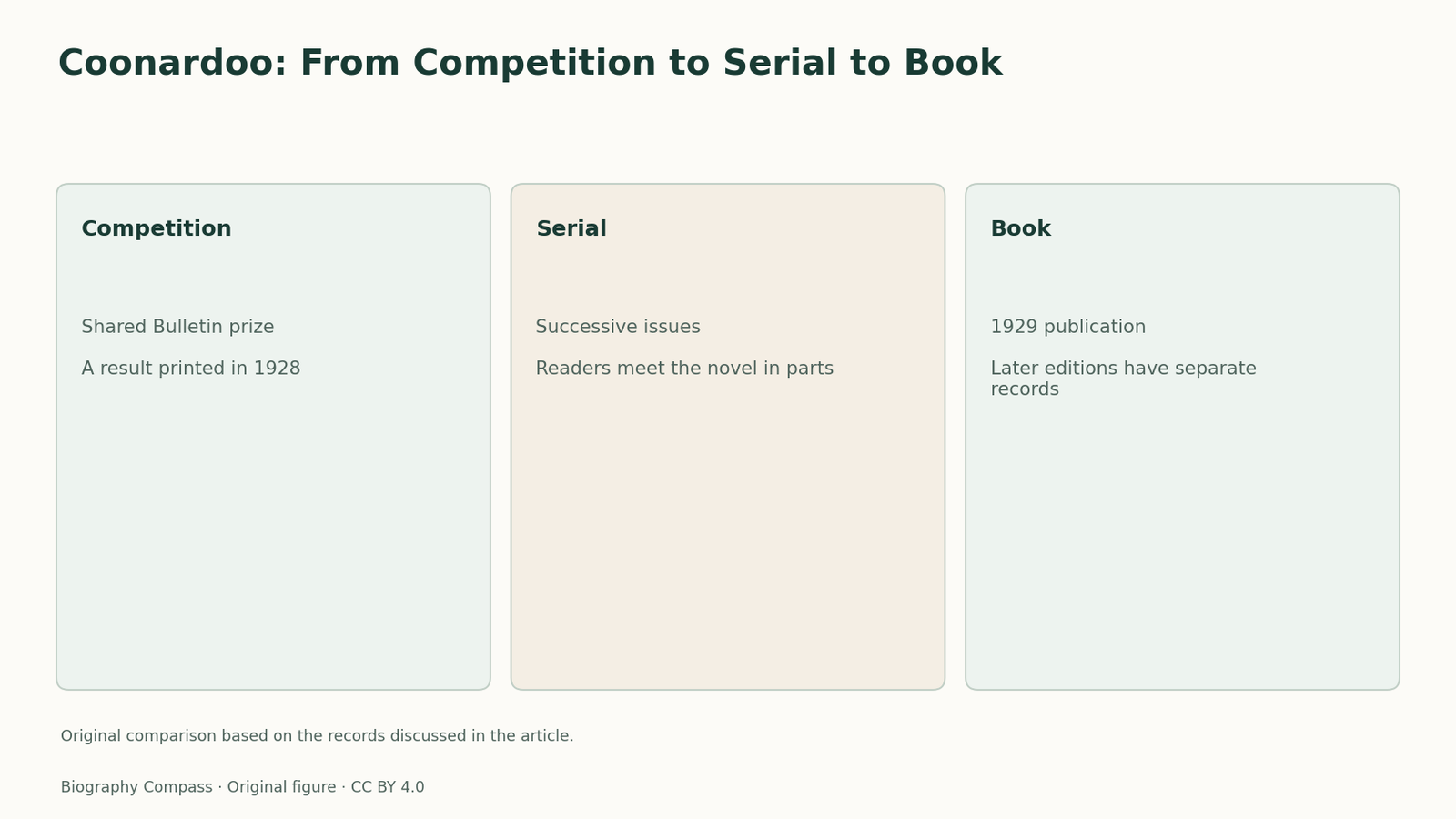
Coonardoo entered public life through a literary competition, newspaper serialisation and a book. Those events are connected, and each is a different thing a reader can document. The sequence helps explain why 1928 and 1929 both appear in records of the novel.
Evidence comparison
Coonardoo in three publishing settings
Give each event its own date and source.
| Event | What it documents |
|---|---|
| 1928 competition | Shared recognition before book publication. |
| 1928 serial | Public reading in successive issues. |
| 1929 book | Publication as a volume. |
The prize is an event in the book’s history
The Bulletin’s competition brought Coonardoo to public notice in 1928. It shared the prize with A House Is Built. A digitised issue records the competition in the periodical’s own pages. That fixes the recognition to a particular setting and year. It also keeps the shared award visible. A catalogue label saying that Coonardoo won a prize can be correct and still omit the other work and its jointly credited authors. Restoring those details gives the result a fuller publishing context.
A serial has a different rhythm
The novel appeared in the Bulletin later in 1928. Publication in parts lets a newspaper bring a long text to readers in successive issues. It also creates intervals in which a reader can form expectations or encounter responses before the next part arrives. That is an analytical consequence of the form, rather than evidence that every reader reacted in a particular way. The scholarly account describes dispute about the novel during this period. Anyone making a more specific claim about an issue or a pause in the story should identify the actual instalment.
The book and later edition need their own labels
The 1929 book is the next publication event. A present-day publisher’s page gives access to a later edition and identifies the novel’s setting and central relationship. These three objects carry different evidence. The prize announcement documents selection. The serial belongs to a sequence of periodical issues. The book brings the work together under one cover, and a modern edition can add material that frames it for a new audience. Keeping edition dates separate avoids making a present-day cover or introduction stand in for what a reader saw in 1928.
Do not let a publication milestone settle the reading
The novel’s treatment of Aboriginal people, work and power generated debate. Its origins in Prichard’s observations can explain where she gathered some material. They cannot establish that a fictional character’s speech represents all the people whose experience the novel addresses. A responsible comparison asks two questions: how did readers receive this published work, and what evidence would support a historical claim about life on a station? A contest result, a letter to a periodical and an account by a person who lived under the system cannot be treated as equivalent answers. Their difference gives the controversy more historical substance.
A citation exercise for two dates
Write a short citation for an argument about the contest and another for a discussion of a passage in the book. The first should identify the periodical and date. The second should identify the edition actually consulted. This makes 1928 and 1929 complementary dates instead of competing answers. If comparing the serial text with the book, look up both passages before claiming that wording or chapter divisions changed.
Biography context
Explore Australia through connected lives
Connected biographies
People connected to the work
1883–1969
Katharine Susannah Prichard
Novelist, playwright and political activistKatharine Susannah Prichard used working communities as material for fiction and drama. Coonardoo’s publication history makes the competing pressures on her work particularly visible.Read biography1901–1985
Eleanor Dark
Novelist and writerEleanor Dark wrote psychologically focused novels and researched a trilogy about the early British colony in New South Wales. Her home at Varuna became part of a later literary institution.Read biographyQuick answers
Common questions
- Why is Coonardoo sometimes dated 1928 and sometimes 1929?
- The competition and serial belong to 1928. The book appeared in 1929.
- Was the Bulletin prize shared?
- Yes. Coonardoo shared it with A House Is Built by M. Barnard Eldershaw.
Primary and institutional sources
How this history was checked
Dates, legal milestones and historical claims are checked against the official and institutional records below. This article was reviewed on 13 November 2026.