
The short answer
International cooperation is easier to understand when the participating country, the working group and the supporting secretariat remain distinct. The charter offers a concrete structure for making those relationships visible.
Read the specified record
Read roles before adding rows
Counts of organisations, people or assignments answer different questions.
| Item | What it describes | What it does not count |
|---|---|---|
| Member country | An independent participating state. | A working group or a measured outcome. |
| Action Group | A particular cooperation task. | Every institution serving a country. |
| Champion assignment | A leadership role in one group. | All unique countries automatically. |
Chronology
A timeline of the turning points
Declaration
Country-led ocean cooperation.
Publication inspected
A dated edition reproduces the declaration.
The declaration preserves national responsibility
The declaration dated 20 April 2018 recalls that Commonwealth members are independent sovereign states responsible for their own policies. Clauses 23 and 24 connect cooperation with sharing knowledge and with interested countries leading or joining Action Groups; clause 32 sets out a country-led plan of action.
These clauses describe coordination across institutions. They should not be read as replacing every member’s government with a single ocean authority. A shared priority still needs a place where expertise, responsibility and practical work can meet.
Sources for this section: [1]
A Champion is a role within a particular group
The implementing page names the United Kingdom and Vanuatu as co-leads on marine plastic pollution. It lists Australia, Belize and Mauritius for coral reefs, and Barbados and Seychelles for marine protected areas.
The examples make co-leadership concrete. A country name is not the name of an Action Group, and a leadership assignment is not a count of every participating country. The institutional role must accompany the name before a table or diagram can be interpreted.
Sources for this section: [2]
Original membership model
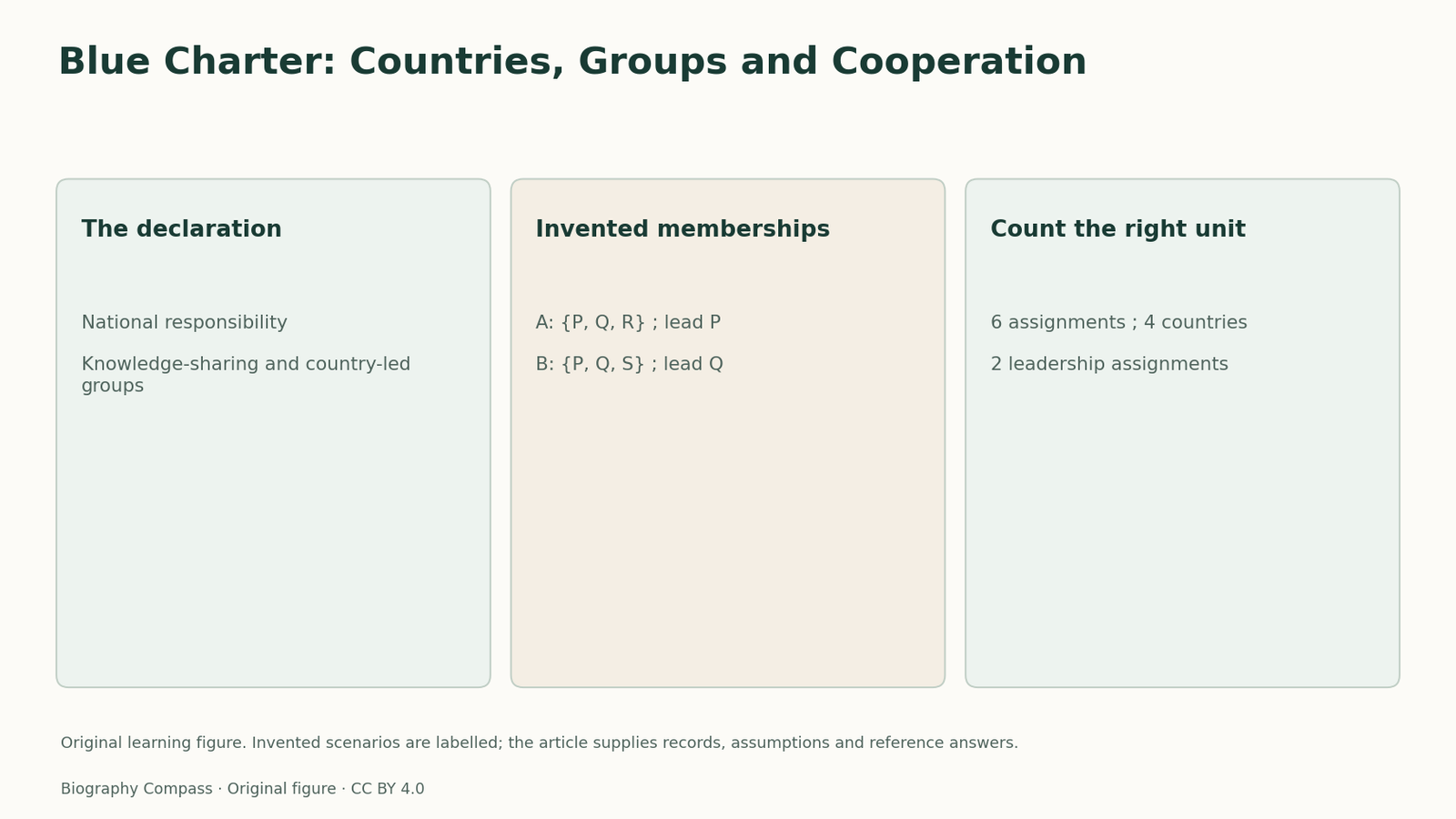
Invent Group A with members P, Q and R, led by P. Invent Group B with members P, Q and S, led by Q. In this model a lead country is included in its group’s membership. Count membership assignments, distinct countries and leadership assignments. Describe P’s two roles.
Reference answer: six membership assignments, four distinct countries and two leadership assignments. P leads A and also participates in B. Adding row lengths double-counts P and Q when the question is about unique countries; it is correct when the question is about assignments. The supplied letters are not actual Blue Charter membership data.
Use the structure before claiming a result
A useful project note would identify the group, its intended task, the participants’ responsibilities and the observations by which progress could be assessed. A network diagram can show relationships without pretending to measure a change in water quality or restored habitat.
The 2021 booklet reproduces the 2018 declaration. Its publication date, the declaration date and later web descriptions are different timestamps. The exercise keeps its own invented memberships separate from all three, so a changing country total on a current page is not silently projected back into 2018.
Continue the chronology
Related history guides
Biography context
Explore Worldwide through connected lives
Connected biographies
A connected working life
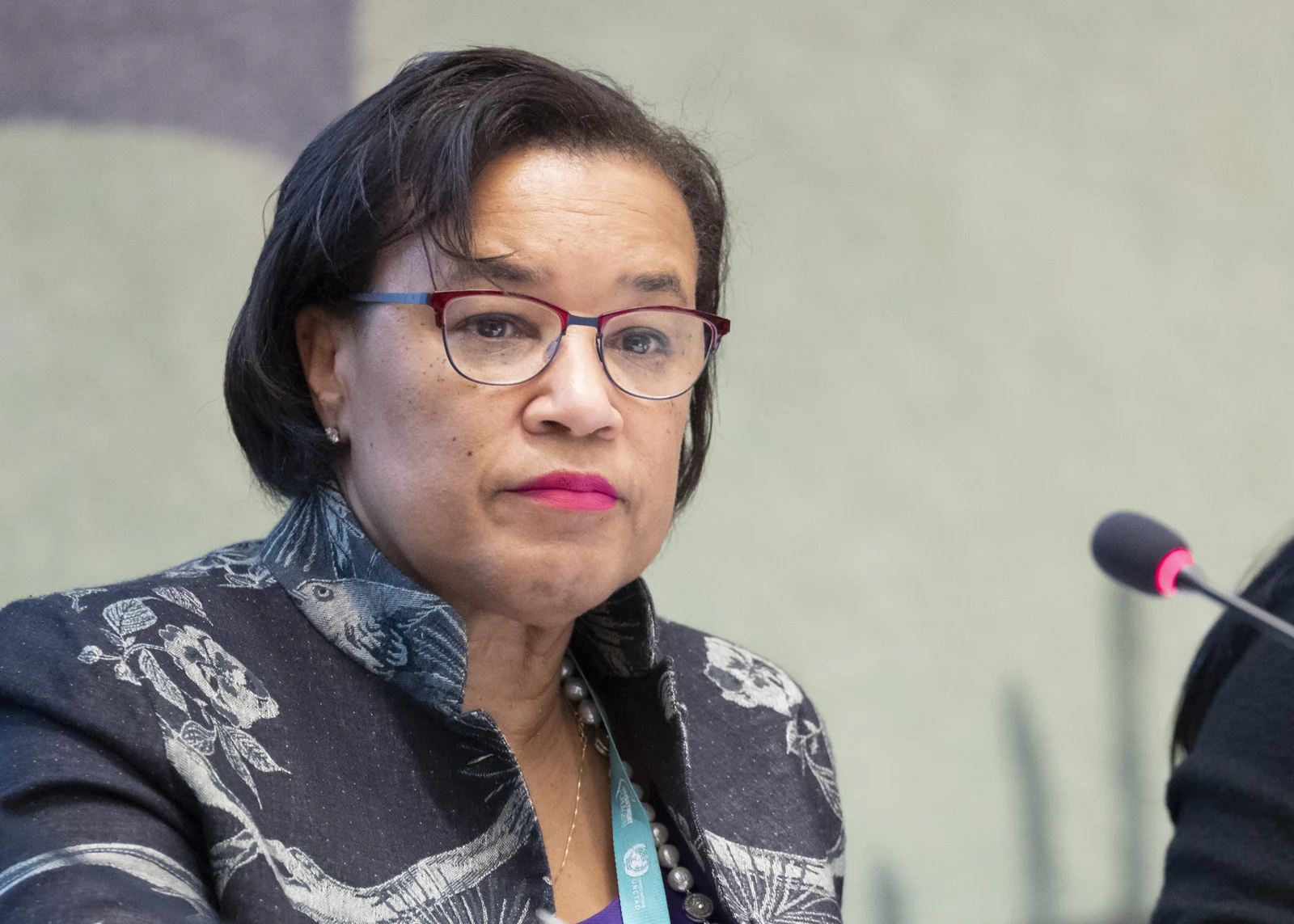
Born 1955
Patricia Scotland
Lawyer and former Commonwealth Secretary-GeneralHer career connects legal practice, government and the work of coordinating a shared international institution.Read biographyQuick answers
Common questions
- Are the six assignments six different countries?
- No. In the invented model two countries participate twice, so there are four distinct countries.
Primary and institutional sources
How this history was checked
The study identifies selected records and their dates. Its invented examples are learning models, with reference answers supplied in the article. This article was reviewed on 31 October 2026.