
The short answer
A machine can move liquid yet fail to preserve the separation its design describes. Follow the return path as well as the supply path, keeping the patent’s stated arrangement distinct from later appliance summaries.
The records answer different questions
Keep the measures separate
The question changes when the object, unit or reporting period changes.
| Record or measure | What it establishes | What it does not establish |
|---|---|---|
| Supply path | Where liquid reaches the working space | Its return destination |
| Return mechanism | How the described separation is maintained | A measured cleaning result |
| Commercial history | Customers and operating constraints | Universal household suitability |
Chronology
A timeline of the turning points
Application
A particular design is submitted.
Patent
Specification and claims are distinct parts.
Read the particular arrangement
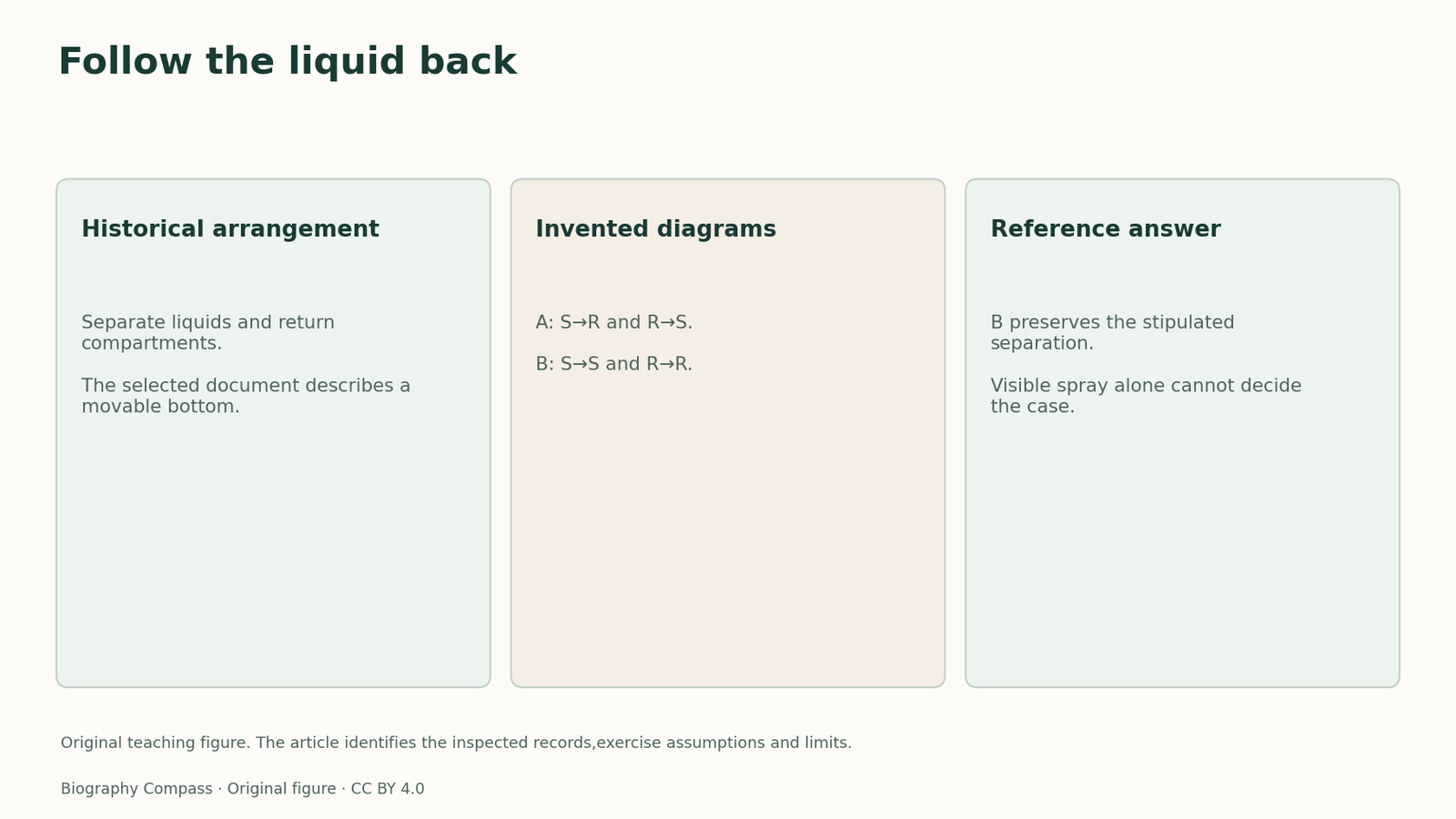
The opening specification describes soapy water and clear hot water supplied to racks in a rotating crate. Two compartments and a movable bottom return each liquid to its appropriate pump for reuse.
This account concerns a particular arrangement in the filed document. A general modern biography’s description of a dishwasher should not silently replace its components with those of a later model. The selected drawing and text identify an operating lever, not a claim that every subsequent machine used the same power source.
The return path is part of the function
Claim 1 combines the washing box, connected receptacles and a movable bottom that covers one receptacle and diverts returning water into the other.
The critical relationship is between selection and return. Merely seeing water reach dishes would not establish that the described separation was maintained. The document makes the return destination part of the arrangement, rather than an incidental drain outside the system. This close reading does not assess sanitation or determine the scope of any present patent.
Sources for this section: [1]
Original two-label routing exercise
Use an invented abstract system with reservoirs S and R. During an S phase, the supplied liquid must return only to S; during an R phase, only to R. Assume perfect pumps, no leakage and no other source of mixing. Diagram A sends S→R and R→S. Diagram B sends S→S and R→R. Which preserves the stipulated separation? What observation would distinguish them if both still produce a visible spray?
Reference answer: only B meets the supplied return rule. A swaps the destinations and violates separation in both phases. Observing spray is insufficient; track the labelled returning liquid’s destination. The answer follows the stated model assumptions, not an experiment performed on the historic machine. No flow rate, pressure, temperature or cleaning result is supplied.
Sources for this section: [1]
A mechanical design and a commercial market
Commercial customers adopted the machines before ordinary households, whose hot-water capacity could be a constraint.
Cochrane also sold, installed and improved the machines.
The commercial story thus requires more than a clever internal mechanism. A suitable site and a customer able to support its operation also mattered. The record comparison teaches two connected questions: what the particular design did with liquid, and why a working design did not immediately imply universal household adoption.
Continue the chronology
Related history guides
Biography context
Explore United States through connected lives
Connected biographies
The connected careers
1839–1913
Josephine Cochrane
Inventor and manufacturerCochrane developed and sold dishwashers.Read biographyQuick answers
Common questions
- Does visible spray prove correct routing?
- No. Both invented diagrams can spray while only one preserves the stipulated returns.
Primary and institutional sources
How this history was checked
Read these dated records together; the original task states its own assumptions and separates them from reported facts. This article was reviewed on 31 October 2026.