
The short answer
A familiar name for parliamentary debate grew out of private publishing. The early publications need to be read in their original commercial and reporting context.
Evidence comparison
Read the records together
The records were created for different purposes and support different kinds of claims.
| Record | What it establishes | Question to keep open |
|---|---|---|
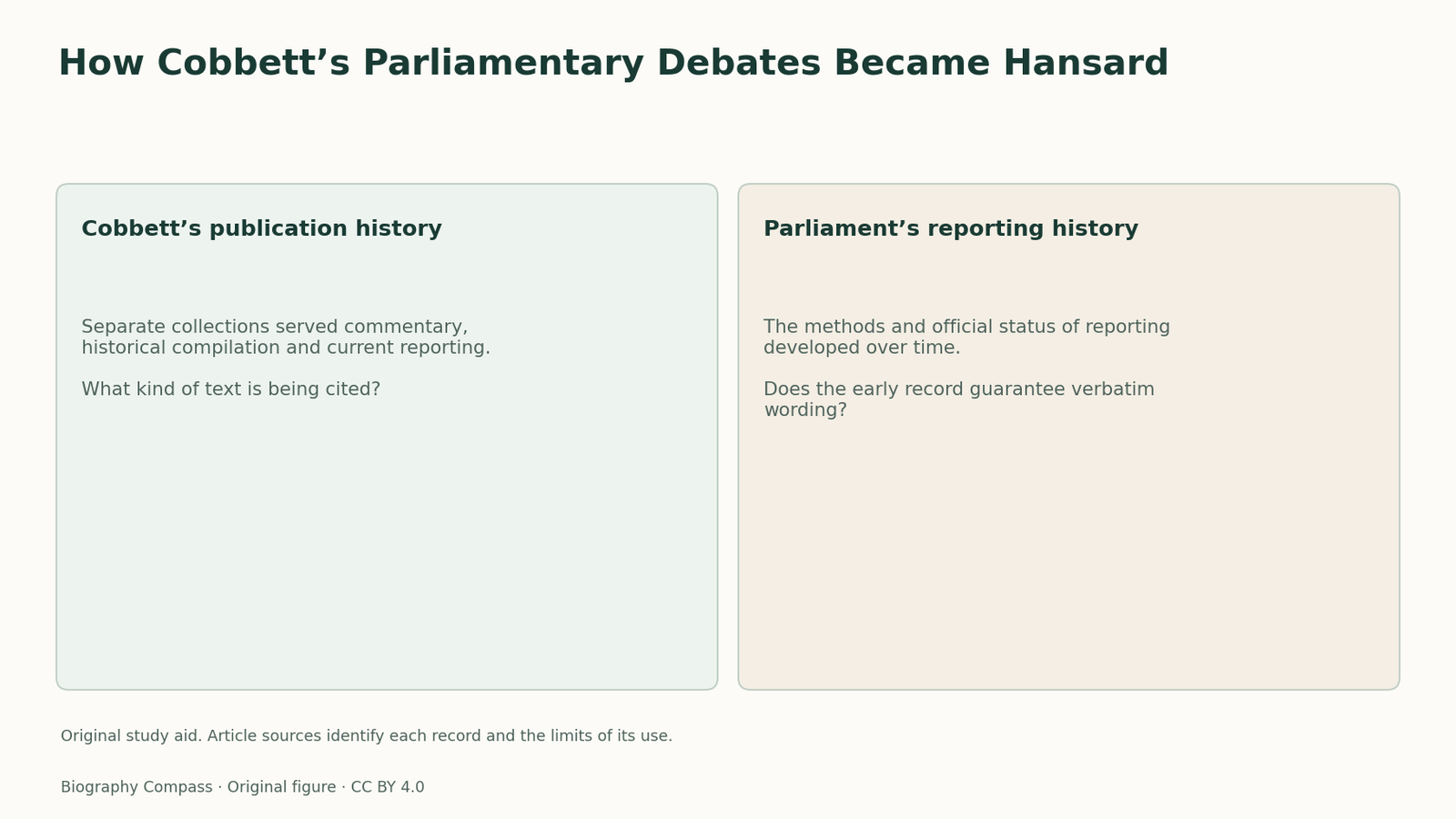
| Cobbett’s publication history | Separate collections served commentary, historical compilation and current reporting. | What kind of text is being cited? |
| Parliament’s reporting history | The methods and official status of reporting developed over time. | Does the early record guarantee verbatim wording? |
Chronology
A timeline of the turning points
Separate debates
Debate reports appear as a distinct publication.
Transfer of interests
Cobbett sells his documentary publishing shares.
Identify the publication’s job
The Political Register combined political commentary with access to debate reports. Parliament’s collection history dates the weekly publication from 1802, while its general reporting overview uses an earlier starting date. Both accounts identify the movement from supplements to a separate parliamentary publication. Preserve that limited agreement rather than forcing the two summaries into a single unsupported founding date. The separate debates appeared in 1803, giving a more secure point in the publishing sequence.
Ask how the words were obtained
Parliament’s reporting history describes an earlier practice in which journalists reconstructed speeches from memory. Restrictions on note-taking were eventually relaxed, but publication did not immediately acquire the status or precision of a modern official transcript. A reader quoting an early debate should therefore identify the edition and reporting circumstances. The existence of a printed speech establishes that a report circulated, while exact wording may require attention to editorial mediation and competing versions.
Sources for this section: [3]
Follow ownership without assuming official status
Cobbett’s projects included a large retrospective parliamentary history, state trials and contemporary debates. He sold his shares in all three in 1812. That business transaction helps explain the transition to the Hansard name. It does not itself establish that Parliament commissioned every volume or guaranteed each reported word. Ownership, publication format and institutional authority are separate questions that need their own evidence when tracing the development of the record.
Sources for this section: [2]
Annotate a citation correctly
Draft a citation for an early debate with spaces for the sitting date, printed volume, publisher and type of report. Then add a short caution if the account was reconstructed or retrospectively compiled. The strongest answer describes an identifiable printed report without calling it a stenographic transcript. Compare it with a modern official record to see how a shared historical label can cover publications produced under substantially different reporting arrangements.
Continue the chronology
Related history guides
Biography context
Explore United Kingdom through connected lives
Connected biographies
People behind the records
1763–1835
William Cobbett
Political journalist, farmer and parliamentarianCobbett used journalism and documentary publishing to connect political reform with the circumstances of working people.Read biographyQuick answers
Common questions
- Did the 1812 sale make the reports official?
- The sale establishes a change in ownership. Official status and reporting methods require separate evidence.
Primary and institutional sources
How this history was checked
Sources support the chronology and the record comparison. The reading exercise is original. This article was reviewed on 7 November 2026.