
The short answer
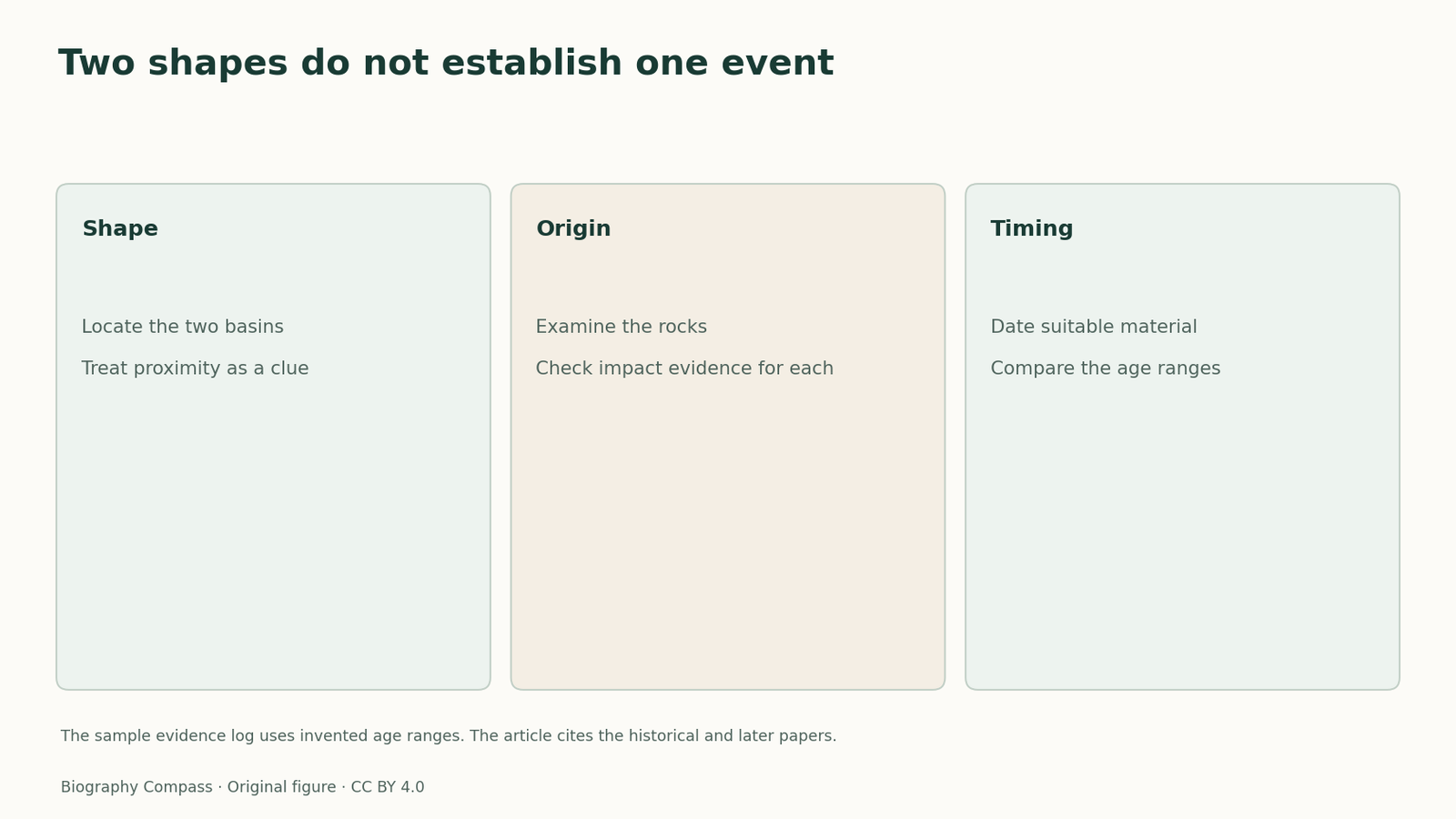
Two nearby ring-shaped structures can suggest a shared explanation. Establishing that both are impacts does not, by itself, show that they formed at the same time.
Reading the evidence
Three tests for a proposed double impact
Match the type of evidence with the claim it can answer.
| Stage | Evidence | Question it can address |
|---|---|---|
| Shape | Two circular basins in a mapped field. | Where to look and what to compare. |
| Origin | Geological evidence in the rocks. | Whether each structure formed by impact. |
| Age | Independent dates from suitable material. | Whether the impacts were contemporaneous. |
Make the original proposal explicit
Innes and Beals discussed the two Clearwater Lake basins and proposed impacts from a related pair of objects. The proposition has two parts. One concerns the origin of each basin. The other concerns the relationship between their dates. An aerial shape and the proximity of the lakes were useful clues for deciding what to investigate.
Library and Archives Canada describes a broader programme that paired aerial photographs with field investigation. Read the image as a search tool. The shape of a lake does not in itself date its formation or identify the process responsible for it.
Read a later test of timing
Schmieder and colleagues reported argon dating from impact melt material from both structures. The results supported separate ages rather than a single event. That comparison can revise the shared-event proposal while leaving the evidence for impact origins in place. A later measurement can reject one part of a historical explanation without discarding the observation that prompted it.
The distinction also explains why the basins should be described using the estimates from the work actually cited. Later research can revise geometry as well as timing.
Try a two-site evidence log
Imagine two circular sites with rocks consistent with impact and independent age ranges that do not overlap. Record the evidence for origin in one column and the evidence for simultaneity in another. The origin may be supported at both sites while the shared date is not. If the age ranges overlap instead, the dates would be consistent with a shared event, but overlap alone would still be weaker than a demonstrated connection.
Continue the chronology
Related history guides
Biography context
Explore Canada through connected lives
Connected biographies
People in the records
1899–1979
Carlyle Beals
Spectroscopist and Dominion AstronomerBeals studied stellar spectra and later led a Canadian programme investigating possible impact structures.Read biographyQuick answers
Common questions
- Does a confirmed impact origin prove the lakes formed together?
- No. The origin and timing of each structure need distinct evidence, and later dating supports different impact ages.
Primary and institutional sources
How this history was checked
Dates, legal milestones and historical claims are checked against the official and institutional records below. This article was reviewed on 5 November 2026.
- Library and Archives Canada, Carlyle Smith Beals fondsCarlyle Smith Beals: a great Canadian astronomer
- Innes and Beals, The Astronomical JournalOn the Probable Meteorite Origin of the Clearwater Lakes, Quebec
- Schmieder and colleagues, Geochimica et Cosmochimica ActaNew argon dating of the Clearwater Lake impact structures