
The short answer
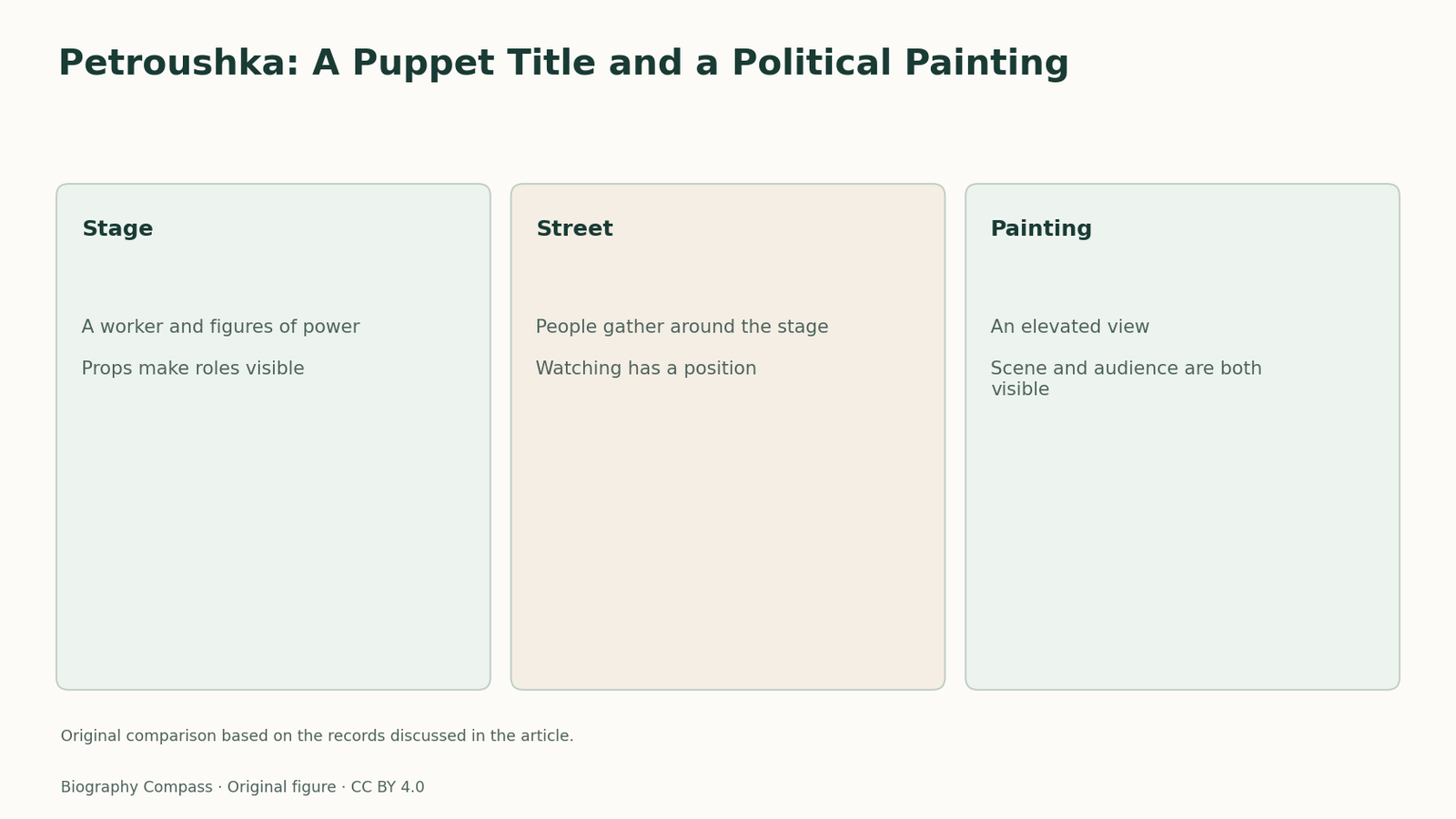
Petroushka places a puppet theatre inside a painted public scene. The viewer looks down on its audience and sees figures that carry different forms of power. Clark’s use of a familiar puppet gives the political relation a shape rather than illustrating it in words.
Evidence comparison
Watchers and actors in one scene
Distinguish visual identification and interpretation.
| Position | Reading task |
|---|---|
| Puppet stage | Identify the different roles shown through props. |
| Crowd | Ask how watching becomes part of the subject. |
| External viewer | Consider what the elevated view makes available. |
The puppet comes from one setting and acts in another
The exhibition records identify Petroushka as a 1937 oil painting in the National Gallery of Canada. Its title refers to a puppet figure, and the essay explains Clark’s adaptation of a popular character to a contemporary argument about workers. The picture makes this move through a theatre inside the scene. A viewer does not have to assume that all spectators in the depicted street share the same point of view. They have gathered around a performance, and the painting gives the observer a position from which to look at both the performance and the gathering.
Separate the parts of the allegory
The museum description and the related essay identify figures associated with money and policing alongside the worker represented through the puppet story. That arrangement makes a relation visible. One figure can control or constrain another, and another can watch without changing the relation. In describing the painting, preserve the difference between what the painted props identify and what the political reading infers from them. A uniform or a bag of money can help identify a role. The relation among figures gives the objects their force. Looking at the roles separately helps explain how a particular scene can support a broader argument.
The viewpoint includes people who watch
An elevated view shows more than a spectator standing directly in front of the little stage might see. The essay relates the viewpoint to a crowd gathered around the performance. The position gives the painting a way to place an audience inside its own subject. The observer can see that other people have come to see something and can ask what sort of attention they bring. An interpretation that begins and ends with identifying the puppets would leave that audience unexplained. The crowded setting is another decision through which the artist situates the allegory in public life.
Compare a puppet role with a spectator’s role
Sketch three positions in a generic diagram: a figure acted upon, a figure holding power and someone who can see the relation without intervening. Put the observer outside the diagram and decide what that person can see that an individual inside it may miss. This original exercise isolates the relation between a staged incident and a public response. It helps a reader ask why Clark placed the puppet story where people could watch it. The answer can involve both political content and a compositional decision about whose attention is represented.
Check the distinction in a dated exhibition
Clark showed the work with other paintings in 1937. An exhibition record can establish that public presentation. The painted spectators remain part of the image, while actual viewers at the exhibition belong to a separate history of reception.
Biography context
Explore Canada through connected lives
Connected biographies
People connected to the work
1898–1986
Paraskeva Clark
PainterParaskeva Clark brought experience of Russian art and theatre into a Canadian painting career. Petroushka gives a concrete example of her use of public subjects and figure composition.Read biography1896–1947
Prudence Heward
PainterPrudence Heward made figure paintings that give a sitter a specific relation to the space around her. Girl on a Hill is an example with a named sitter and a documented exhibition history.Read biographyQuick answers
Common questions
- What does the title Petroushka refer to?
- It invokes a puppet figure that Clark adapted to a political scene.
- Why is the crowd part of the reading?
- It makes watching a visible role, distinct from the roles of the figures on the puppet stage.
Primary and institutional sources
How this history was checked
Dates, legal milestones and historical claims are checked against the official and institutional records below. This article was reviewed on 13 November 2026.