
The short answer
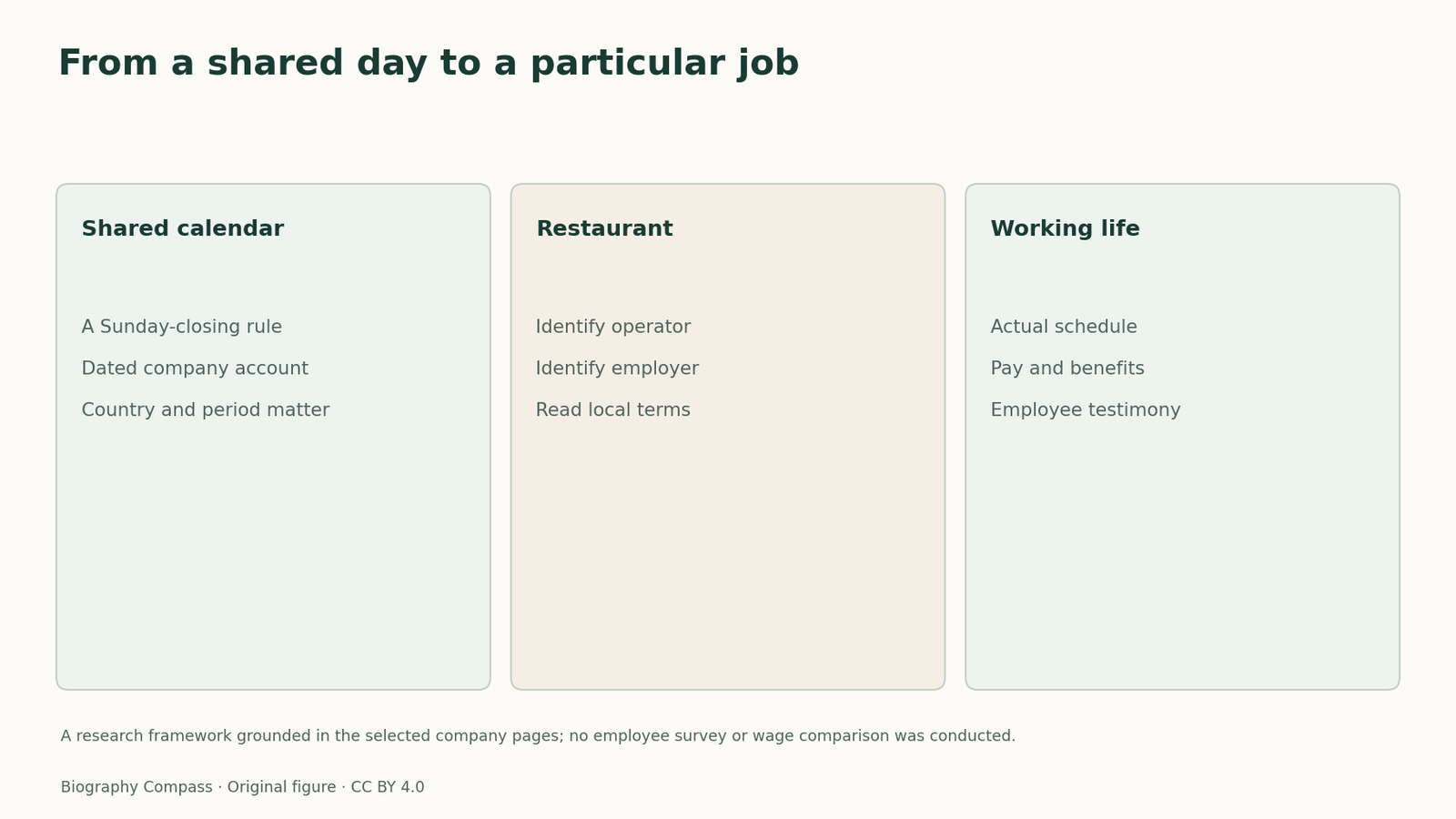
One visible rule can become shorthand for a whole business culture. A more careful reading separates a day on the calendar from the people and arrangements that organise the rest of restaurant work.
Evidence and interpretation
A policy is one part of a workplace record
The selected sources describe different people and jurisdictions.
| Question | Evidence it supplies | Evidence still needed |
|---|---|---|
| Company origin account | Its explanation of Sunday closure. | Independent employee experience. |
| Canadian employee page | Benefits vary across individual restaurants. | Actual terms at a named location. |
| US operator recruitment | A full-time operating commitment. | A staff member’s working schedule. |
| Original research plan | Policy → employer → schedule → testimony. | A particular completed workplace study. |
A dated origin story
Chick-fil-A says Cathy chose Sunday closure in 1946 after knowing the demands of seven-day restaurant work. It presents a day of rest and the option of worship as the reasons, and says the practice continues.
This gives a date and the company’s explanation of its founder’s decision. It does not measure every employee’s hours or establish a worker’s personal beliefs. A biography can include the religious and practical context without assuming that those contexts explain every later workplace experience.
Sources for this section: [1]
A brand rule and a local employer are different layers
The Canadian employee page says most restaurants are individually operated by franchisees and that compensation and benefits vary by restaurant. It also states the common Sunday closure.
The United States franchise recruitment page describes a full-time, hands-on operating commitment. Selection requirements concern the prospective operator, not an account of every employee’s working week.
Read the geographic scope before combining these statements. The Canadian page is not a wage survey of the United States, and a recruitment page is not an employee contract. The sources nevertheless help identify distinct levels: a shared brand practice, an operator’s responsibilities and the particular terms under which an individual works.
Closure is not a measure of the whole job
Suppose two invented restaurants both close on Sunday. At one, a worker has four long shifts; at the other, five shorter shifts. The shared closure tells us nothing about their total hours until those shifts are specified. It also tells us nothing by itself about pay, predictability, leave or whether a worker has another job.
The point is not to infer good or bad conditions from an imagined case. It is to choose the correct evidence for a question. A calendar rule answers when a restaurant is closed. Payroll and schedules answer some questions about paid work; worker testimony can address experiences that a policy page does not describe.
An evidence plan for a better company history
A useful research project would select a country and period, identify the operator and employer at each location, then compare a dated calendar policy, actual schedules and accounts from staff. Keep the founder’s account as one part of that record rather than a substitute for the others.
This also helps distinguish business history from a management slogan. Cathy’s decision is historically significant because a chain preserved an unusual operating choice. Its consequences require evidence at the level at which the consequences occurred. The related biography supplies his working life; this page explains how to investigate the policy as an organisation grows.
Continue the chronology
Related history guides
Biography context
Explore United States through connected lives
Connected biographies
The working life
1921–2014
S. Truett Cathy
Restaurant entrepreneurCathy built a restaurant business from a small diner.Read biographyQuick answers
Common questions
- What does Sunday closure tell us about an individual job?
- It identifies a shared closing day. An employee’s hours, pay and benefits need evidence from the particular workplace.
Primary and institutional sources
How this history was checked
Selected passages and records support the discussion below. Original reasoning and invented classroom cases are labelled; no whole-archive or product-testing claim is made. This article was reviewed on 4 November 2026.