
The short answer
How do repeated schoolgirl figures carry different situations without becoming a literal news record?
Read the evidence
Sources, interpretation and production roles
The records answer different questions about this work. The final exercise is an original teaching model.
| Record or question | Supported reading | Boundary or contrast |
|---|---|---|
| NGV work discussion | Links Rooftop 1953 with the motif and surroundings. | A reading of one drawing is not a universal code for the whole series. |
| 1979 artist interview | Records several overlapping associations. | The artist resists a single literal explanation. |
| Original reading plan | Separates motif, setting and a proposed relationship. | No painting or literary passage is reproduced. |
A series is more than one image
Charles Blackman’s schoolgirls recur across works of the early 1950s, including Schoolgirl with a Bicycle and Rooftop. A series creates recognition while allowing situations to change. A familiar figure can appear vulnerable in one arrangement and elusive in another. Identifying the repeated motif is therefore a beginning: the next question is how a particular work places it within a street, a building or an imagined spatial relationship.
Several encounters fed the motif
Jennifer Phipps’s NGV account connects the schoolgirls with schools near the Blackmans’ Hawthorn surroundings and with their reading of John Shaw Neilson. Blackman’s 1979 interview offers a more complicated account than a single-source origin story. He discussed associations involving schoolgirls, poetry and Barbara’s blindness while resisting a reductive explanation proposed by others. A life circumstance can matter without becoming a literal caption for every object in a painting.
Rooftop and the problem of security
The NGV discussion identifies Rooftop as a 1953 charcoal drawing and connects roofs and houses with psychological associations of security. This is a focused interpretive proposal attached to a particular work. It does not establish that all buildings in the series mean the same thing. Read together with the interview, it suggests a productive tension: a repeated built form can invite psychological associations while the artist’s invented world remains open to more than a single biographical decoding. Comparing two series works can then focus on what the recurring figure is allowed to do differently. A bicycle, a roof or a street provides a changed relation, not merely another illustration of a predetermined private meaning.
Original exercise: motif, setting, interpretation
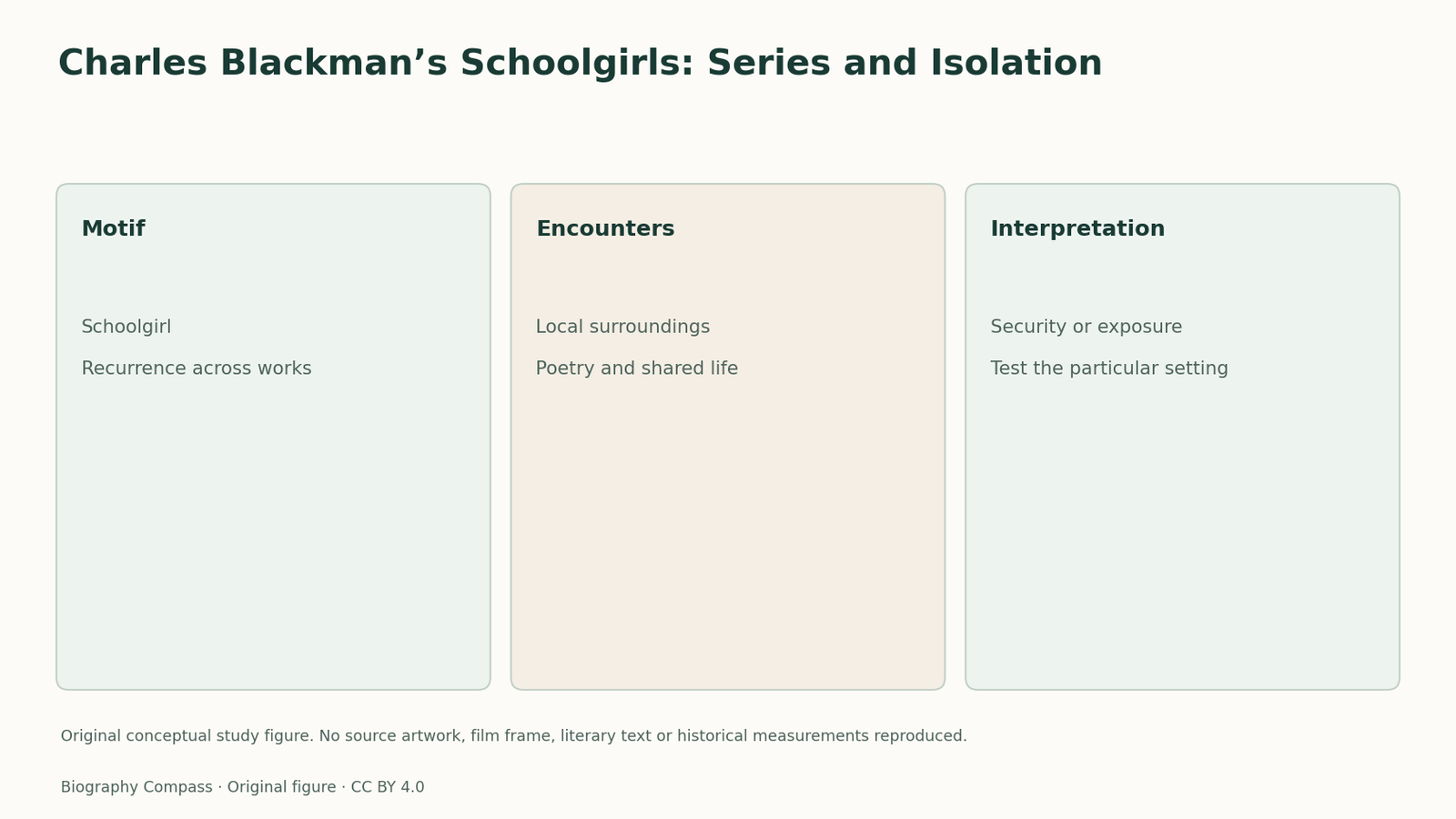
Make a three-part reading plan without copying an artwork. In the first box place the phrase “recurring schoolgirl”; in the second put “street”, “roof” or “bicycle”; in the third formulate a question about a relationship, such as whether a setting shelters or isolates the figure. A possible response connects a roof with the idea of security while treating that as an interpretation to test against the particular work. Another response may explain why height or separation makes the setting feel precarious. Neither should claim to recover a hidden event in Barbara’s life from a shape alone. The model separates recurrence from repetition: a series can retain a figure while changing what happens around it. It also explains why a catalogue account of one drawing and a later interview can be complementary evidence rather than competing final answers. The resulting interpretation should say what the setting does, not merely list the artist’s possible influences.
Continue the chronology
Related history guides
Biography context
Explore Australia through connected lives
Connected biographies
People and related creative practices
1928–2018
Charles Blackman
Australian painter and draughtsmanCharles Blackman developed recurring figures of vulnerability and imagination in schoolgirl paintings, drawings and his Alice in Wonderland series.Read biography1920–1999
John Brack
Australian painter and art teacherJohn Brack moved from insurance work and art school into teaching and a sustained painting career focused on social arrangements, rituals and ordered forms.Read biographyQuick answers
Common questions
- Do all schoolgirl paintings have one biographical meaning?
- The inspected interview does not support that reduction. Interpret individual arrangements alongside the documented associations.
Primary and institutional sources
How this history was checked
Sources include production records, institutional collections and the specifically identified passages discussed here. Interpretations and teaching models are distinguished from credits and publication facts. This article was reviewed on 8 November 2026.
- National Gallery of AustraliaCharles Blackman obituary
- National Gallery of AustraliaCharles Blackman interviewed by James Gleeson
- National Gallery of VictoriaCharles Blackman: Joseph Brown Collection
- National Gallery of VictoriaSchoolgirls and Angels
- National Gallery of VictoriaCharles Blackman’s Feet Beneath the Table