
The short answer
How could Catholic emancipation widen access to Parliament while a companion law narrowed part of the electorate? Read the original Acts as different interventions, rather than treating emancipation as universal suffrage.
Original source comparison
What does each record establish?
The document’s purpose and scope define the strongest supported claim.
| Country | Supported statement | Limit |
|---|---|---|
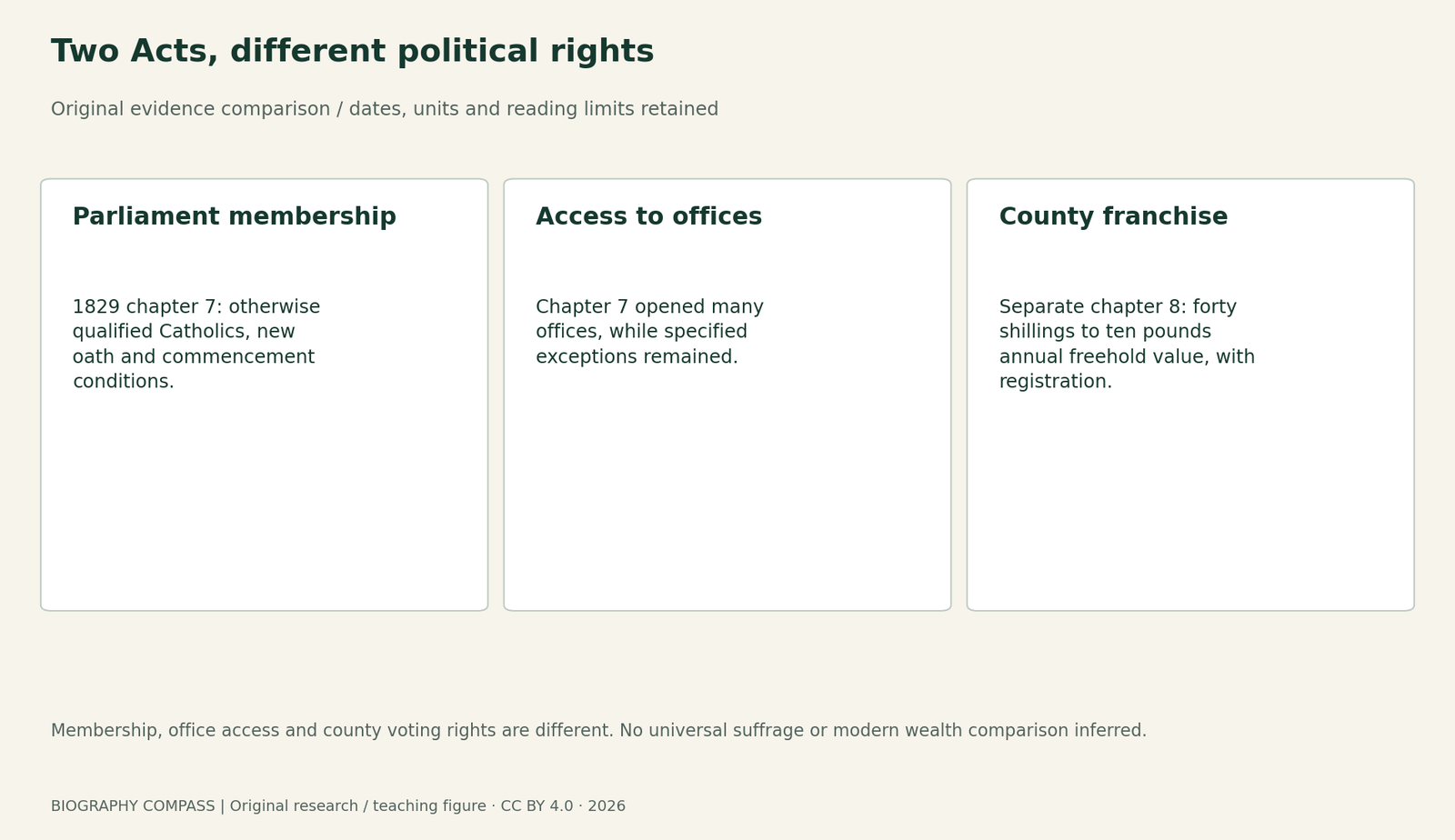
| Relief Act, section II | Otherwise qualified Catholics could sit after the new oath. | Not a universal electoral franchise. |
| Relief Act, sections X–XII | Many offices opened with explicit exceptions. | Not removal of every confessional restriction. |
| Election Act, sections I–III | County freehold threshold and registration changed. | Not a complete borough or turnout dataset. |
Chronology
A timeline of the turning points
Clare election
O’Connell won while the oath prevented admission.
Two separate Acts
Relief and county franchise rules changed different relationships.
Admission disputed
The Commons considered the Clare election case.
Seat taken
Admission followed another election.
Separate two Acts passed on the same day
The Roman Catholic Relief Act is chapter 7 of the tenth year of George IV; the Parliamentary Elections (Ireland) Act is chapter 8. Both bear 13 April 1829, but their purposes differ. One addresses religious disabilities affecting membership, offices and civil rights; the other changes Irish county electoral qualifications and registration. The common shorthand Catholic emancipation can conceal this distinction. Begin a research note with two document headings, recording chapter, date, affected population and mechanism before attempting an overall judgment about whether the settlement expanded political equality.
A new oath opened parliamentary membership
Section II of the Relief Act permits otherwise qualified Catholics returned after commencement to sit and vote after taking the substituted oath. Its wording makes clear that religious relief did not remove every other qualification. It changed a legal obstacle to membership, rather than creating an unrestricted entitlement for every person to become an MP. The oath itself retained allegiance and commitments concerning the Protestant succession and establishment. Reading the actual language gives a more precise account than describing the measure as the disappearance of all religious tests or as complete separation of church and state.
Sources for this section: [1]
Public office access retained exceptions
Section X extends access to civil and military offices under the stated oath arrangements, but section XII withholds specified offices, including the Lord Lieutenancy of Ireland and certain senior constitutional positions. Other sections address clergy and ecclesiastical matters. These exceptions are part of the achievement’s actual legal shape, not reasons to pretend no change occurred. The source supports substantial relief within a continuing confessional state. It does not support a modern claim that all offices were now open on identical terms to every religious group or that current eligibility can be read directly from the 1829 print.
Sources for this section: [1]
The county electorate faced a higher property test
The companion Act’s preamble recalls the forty-shilling freehold threshold. Section II requires a freehold of at least ten pounds clear annual value for the relevant Irish county vote, subject to the Act’s provisions. Section III also addresses registration for smaller freeholds within the stated range. Forty shillings equalled two pounds, so the threshold rose fivefold in nominal annual-value terms. This is a change in a property qualification, not evidence that the number of voters fell by precisely four-fifths. Electorate size requires registration or poll data, and borough qualifications cannot simply be inferred from county provisions.
Sources for this section: [2]
O’Connell’s case exposed a transition problem
Daniel O’Connell won Clare in 1828, before the Act whose parliamentary clause referred to members returned after commencement. The Commons debated his position on 18 May 1829. That record is valuable precisely because passing a general measure did not automatically settle his particular admission. After another election he took his seat on 4 February 1830. Keep the election, statute, dispute, re-election and admission distinct. They show how a legal reform could be associated with one leader’s success while still requiring procedural steps before he could use it.
Exercise: audit three eligibility notes
Assume the historical version and that all qualifications not mentioned are satisfied. Note A concerns a Catholic returned after commencement who takes the new oath. Note B concerns a county freeholder with forty shillings annual value and no alternative qualifying estate. Note C claims that a ten-pound freehold automatically proves a valid vote without checking registration. Identify which legal barrier A has passed, why B does not meet the new property threshold and why C needs another check. Then explain why none of these examples supplies the number of people who actually voted in Clare.
Reference answer: distinguish the subject of the right
A has passed the religious-oath barrier described by section II to sitting and voting as an MP; this is not the ordinary elector’s vote. B’s two-pound annual freehold is below the new ten-pound county threshold. C wrongly skips the relevant registration rules and evidence of compliance. A person’s entitlement, an electorate’s composition and a recorded turnout are separate research questions. The nominal fivefold threshold change does not answer the turnout question. The answer needs the right unit, office or election, as well as the correct statutory provision.
A reform can widen one door and narrow another
The two documents explain why it is possible to recognize emancipation as a major removal of religious disabilities while also examining the exclusion of poorer county freeholders. Neither effect cancels the other. O’Connell’s organization and victory help explain the political pressure, while the statutes establish the legal mechanisms. A fuller assessment would add registration evidence, accounts from affected voters and parliamentary debate on the franchise measure. This guide reads selected original clauses and the Clare admission debate; it does not claim a full reconstruction of every constituency or a current legal opinion.
Continue the chronology
Related history guides
Biography context
Explore Ireland through connected lives
Connected biographies
People connected with the questions
1775–1847
Daniel O’Connell
Barrister, nationalist leader and MPDaniel O’Connell combined legal advocacy, popular subscriptions and electoral pressure in the emancipation campaign. He later led an unsuccessful movement to restore an Irish parliament.Read biographyQuick answers
Common questions
- Were office access and the ordinary elector’s vote the same right?
- No. The Relief Act’s parliamentary and office provisions must be distinguished from the companion county voting qualification.
- Does a fivefold nominal threshold change prove a fivefold electorate change?
- No. The number of eligible or actual voters requires registration and election evidence.
Primary and institutional sources
How this history was checked
Compare the inspected primary records, retain their historical versions and distinguish a stated intention from a legal or practical outcome. This article was reviewed on 27 October 2026.
- UK Parliament / legislation.gov.ukRoman Catholic Relief Act 1829, 10 Geo.4 c.7, original print
- UK Parliament / legislation.gov.ukParliamentary Elections (Ireland) Act 1829, 10 Geo.4 c.8, original print
- UK Parliament, HansardMr O’Connell—Clare Election, 18 May 1829
- Dictionary of Irish Biography, Royal Irish AcademyGearóid Ó Tuathaigh, O’Connell, Daniel (1775–1847)
- UK ParliamentCatholic emancipation: election and parliamentary change