
The short answer
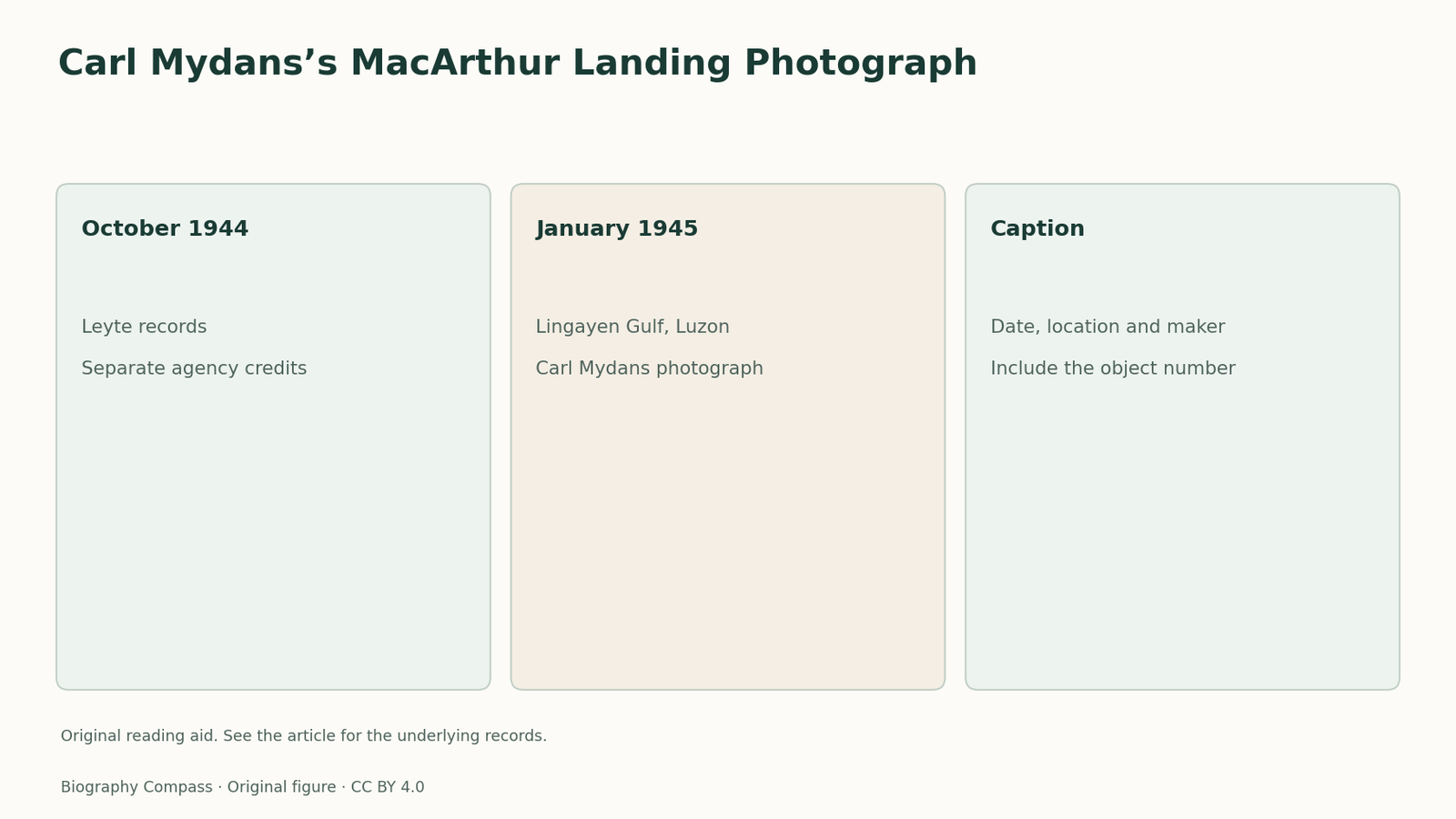
Carl Mydans’s photograph of MacArthur on Luzon has a distinct date and location. Comparing records prevents it from being confused with images of Leyte in October 1944.
Compare the evidence
Distinguish the events and pictures
The picture records use different locations and dates.
| Record or element | Date and place | Identifying record |
|---|---|---|
| Mydans landing photograph | 9 January 1945, Lingayen Gulf, Luzon | Smithsonian nmah_1303377 |
| Leyte beachhead inspection | 20 October 1944, Leyte | Naval History and Heritage Command SC 255863 |
| Separate Mydans portrait | 1945, related to the Luzon landing | Smithsonian nmah_1303384 |
Start with an exact object title
The Smithsonian’s Mydans record identifies the photograph as General Douglas MacArthur lands in the Philippines at Lingayen Gulf on Luzon, January 9, 1945. The title gives the person, location and date. A shortened description saying only that MacArthur goes ashore in the Philippines loses the fields that distinguish this picture from others. Keep the museum object number alongside the title when identifying the image. That helps a later reader locate the record even when the picture is reproduced at a different size or with an abbreviated caption. It also puts Mydans’s authorship on the same line as the scene.
Leyte has separate documentation
The Naval History and Heritage Command has records of MacArthur and others at Leyte on October 20, 1944. The record numbered SC 255863 names officers heading toward shore to inspect the beachhead. Another record identifies a Coast Guard photograph from that day. Those are evidence of a separate landing and have their own credits. The Smithsonian explains that Mydans missed the famous October return, even though he photographed some of the Leyte campaign. A person’s presence on an assignment in the area does not establish that they made a particular frame. Check the image credit and date together.
Compare appearance with catalog evidence
Two pictures of the same person walking through water may look related. The similarity is a reason to check the records, since the image alone cannot give the whole date or location. Start by describing what can be seen and write down any title that accompanied the copy. Then compare the possible museum or agency entries. A separate Mydans portrait of MacArthur associated with the Luzon landing is another useful check. It concerns the same person and event without being the photograph of the landing itself. The method distinguishes related pictures without relying on a familiar story to identify every frame.
What to include in a reliable caption
Write the photographer’s name, place, day and year for the Mydans picture. Then add the holding institution and its identifier. If making a comparison with Leyte, give the 1944 example its own full line. Keep a distinction between the name of the person in the image and the person or agency that made it. The resulting comparison has a practical use for a reader looking at online copies. It makes it possible to check both the historical event and the authorship of the photograph. If those records are missing on a repost, the museum entries are better starting points than the repost’s label. A place name such as Lingayen Gulf narrows the search more reliably than the general subject alone, especially when an archive contains several images of MacArthur.
Continue the chronology
Related history guides
Fort Peck on the First Issue of Life
Compare Margaret Bourke-White’s Fort Peck photograph with the first issue of Life and its inside story about a New Deal construction settlement.
Read the timeline1955–1957W. Eugene Smith’s Pittsburgh Project
Compare W. Eugene Smith’s 1955 commission for Stefan Lorant with the growing Pittsburgh archive and the later selection published in Dream Street.
Read the timelineBiography context
Explore Philippines through connected lives
Connected biographies
Photographers and related work
1907–2004
Carl Mydans
PhotojournalistCarl Mydans photographed work and everyday life for a federal unit and went on to cover international assignments for Life.Read biography1904–1971
Margaret Bourke-White
Industrial photographer and photojournalistMargaret Bourke-White photographed industry, war and public life and supplied the cover of the first issue of Henry Luce’s Life magazine.Read biography1903–1975
Walker Evans
Photographer, editor and teacherA photographer and editor who found lasting visual complexity in ordinary places, objects and public encounters.Read biographyQuick answers
Common questions
- Was the Mydans photograph taken at Leyte?
- The Smithsonian identifies this photograph as Luzon, on 9 January 1945.
- What is the best way to distinguish these photographs?
- Use the date, place, maker and individual object identifier together.
Primary and institutional sources
How this history was checked
Dates, legal milestones and historical claims are checked against the official and institutional records below. This article was reviewed on 13 November 2026.
- National Museum of American HistoryPhotographic History Collection: Carl Mydans
- Amon Carter Museum of American ArtCarl Mydans
- U.S. Department of State, Art in EmbassiesCarl Mydans
- Smithsonian InstitutionMacArthur lands at Lingayen Gulf, 1945
- Smithsonian InstitutionCarl Mydans: Photojournalist
- Naval History and Heritage CommandLeyte beachhead inspection, SC 255863
- Naval History and Heritage CommandInvasion of Leyte, 20 October 1944
- Smithsonian InstitutionGeneral Douglas MacArthur