
The short answer
Why did Bourassa make public consultation a separate issue in the naval debate?
Evidence comparison
Read the records together
The records were created for different purposes and support different kinds of claims.
| Record | What it establishes | Question to keep open |
|---|---|---|
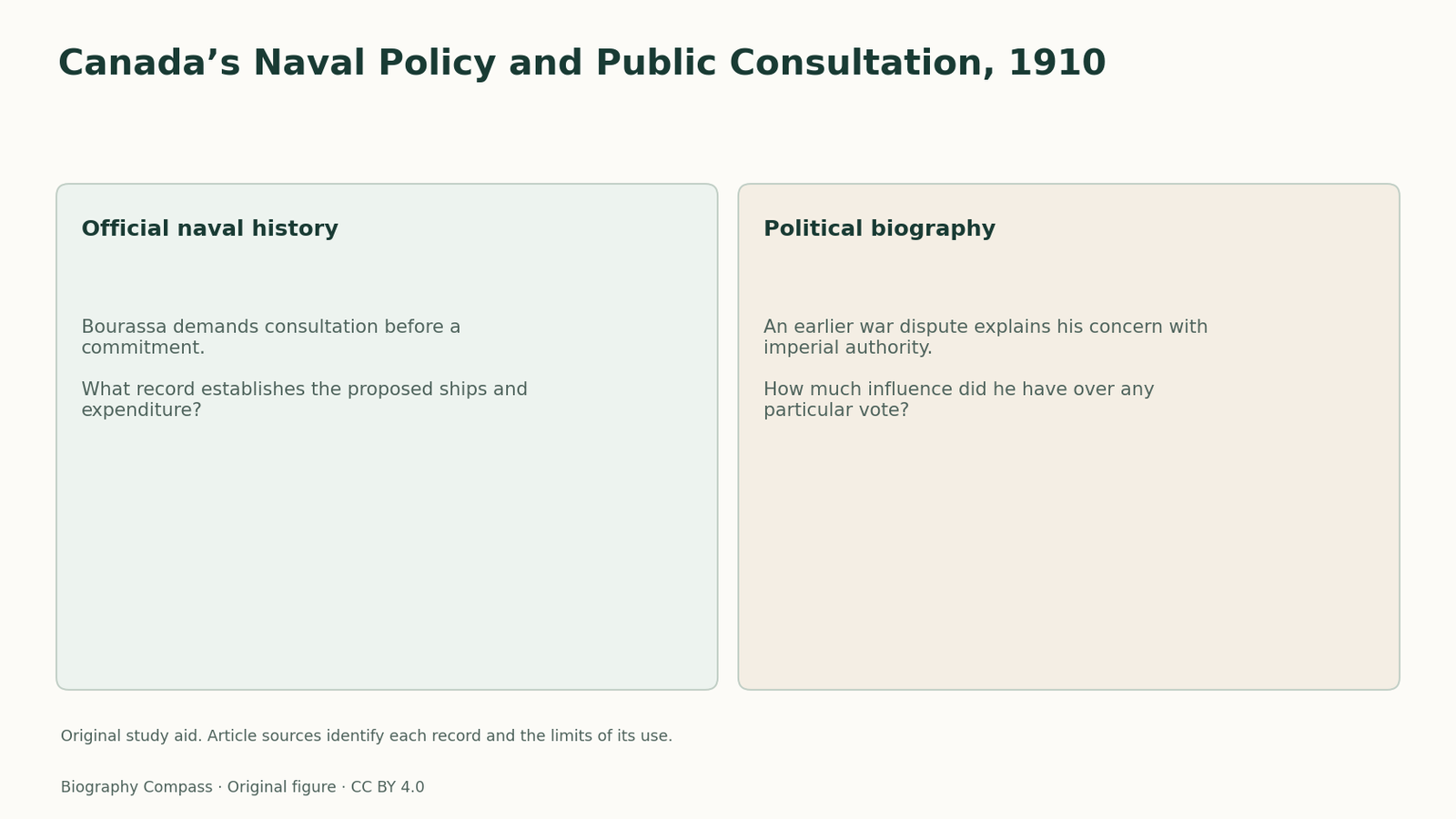
| Official naval history | Bourassa demands consultation before a commitment. | What record establishes the proposed ships and expenditure? |
| Political biography | An earlier war dispute explains his concern with imperial authority. | How much influence did he have over any particular vote? |
Chronology
A timeline of the turning points
Earlier dispute
Bourassa challenges participation in the South African War.
Naval controversy
Public consultation becomes an issue in the naval debate.
Identify the decision being disputed
The official naval history describes Bourassa’s insistence that Canadians be consulted before the government adopted a positive naval policy. That statement concerns the authority for a commitment. It does not provide a fleet specification, cost estimate or vote on a particular ship. A reader should first identify the kind of decision under discussion before treating every intervention in the naval controversy as an argument about the same technical question.
Sources for this section: [2]
Connect the earlier precedent
Bourassa’s opposition to participation in the South African War supplies a relevant earlier case. He challenged decisions that he believed changed Canada’s imperial relationship without sufficient public authorisation. The comparison shows continuity in his concern with consent, while leaving room for differences between sending troops and establishing a naval policy. It does not justify assuming that his objections, allies or proposed remedies remained identical in every later military debate.
Keep advocacy apart from an outcome
A political biography can explain how Bourassa campaigned, while an official service history explains how naval policy developed. Neither perspective should automatically absorb the other. A speaker may influence public opinion without determining every parliamentary vote. A government may establish a service without settling every dispute about the process. Claims about who defeated or secured a later bill need the relevant legislative sequence, rather than inference from a prominent campaigner’s reputation.
Construct a decision checklist
Create columns for strategic purpose, financial commitment and public authorisation. Place Bourassa’s consultation demand in the third column, then identify what additional record would fill each of the others. A useful answer asks for a proposal and parliamentary expenditure evidence instead of inventing them. The completed checklist demonstrates why a debate about consent remains intelligible even when the reader has not yet resolved every disagreement about the military merits of the proposed policy.
Continue the chronology
Related history guides
Biography context
Explore Canada through connected lives
Connected biographies
People behind the records
1868–1952
Henri Bourassa
Nationalist journalist and politicianBourassa used Parliament and Le Devoir to debate Canada’s imperial obligations, French-Canadian rights and the need for public consultation.Read biographyQuick answers
Common questions
- Was consultation the same question as the size of a fleet?
- No. It concerned authority for the commitment, which must be distinguished from its strategic and financial details.
Primary and institutional sources
How this history was checked
Sources support the chronology and the record comparison. The reading exercise is original. This article was reviewed on 7 November 2026.