
The short answer
How did a Canadian refugee campaign differ from the machinery negotiated at Evian, and what would demonstrate that either produced an actual admission?
Read the documents together
Different records, different conclusions
Keep the scope of each record visible when making a historical claim.
| Record | What it shows | Limit |
|---|---|---|
| October dispatch | A public appeal and intended national committee. | Not a visa or arrival register. |
| March invitation | Proposed cooperation within existing legislation. | Not a commitment to exceed legal admission limits. |
| July telegram | Reported agreement on continuing machinery. | Not a record of each country’s admissions. |
Chronology
A timeline of the turning points
Historical records
Read the dated documents before comparing their implications.
A Canadian appeal before Kristallnacht
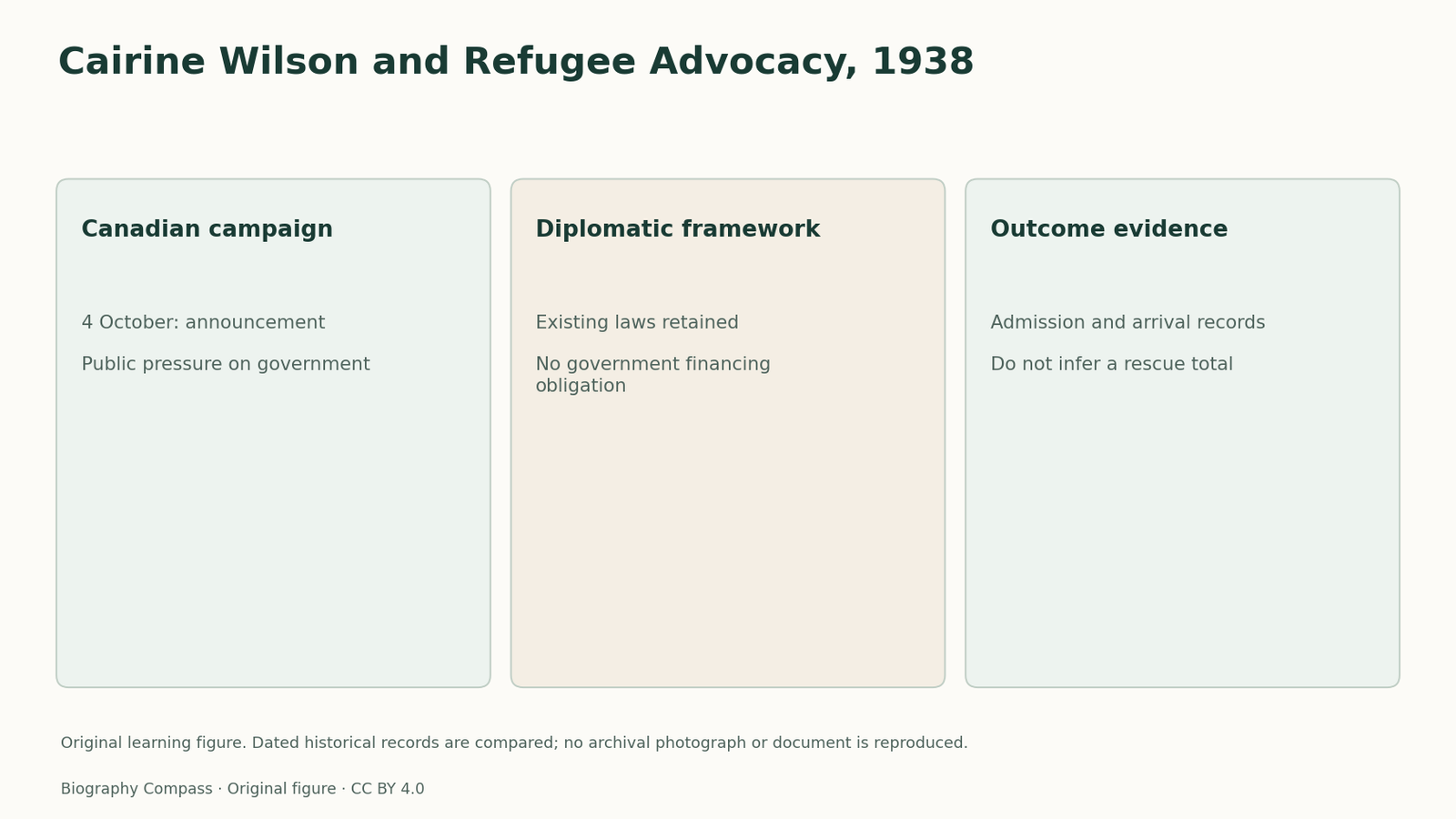
On 4 October 1938, Jewish Telegraphic Agency reported Wilson’s plan to involve Jewish and other Canadian leaders in a national refugee committee. Her stated strategy was to mobilise public opinion and ask government to act. The report predates the 9–10 November anti-Jewish pogrom known as Kristallnacht; the selected evidence therefore does not support describing all Canadian organising as beginning only after that event.
The announcement concerned a proposed campaigning body associated with the Canadian League of Nations Society. It is evidence of an appeal and intended organisation, rather than a register of people admitted to Canada. Later institutional accounts place Wilson’s refugee committee leadership across 1938–1948.
What the diplomatic proposal actually offered
The US invitation of 23 March, preserved as FRUS document 713, proposed a government-representative committee while assigning emergency-emigration financing to private organisations. It said countries would not be asked to receive more people than existing legislation permitted. The editorial note records a favourable Canadian reply.
Agreement to join discussions consequently did not itself change domestic admission law. This limitation was built into the invitation. It should be read before interpreting participation as a promise to admit a specified number of refugees.
Sources for this section: [3]
The July resolution and the financing gap
FRUS document 736 is Myron Taylor’s 14 July telegram reporting an agreed resolution text. Its provisions envisaged confidential information about what governments were prepared to receive, work within existing laws, a director to pursue orderly emigration and settlement opportunities, and a continuing committee in London. The text did not impose a government financing obligation for emigration.
Compare the two kinds of mobilisation. Wilson’s reported campaign sought pressure on Canadian decision makers; the diplomatic record created a framework for intergovernmental discussion and further work. Neither selected text is an individual visa decision. This comparison does not establish every delegation’s motives or reproduce the complete conference proceedings.
Reference exercise: three different achievements
Consider these statements: “a senator announced a campaign,” “governments agreed on committee machinery,” and “a refugee arrived safely in Canada.” Name the appropriate record for each. Explain why the first two are insufficient to establish the third, without dismissing the significance of organising or international negotiations.
Reference answer: the contemporary dispatch supports the announcement; the diplomatic telegram supports its reported negotiated text. An admission or arrival needs additional evidence such as an official decision, passenger record and corroborating personal documentation. Do not invent a success total by counting committee members or participating states.
Extension: write a two-column source note comparing the public audience of a news dispatch with the governmental audience of a diplomatic telegram. Explain how intended audience may affect emphasis. That is an interpretive question; it does not authorise altering either document’s stated conditions.
Continue the chronology
Related history guides
Biography context
Explore Canada through connected lives
Connected biographies
The career behind the documents
Quick answers
Common questions
- Does the October report place the campaign after Kristallnacht?
- No. Its date is earlier. The later escalation of campaigning should not erase the earlier announcement.
- Did the Evian invitation require countries to exceed their immigration laws?
- No. The invitation explicitly preserved that limit; participation did not itself prove a particular admission.
Primary and institutional sources
How this history was checked
The identified passages support the historical comparison. Exercises and reference answers are original learning material, not recovered individual files. Only the specified records or selected passages were read. This article was reviewed on 31 October 2026.
- Jewish Telegraphic AgencyCanadian League Body to Form Group to Aid Refugees, 4 October 1938
- Parks CanadaThe Honourable Cairine Reay Mackay Wilson, 1885–1962
- US Department of State, Office of the HistorianFRUS 1938, Volume I, document 713: Hull to Kennedy, 23 March
- US Department of State, Office of the HistorianFRUS 1938, Volume I, document 736: Taylor to Secretary of State, 14 July
- United States Holocaust Memorial MuseumKristallnacht: 9–10 November 1938