
The short answer
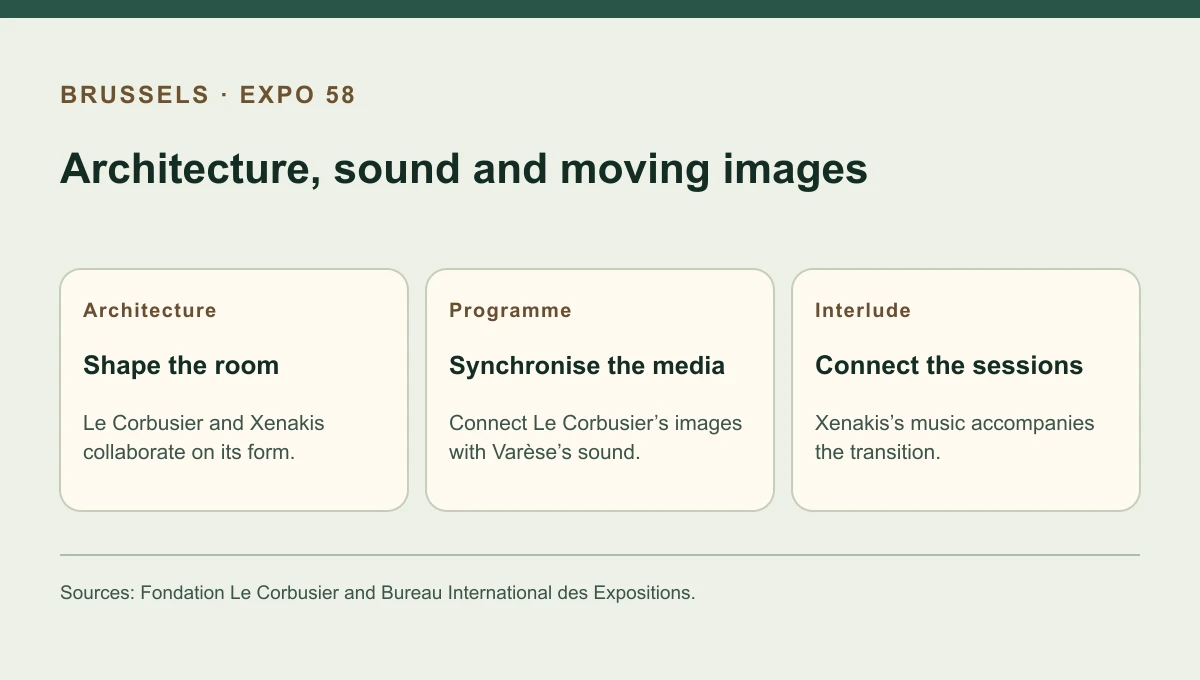
People entered the Philips Pavilion at Expo 58 to experience a sequence of projected images, light and electronic sound inside an unusual concrete shell. The event used several coordinated works. Le Corbusier and Iannis Xenakis collaborated on the architectural project, Edgard Varèse created the principal electronic soundtrack, and Xenakis also composed music heard between sessions.
Separate the credits
One audience experience, several authored works
The room, main programme and transition each involved their own decisions.
| Work | Recorded contribution | What it did for the visit |
|---|---|---|
| Architecture | Le Corbusier and Iannis Xenakis collaborate on the project | The enclosed form houses the visitors and media system. |
| Main programme | Le Corbusier arranges images and lights; Varèse makes the soundtrack | Pictures and sound combine over the course of a session. |
| Interlude | Xenakis composes Concret PH | A separate work accompanies the transition between sessions. |
Chronology
A timeline of the turning points
The architectural and media design develops
Philips commissions an exhibition environment and the collaborators build the programme.
Expo audiences enter the pavilion
The enclosed room presents a sequence of sound, light and images.
The interlude has its own music
Xenakis’s electronic composition accompanies the transition.
Why Philips commissioned an environment
An exhibition of electronic media could have been arranged as a display of equipment. The Philips Pavilion used the tools to organise a whole room and a timed encounter. The Fondation Le Corbusier describes the collaboration with Iannis Xenakis on a reinforced-concrete structure whose plan and curved forms give shape to the space. That construction is part of the evidence for how a group of visitors could enter and experience the programme together.
The soundtrack and the interlude
The foundation assigns the main soundtrack to Edgard Varèse and identifies Le Corbusier as responsible for the arrangement of images and lights. It separately records Xenakis’s Concret PH as an electronic composition between presentations of the main work. The distinction helps when looking for recordings. The transition music has its own title and author. The soundtrack belongs to the main programme, while the complete exhibition also involves the space, image sequence and the way people enter it.
The difference between a soundtrack and a visit
A recording can preserve sounds from an event without reconstructing the circumstances in which people heard them. The pavilion coupled listening with images, lighting and a room designed for the presentation. A visitor’s position and the order of the programme helped make these elements a whole. Compare architectural drawings, programme records and recordings when studying it. Each documents a different part of the original encounter.
Continue the chronology
Related history guides
Connected biographies
People connected to this history
Quick answers
Common questions
- Who composed the main electronic soundtrack for the Philips Pavilion?
- Edgard Varèse composed the main soundtrack for Poème électronique.
- What did Iannis Xenakis contribute?
- He worked on the architecture with Le Corbusier and composed Concret PH for the transition between sessions.
Primary and institutional sources
How this history was checked
Dates, legal milestones and historical claims are checked against the official and institutional records below. This article was reviewed on 19 November 2026.