
The short answer
An object can stop being exposed while its measured activity continues to rise. The key question is whether the model includes every process capable of producing the measured signal.
Evidence and original analysis
What each statement establishes
Historical observation and invented model rejection answer different questions.
| Record or assumption | Supported inference | Not established |
|---|---|---|
| Recipient initially grows | An isolated loss-only account is insufficient. | A unique modern identity. |
| A: 9→6 | q=2/3 fits the toy decay family. | A physical half-life. |
| B: 3→9; q=1/2 | u=7.5 is required by the expanded toy rule. | Whether u is external transfer or internal production. |
Chronology
A timeline of the turning points
Letter signed
McGill, Montreal.
Publication
Nature letter appeared.
Production matters as well as disappearance
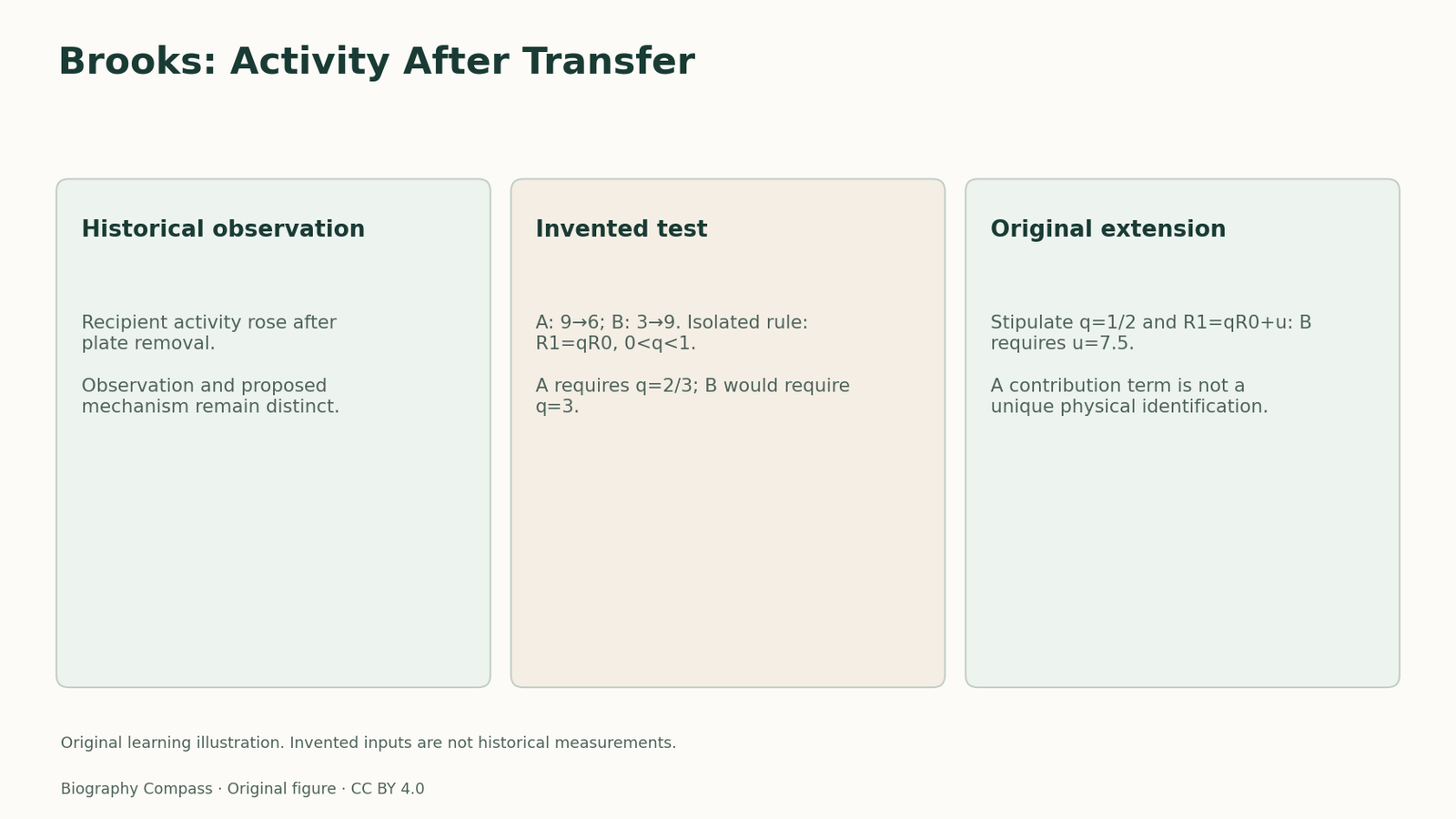
Brooks found temporary activity on a testing vessel’s wall after removing an active plate. It initially increased before falling. Her letter considered a volatile product and successive changes, comparing the growth with Rutherford’s prediction.
The recipient was not simply a smaller copy of the source. This makes the question different from calculating how much of one isolated decaying stock remains. The selected letter does not by itself prove a modern isotope identity or a later recoil interpretation.
Sources for this section: [1]
An original one-step test
Use arbitrary signal units and a single time step. Record A falls from 9 to 6; record B rises from 3 to 9. First test the stipulated isolated-decay rule R1=qR0 with 0<q<1. Determine the q required by each record.
Next enlarge the model to R1=qR0+u, stipulating q=1/2. Calculate u for B. Here u is any net contribution not represented by survival of the initially measured signal. It is not automatically continued transfer from outside.
Sources for this section: [1]
Reference answer
A requires q=6/9=2/3 and fits the stipulated isolated-decay family. B requires q=9/3=3, outside 0<q<1. Thus B contradicts that narrow family; it does not contradict every possible decay-chain model.
With q=1/2, B requires u=9−(1/2×3)=7.5 signal units. A production term can represent a missing process. It cannot, from these two observations alone, identify the physical carrier, establish a half-life or distinguish all possible mechanisms.
Sources for this section: [1]
The historical inference is narrower than the model’s rejection
A failed simple model tells us what needs explanation; it does not uniquely supply the explanation. Brooks’s observed pattern and her proposed successive changes belong in separate columns of a reading notebook. The invented calculation makes this logic explicit without fitting her table or reconstructing radioactive material handling.
Sources for this section: [1]
Continue the chronology
Related history guides
Biography context
Explore Canada through connected lives
Connected biographies
Researcher and context
Quick answers
Common questions
- Does rising activity mean decay has stopped?
- No. Production and disappearance can coexist; the net measured signal may rise.
- Are the invented values Brooks’s data?
- No. They are an original model test, with no historical table reproduced.
Primary and institutional sources
How this history was checked
Selected records support the historical explanation. Invented inputs and original calculations are labelled separately. This article was reviewed on 31 October 2026.