
The short answer
An annual report can count shares, registered holders and directors without counting the same thing three times. Use Britam’s year-end tables to practise keeping the entity, denominator and date aligned.
Original source-reading framework
Three counts, three questions
Align the numerator and denominator before calculating.
| Country | What it establishes | What still needs evidence |
|---|---|---|
| Share count | How many issued shares a named entry holds. | Any changes after the snapshot date. |
| Registered-holder count | How many entries are in the register. | Number and identity of underlying beneficial investors. |
| Director list | Who serves on the board and how interests are disclosed. | Personal holdings must not absorb a represented institution’s shares. |
| Investor categories | A stated classification of the same register. | Do not add category totals to the register again. |
Chronology
A timeline of the turning points
Snapshot date
The report’s director and shareholder tables refer to this date.
Governance report signature
The chairman signed the governance report after the year end.
Historical reading
This guide analyses the 2024 snapshot and does not claim holdings remain unchanged.
Locate the entity and the snapshot date
Britam Holdings Plc’s 2024 report has separate director-shareholding and shareholder-information tables on pages 68–69. At 31 December 2024, the issued total was 2,523,486,816 ordinary shares. The register contained 23,458 shareholder records. Peter Kahara Munga’s entry was 75 million shares, shown as 2.97 percent. These are historical statements about one listed holding company. They are not balances of every subsidiary or a current estimate of a director’s fortune. Before interpreting a table, write down its entity, unit and date. Without those three items, even correct arithmetic can answer the wrong question.
Sources for this section: [1]
Distinguish a registered name from a final beneficial owner
The major-shareholder list includes nominee accounts. A nominee entry names the registered holder or account in that register; it does not necessarily identify every underlying beneficial investor. The table alone cannot establish that all accounts with the same banking name belong to one economic owner. Nor does it prove that one account represents only one person. Additional ownership disclosures would be needed to trace underlying interests. This is a question of what a document reveals, not a guess about who a particular nominee represents. Leave an unestablished link blank rather than completing an attractive ownership diagram with speculation.
Sources for this section: [1]
Compare counts only after identifying their unit
The report groups holdings by share-volume bands and by investor category. These are two classifications of the same share register, not separate pools to add together. A band containing a small number of large accounts can hold most shares while representing few records. A category percentage based on shares can therefore look very different from its share of the holder count. This is a general denominator problem: a chart of people answers a different question from a chart of voting shares. Whenever a presentation says “most investors,” ask whether it means most registered records or most of the issued shares.
Sources for this section: [1]
Fictional exercise: reconcile a small register
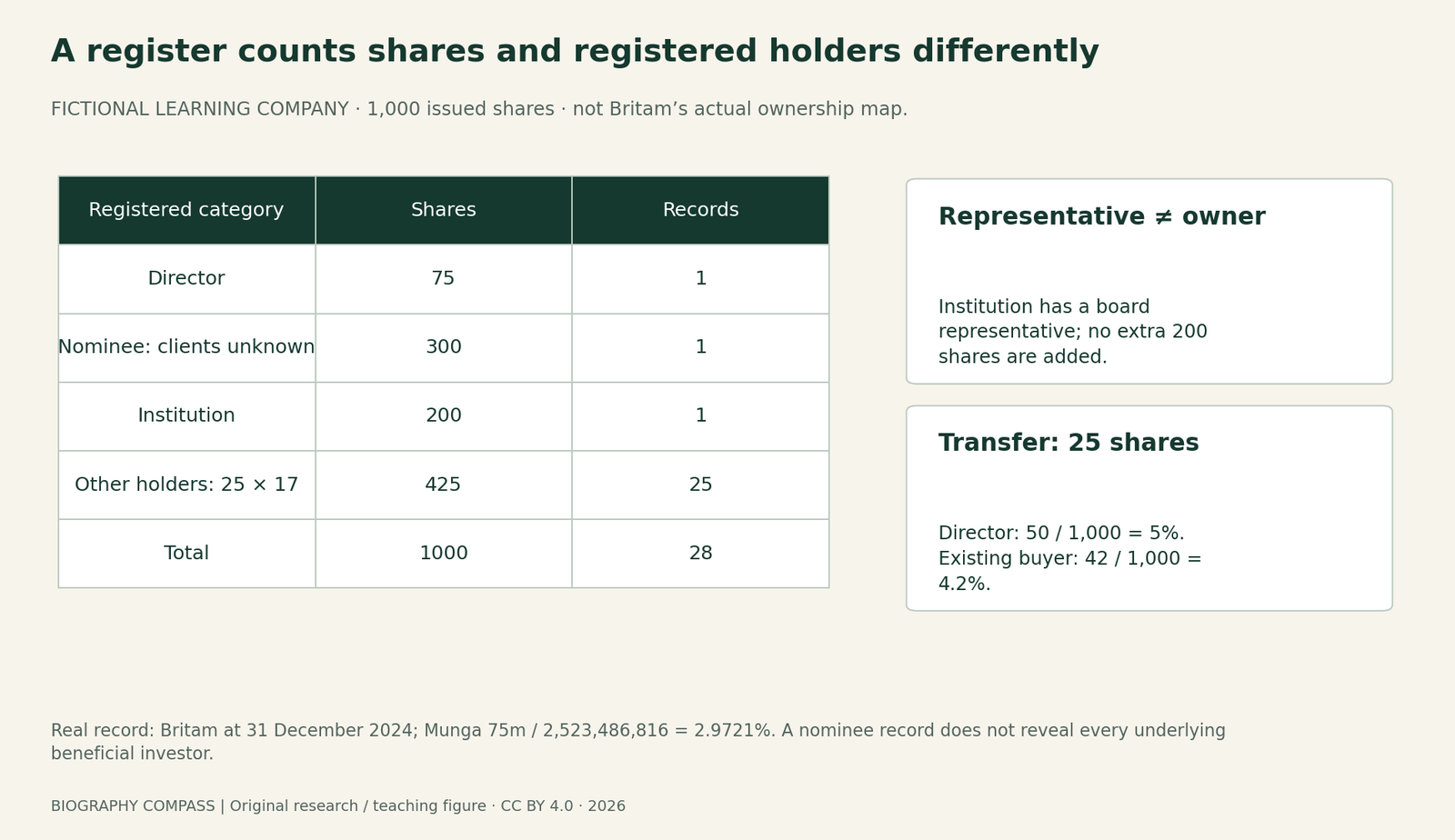
The following company is invented and has no connection with Britam’s actual register. It has 1,000 issued ordinary shares. A director holds 75 personally, a nominee account holds 300 for undisclosed clients, an institution holds 200 and 25 other registered holders each hold 17. The institution has a board representative who holds no personal shares. First check that the register totals 1,000. Then calculate the director’s stake, the institution’s stake and the combined shares of the 25 other holders. Count registered holders, and explain why you cannot calculate the exact number of beneficial owners from these data. The nominee is one record, not necessarily one investor.
Sources for this section: [1]
Worked answer: do not count a representative twice
The total is 75 + 300 + 200 + 25 × 17 = 1,000. The director holds 7.5 percent, the institution 20 percent and the 25 other holders together 42.5 percent. The register has 28 records: the director, nominee, institution and 25 others. The institution’s representative does not add another 200 shares merely by appearing in a director table. The underlying clients of the 300-share nominee are not specified, so neither their number nor their individual interests can be calculated. A correct ownership picture can therefore have a complete registered-share total while leaving beneficial ownership partly unresolved.
Sources for this section: [1]
Add a transfer without inventing a company transaction
Continue the fictional exercise. The director sells 25 shares to one existing small holder, with no new shares issued and no cancellation. The director now has 50 shares, or 5 percent; the recipient has 42 shares, or 4.2 percent. Issued shares remain 1,000 and registered-holder count remains 28. The buyer pays the seller under this assumption. That is different from a new issue, where the company issues additional shares and the denominator changes. This example explains why a fall in a person’s percentage cannot be interpreted without knowing whether a transfer, new issue, cancellation or some combination occurred.
Sources for this section: [1]
Write a conclusion that the table can carry
For the historical record, a defensible sentence names Britam Holdings, Munga’s disclosed shares, the year-end date and the reported percentage. It does not say that board membership alone proves control or that the register measures his net wealth. For an original chart, give the unit in the title and keep nominee labels intact. If comparing years, use the issued total and ownership definitions applicable to each year. The purpose is document literacy: understanding what a public table establishes, the arithmetic that follows from it and the questions left open by its scope. It provides no assessment of whether anyone should buy or sell shares.
Sources for this section: [1]
Continue the chronology
Related history guides
Bidco’s Loan: Proposal to Disbursement
Follow Bidco’s 2014 IFC loan proposal through approval, signature and 2016 disbursement, separating funding ceilings, company ownership and outcomes.
Read the timeline2011–2012Chandaria’s Incubator: Inputs and Results
Use Kenyatta University’s 2011–2012 incubation records to separate donations, applications, admissions and outcomes, with rates and a fictional follow-up exercise.
Read the timelineConnected biographies
People and institutions
1943–
Peter Munga
Founder chairman of Equity and diversified business investorPeter Kahara Munga combined public administration with enterprise, founding Equity Building Society and later serving on business boards while supporting agricultural and educational institutions.Read biographyQuick answers
Common questions
- Do the director and shareholder tables contain different shares?
- They can report the same holding for different purposes. Matching entries should be reconciled, not added.
- Does a nominee account reveal its final owners?
- The registered account name alone does not reveal every underlying beneficial owner; further disclosure is needed.
Primary and institutional sources
How this history was checked
Original institutional records establish the dated facts below. Worked examples and questions are original teaching material; fictional data are explicitly labelled. This article was reviewed on 27 October 2026.