
The short answer
How can several true beginning dates describe different stages rather than competing claims to one moment?
Evidence and interpretation
Keep the claim attached to the record
Each row answers a different part of the question.
| Record | Supported reading | Limit |
|---|---|---|
| Resources | Accumulated footwear capital. | Not a complete capability inventory. |
| Output / entity | Different dated events. | Not interchangeable milestones. |
| Facility | A completed plant. | Not an annual output figure. |
Chronology
A timeline of the turning points
Output
First tyre recorded.
Entity
Independent company established.
Facility
Kurume plant completed.
Follow the resource before the new product
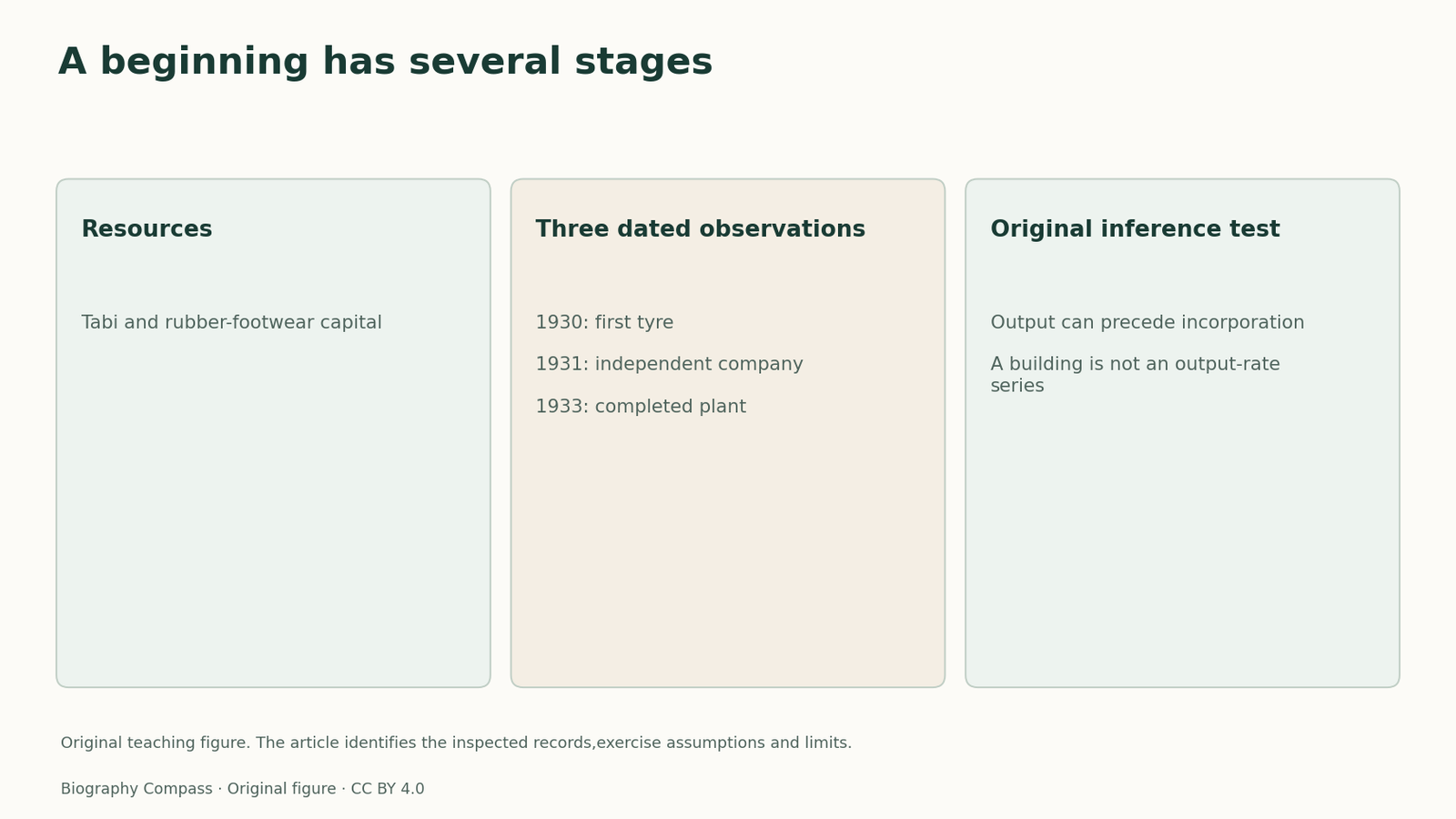
Bridgestone’s account connects tyre entry to capital accumulated from tabi and rubber footwear.
That is a resource claim. It does not establish that every worker, machine or process transferred unchanged. Money available for a venture and the capabilities needed to run it are related questions, but they require different evidence.
Sources for this section: [1]
Attach each date to its stage
The record places the first tyre in 1930, independence in 1931 and the completed Kurume plant in 1933.
The first item is output; the second concerns organisation; the third concerns a facility. Calling all three “the start” loses the useful information in the sequence. A facility’s completion also does not, by itself, state how much saleable output it could sustain.
Sources for this section: [2]
Original task: test a startup caption
Use four columns: resources, output, entity and facility. Place the four observations above in the appropriate columns. Then examine the claims “there was no product before incorporation” and “a completed plant proves a particular annual capacity”. Which observation contradicts the first? What additional record would be needed for the second?
Write a two-sentence replacement for a caption that merges all four stages. Keep the sequence, but add no output rate, profit estimate or assumption about which workers moved between activities.
Reference answer: sequence is not capacity
The mapping is resources → output → entity → facility, in the order of the four observations. The earlier output contradicts the claim that incorporation had to precede every product. A production-rate claim would need evidence such as dated output and working-time records, not merely the existence of a building.
A defensible replacement describes preparation, first output, independent organisation and the later facility in order. It leaves capacity unquantified. This is more informative than selecting one date and declaring the others wrong, because it preserves the different operational questions the records can answer.
Sources for this section: [2]
Continue the chronology
Related history guides
Biography context
Explore Japan through connected lives
Connected biographies
The working life
Quick answers
Common questions
- Can a first product date establish sustained capacity?
- No. An event and a rate need different evidence.
Primary and institutional sources
How this history was checked
Compare the selected accounts and objects below; each has a stated date and scope, and the learning task supplies its own instructions. This article was reviewed on 31 October 2026.