
The short answer
How does Maman connect an enormous spider to memories of textile work?
Compare the records
What the sources allow us to say
Read the object record alongside the contextual account.
| Record | Evidence | Reading limit |
|---|---|---|
| Guggenheim object record | 1999 work/2001 cast,materials and maternal association. | A cast date does not replace the work’s originating date. |
| MoMA chronology | Childhood tapestry work and later artistic education. | A life event does not explain every formal decision. |
A work date and a cast date answer different questions
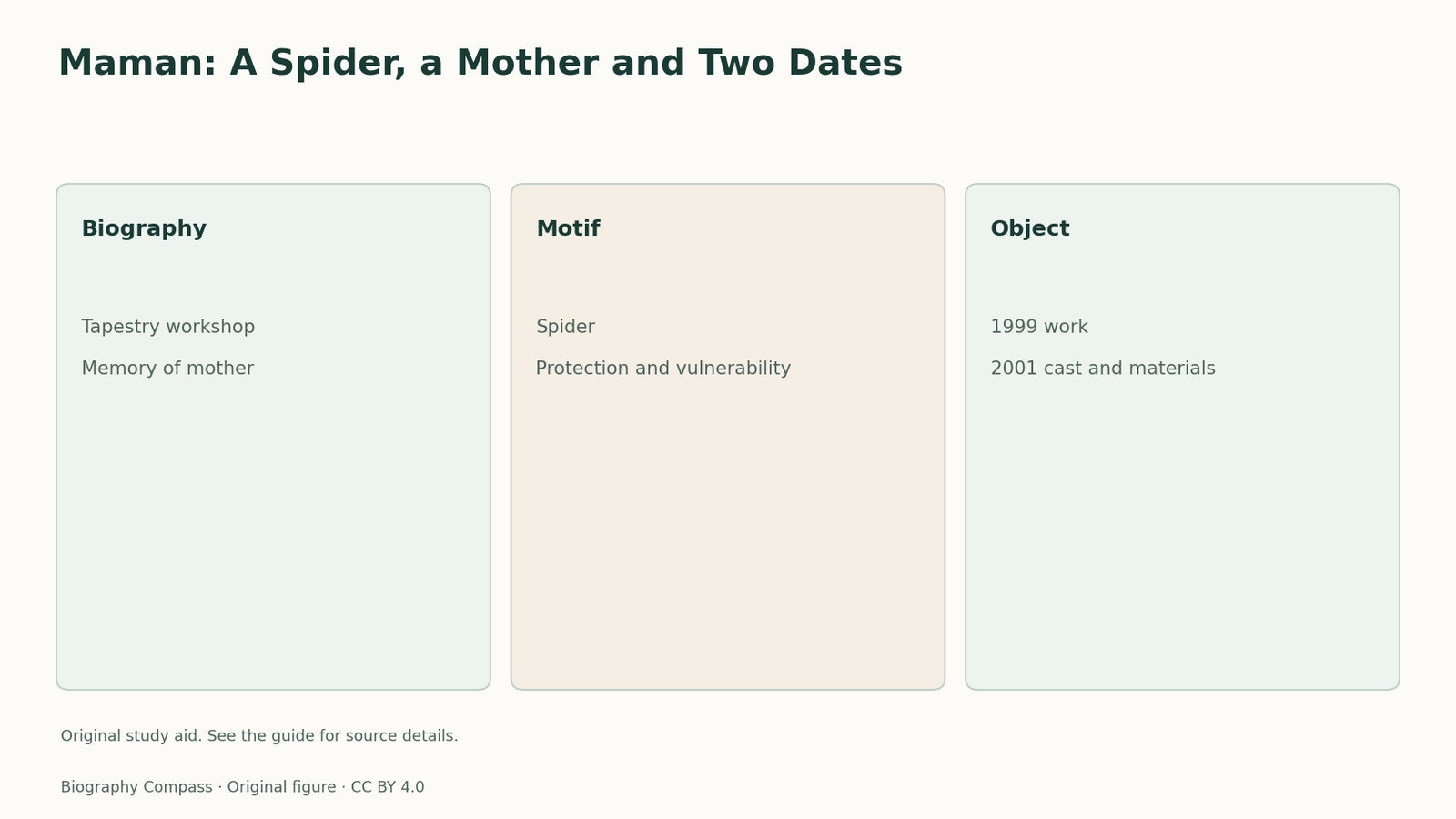
The Guggenheim identifies Maman as 1999,cast 2001. Those dates need not conflict. One identifies the work’s originating date; the other identifies the production of the particular cast in that collection. The record also specifies bronze, marble and stainless steel. Begin an object card with these fields kept separate. That prevents a later photograph, cast or installation from silently replacing the original work’s chronology, and allows another version to be compared without assuming that all versions were fabricated together.
Sources for this section: [2]
Scale complicates the protective association
The museum relates the spider to Bourgeois’s mother. It also describes eggs protected within the body and the extraordinary scale supported on long legs. These features give protection a physically complex expression. A viewer can feel small beneath a form that is both sheltering and potentially threatening. That is an interpretive response to scale and arrangement, rather than proof that the artist intended one fixed emotional reaction. The maternal association supplies context, but it does not eliminate the material encounter.
Sources for this section: [2]
Place memory beside working history
MoMA records Bourgeois helping in the family tapestry workshop before her later move into art. Compare that practical history with the museum’s maternal reading of the spider. A supported answer recognises a relationship without treating biography as a code that automatically solves every sculptural detail. Diagram three layers: a documented life event, an artist-associated motif and a particular cast’s material form. The separation makes interpretation more precise. Personal memory helps explain why a motif mattered, while the specific object still requires attention to its own scale, materials and production history.
Continue the chronology
Related history guides
Biography context
Explore United States through connected lives
Connected biographies
Read the artist’s biography

1911–2010
Louise Bourgeois
Sculptor and printmakerA French-born American artist who transformed personal memory into sculpture, prints and constructed environments.Read biographyQuick answers
Common questions
- Why does Maman have two dates?
- The Guggenheim distinguishes the work’s 1999 date from the 2001 production of the cast in its collection.
Primary and institutional sources
How this history was checked
The listed records support the facts. Observation exercises and arguments are Biography Compass editorial interpretations. This article was reviewed on 7 November 2026.