
The short answer
How do discarded bomb casings change when used as planters?
Compare the records
What the sources allow us to say
Read the object record alongside the contextual account.
| Record | Evidence | Reading limit |
|---|---|---|
| Singapore Biennale record | Bomb casings become planters in Lie of the Land. | Their new use does not erase their earlier history. |
| Artist contextual account | Connects material reuse with Laos’s war legacy. | An artwork is not a measure of all unexploded ordnance. |
The new function does not erase the shape
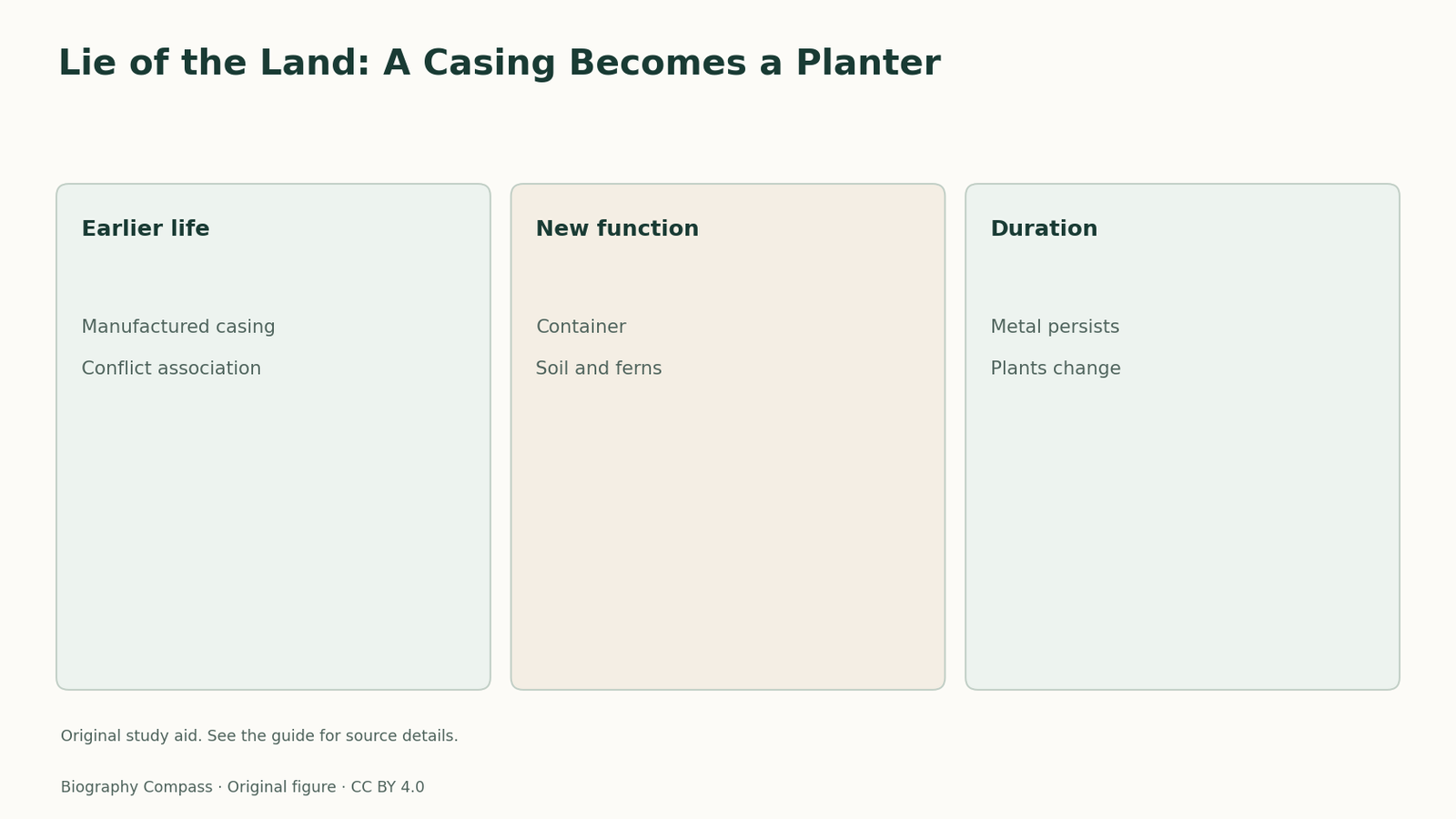
Lie of the Land uses bomb casings as containers for ferns. The Singapore Art Museum identifies aluminium, soil and seeds among its materials and records the work as a 2017 commission. The plants give the containers a new role, but the metal remains recognisable as an earlier manufactured form. That coexistence supports the work’s tension. The viewer encounters growth within an object associated with destruction, rather than a neutral flowerpot whose previous history has disappeared from view.
Sources for this section: [2]
Read the local context with care
QAGOMA connects Phothyzan’s practice with the reuse of war materials in Lao communities and with environmental concerns. This context gives the planter more than a general metaphorical meaning. It relates the installation to ways people adapt available objects within daily life. The artistic act selects and presents that adaptation for another audience. The record concerns reused casings in an artwork. It does not establish a practical procedure for handling unexploded ordnance or provide evidence that the wider legacy of bombing has been resolved.
Compare the timescales in the work
Make a three-stage diagram showing prior manufacture, reuse as a container and the growth of plants. Then explain which stages remain perceptible together. A strong answer would identify the casing’s retained shape and the living material’s continuing change. It would also note that a photograph records the installation at one moment, whereas growth proceeds over time. This distinction helps explain why the material list includes more than metal. Soil and seeds participate in the work’s duration and in its account of how a landscape can carry several histories at once.
Continue the chronology
Related history guides
Biography context
Explore Laos through connected lives
Connected biographies
Read the artist’s biography
b. 1979
Bounpaul Phothyzan
Installation and land artistA Lao artist who works with land, discarded materials and the environmental legacies of war.Read biographyQuick answers
Common questions
- What grows in the reused casings?
- The Singapore Art Museum describes ferns growing in the repurposed metal containers.
Primary and institutional sources
How this history was checked
The listed records support the facts. Observation exercises and arguments are Biography Compass editorial interpretations. This article was reviewed on 7 November 2026.